


JEE Advanced · Chemistry · 18. Chemical Kinetics
Consider a reaction \(A+R \rightarrow\) Product. The rate of this reaction is measured to be \(k[A][R]\). At the start of the reaction, the concentration of \(R,[R]_0\), is 10 -times the concentration of \(A,[A]_0\). The reaction can be considered to be a pseudo first order reaction with assumption that \(k[R]=k^{\prime}\) is constant. Due to this assumption, the relative error (in \%) in the rate when this reaction is \(40 \%\) complete, is _______
[ \(k\) and \(k^{\prime}\) represent corresponding rate constants]
- A 4.47
- B 4.17
- C 25.4
- D 20.5
Answer & Solution
Correct Answer
(B) 4.17
Step-by-step Solution
Detailed explanation
\( \mathrm{A}+\mathrm{R} \rightarrow \text { Product } \)
\( \mathrm{t}=0 \mathrm{~A}_0 10 \mathrm{~A}_0 \)
\( \mathrm{t}=\mathrm{t} 0.6 \mathrm{~A}_0 9.6 \mathrm{~A}_0 \)
\( \text {Rate }=\mathrm{k}[\mathrm{A}][\mathrm{R}] \)
\( \text {Rate }_1=\mathrm{k}\left(0.6 \mathrm{~A}_0\right) \times 9.6 \mathrm{~A}_0 \)
\( \mathrm{~A} \quad+\mathrm{R} \rightarrow \text { Product } \)
\( \mathrm{t}=0 \mathrm{~A}_0 10 \mathrm{~A}_0(\text { excess }) \)
\( \mathrm{t}=\mathrm{t} 0.6 \mathrm{~A}_0 10 \mathrm{~A}_0 \)
\( \text {Rate }=\mathrm{k}^{\prime}[\mathrm{A}], \mathrm{k}^{\prime}=\mathrm{k}[\mathrm{R}] \)
\( \text {Rate }_2=\left(\mathrm{k} \times 10 \mathrm{~A}_0\right) \times\left(0.6 \mathrm{~A}_0\right) \)
\( 100 \times \frac{\Delta \text { Rate }}{\text { Rate }_1}=\frac{(0.6 \times 10-0.6 \times 9.6}{0.6 \times 9.6} \times 100\) \(=4.1666\)
\( \mathrm{t}=0 \mathrm{~A}_0 10 \mathrm{~A}_0 \)
\( \mathrm{t}=\mathrm{t} 0.6 \mathrm{~A}_0 9.6 \mathrm{~A}_0 \)
\( \text {Rate }=\mathrm{k}[\mathrm{A}][\mathrm{R}] \)
\( \text {Rate }_1=\mathrm{k}\left(0.6 \mathrm{~A}_0\right) \times 9.6 \mathrm{~A}_0 \)
\( \mathrm{~A} \quad+\mathrm{R} \rightarrow \text { Product } \)
\( \mathrm{t}=0 \mathrm{~A}_0 10 \mathrm{~A}_0(\text { excess }) \)
\( \mathrm{t}=\mathrm{t} 0.6 \mathrm{~A}_0 10 \mathrm{~A}_0 \)
\( \text {Rate }=\mathrm{k}^{\prime}[\mathrm{A}], \mathrm{k}^{\prime}=\mathrm{k}[\mathrm{R}] \)
\( \text {Rate }_2=\left(\mathrm{k} \times 10 \mathrm{~A}_0\right) \times\left(0.6 \mathrm{~A}_0\right) \)
\( 100 \times \frac{\Delta \text { Rate }}{\text { Rate }_1}=\frac{(0.6 \times 10-0.6 \times 9.6}{0.6 \times 9.6} \times 100\) \(=4.1666\)
See the Complete Solution
Get step-by-step explanations for this and 2.5 Lakh+ more JEE, NEET & CET questions.
- Unlock all solutions
- Practice the full chapter
- Track accuracy across PYQs
4.8 rated on Google Play · 14,000+ reviews
More questions from Chemistry
- An ideal gas in a thermally insulated vessel at internal pressure = , volume = and absolute temperature = expands irreversibly against zero external pressure, as shown in the diagram. The final internal pressure, volume and absolute temperature of the gas are , and , respectively. For this expansion,
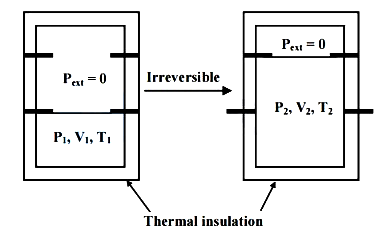 JEE Advanced 2014 Hard
 - The correct option(s) to distinguish nitrate salts of taken separately is(are)JEE Advanced 2018 Easy
- A tetrapeptide has -COOH group on alanine. This produces glycine (Gly), Valine (Val), Phenyl alanine (Phe) and Alanine (Ala) on complete hydrolysis. For this tetrapeptide, the number of possible sequences (primary structures) with -NH2 group attached to a chiral center isJEE Advanced 2013 Hard
- Paragraph:
Chemical reactions involve interaction of atoms and molecules. A large number of atoms/molecules (approximately \(6.023 \times 10^{23}\) ) are present in a few grams of any chemical compound varying with their atomic/molecular masses. To handle such large numbers conveniently, the mole concept was introduced. This concept has implications in diverse areas such as analytical chemistry, biochemistry, electrochemistry and radiochemistry. The following example illustrates a typical case, involving chemical/electrochemical reaction, which requires a clear understanding of the mole concept.
A \(4.0\) molar aqueous solution of \(\mathrm{NaCl}\) is prepared and \(500 \mathrm{~mL}\) of this solution is electrolysed. This leads to the evolution of chlorine gas at one of electrodes (atomic mass: \(\mathrm{Na}=23, \mathrm{Hg}=200 ; 1\) faraday \(=96500\) coulombs).
Question:
The total number of moles of chlorine gas evolved isJEE Advanced 2007 Medium - Match the reactions (in the given stoichiometry of the reactants) in List-I with one of their products given in List-II and choose the correct option.
List - I List - II (P) \(P _2 O _3\) \(+~3 H _2 O \rightarrow\) (1) \(P ( O )\left( OCH _3\right)\) \(Cl _2\) (Q) \(P _4+3 NaOH\) \(+~3 H _2 O \rightarrow\) (2) \(H _3 PO _3\) (R) \(PCl _5+ CH _3\) \(COOH \rightarrow\) (3) \(PH _3\) (S) \(H _3 PO _2\) \(+~2 H _2 O ~+\) \(4 AgNO _3 \rightarrow\) (4) \(POCL _3\) (5) \(H _3 PO _4\) JEE Advanced 2023 Medium - The mole fraction of a solute in a solution is . At , the molarity of this solution is the same as its molality. The density of this solution at is . The ratio of the molecular weights of the solute and solvent, , is:JEE Advanced 2016 Medium
More PYQs from JEE Advanced
- Paragraph:
Let \(p\) be an odd prime number and \(T_p\) be the following set of \(2 \times 2\) matrices
\[
T_p=\left\{A=\left[\begin{array}{ll}
a & b \\
c & a
\end{array}\right] ; a, b, c \in\{0,1,2, \ldots, p-1\}\right\}
\]Question:
The number of \(A\) in \(T_p\) such that \(A\) is either symmetric or skew-symmetric or both, and det \((A)\) is divisible by \(p\) isJEE Advanced 2010 Hard - Paragraph:
The figure shows a surface \(X Y\) separating two transparent media, medium-1 and medium-2. The lines \(a b\) and \(c d\) represent wavefronts of a light wave travelling in medium-1 and incident on \(X Y\). The lines ef and \(g h\) represent wavefronts of the light wave in medium-2 after refraction.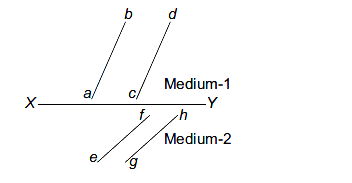
Question:
Light travels as aJEE Advanced 2007 Easy - The option(s) with the value of and that satisfy the following equation is(are)JEE Advanced 2015 Hard
- Paragraph:
A fair die is tossed repeatedly until a six is obtained. Let \(X\) denotes the number of tosses required.Question:
The probability that \(X=3\) equalsJEE Advanced 2009 Easy - In a photoemission experiment, the maximum kinetic energies of photoelectrons from metals and are and , respectively, and they are related by . In this experiment, the same source of monochromatic light is used for metals and while a different source of monochromatic light is used for the metal . The work functions for metals and are and , respectively. The energy of the incident photon used for metal , in is ___.JEE Advanced 2021 Medium
- Consider a helium atom that absorbs a photon of wavelength . The change in the velocity (in ) of atom after the photon absorption is ______ .
(Assume: Momentum is conserved when photon is absorbed.
Use: Planck constant , Avocados number , Molar mass of )JEE Advanced 2021 Medium