


CUET · MATHS · PYQ PAPER 2023
The general solution of the differential equation \(ydx + xdy = 0\) is:
- A \(xy = C\), where C is a constant.
- B \(\frac{1}{x} + \frac{1}{y} = C\), where C is a constant.
- C \(\log x \cdot \log y = C\), where C is a constant.
- D \(x + y = C\), where C is a constant.
Answer & Solution
Correct Answer
(A) \(xy = C\), where C is a constant.
Step-by-step Solution
Detailed explanation
\(d(xy) = 0\) \(xy = C\)
See the Complete Solution
Get step-by-step explanations for this and 2.5 Lakh+ more JEE, NEET & CET questions.
- Unlock all solutions
- Practice the full chapter
- Track accuracy across PYQs
4.8 rated on Google Play · 14,000+ reviews
More questions from MATHS
- If \(\tan ^{-1}(2 x)+\tan ^{-1}(3 x)=\frac{\pi}{4}\), then number of solution(s) of the given equation is :CUET 2023 Medium
- If \(\left(t_1, y_1\right),\left(t_2, y_2\right),\left(t_3, y_3\right), \ldots,\left(t_n, y_n\right)\) denote the time series and \(y_t\) are the trend values of the variable \(y\), then \(\sum\left(y-y_t\right)\), the sum of deviations of \(y\) from their corresponding trend value is equal to :CUET 2025 Hard
- In a linear programming problem, the constraints on decision variables x and y are \(y-2 x \leq 0, y \geq 0,0 \leq x \leq 5\). The feasible region of the above problem :CUET 2025 Hard
- Match List - I with List - II.
Choose the correct answer from the option given below:LIST I LIST II A. \(\left[1+\left(\frac{d y}{d x}\right)^2\right]=\left(\frac{d^2 y}{d x^2}\right)^2\) I. order \(=2\), degree \(=2\) B. \(\frac{d^3 y}{d x^3}-3 \frac{d^2 y}{d x^2}+2\left(\frac{d y}{d x}\right)^4=y^4\) II. order \(=3\), degree \(=2\) C. \(\left(1+\frac{d y}{d x}\right)^3=\left(\frac{d^3 y}{d x^3}\right)^2\) III. order \(=2\), degree \(=1\) D. \(\left[1+\left(\frac{d y}{d x}\right)^2\right]^?=\frac{d^2 y}{d x^2}\) IV. order \(=3\), degree \(=1\) CUET 2023 Medium - The equation of the normal to the curve \(y=\sin x\) at \((0,0)\) is :CUET 2023 Medium
- \(\int \frac{(x-3) e^x}{(x-1)^3} d x\) is equal toCUET 2025 Hard
More PYQs from CUET
- The semi vertical angle of a right circular cone of maximum volume of a given slant height isCUET 2025 Hard
- If matrices \(A=\left[\begin{array}{lll}1 & 2 & 3\end{array}\right]\) and \(B=\left[\begin{array}{l}1 \\ 2 \\ 3\end{array}\right]\), then \(B A\) is equal to:CUET 2025 Hard
- A thin infinite line charge has linear charge density of \( 2.0 \times 10^{-9} \text{ C/m} \). The electric field intensity at a distance of 3 m from the line charge is : (\( \frac{1}{4\pi\epsilon_0} = 9 \times 10^9 \))CUET 2023 Medium
- If \(\int_0^a 3 x^2 d x=8\), then the value of \(a\) is:CUET 2025 Medium
- A die is thrown 4 times and getting 3 is considered a success. The probability of 2 successes is :CUET 2025 Medium
- Read the passage carefully and answer the questions
Ethers with the general formula \(C _n H _{2 n+2} O\) and functional group C-O-C may be divided as symmetrical and unsymmetrical.
Lower symmetrical ether may be obtained by the dehydration of alcohols at low temperatures in the presence of protic acids,
such as \(H _2 SO _4\) and \(H _3 PO _4\) whereas at high temperature intramolecular dehydration takes place.
Formation of ether from primary alcohols is also accompanied by the formation of small amount of alkenes.
Due to the steric hinderance, secondary and tertiary alcohols undergo elimination reaction rather than substitution reaction yielding alkene as major product. Ethers can also be obtained by heating alkyl halides with sodium or potassium alkoxides.
Substituted Ethers (secondary & tertiary) can also be prepared using this method.
If primary halides are replaced with secondary and tertiary halides, alkenes are the major products.
The major product in the following reaction is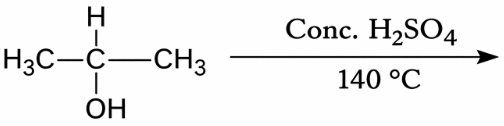
 CUET 2025 Easy