


CUET · CHEMISTRY · PYQ PAPER 2025
Read the passage carefully and answer the questions
Ethers with the general formula \(C _n H _{2 n+2} O\) and functional group C-O-C may be divided as symmetrical and unsymmetrical.
Lower symmetrical ether may be obtained by the dehydration of alcohols at low temperatures in the presence of protic acids,
such as \(H _2 SO _4\) and \(H _3 PO _4\) whereas at high temperature intramolecular dehydration takes place.
Formation of ether from primary alcohols is also accompanied by the formation of small amount of alkenes.
Due to the steric hinderance, secondary and tertiary alcohols undergo elimination reaction rather than substitution reaction yielding alkene as major product. Ethers can also be obtained by heating alkyl halides with sodium or potassium alkoxides.
Substituted Ethers (secondary & tertiary) can also be prepared using this method.
If primary halides are replaced with secondary and tertiary halides, alkenes are the major products.
The major product in the following reaction is
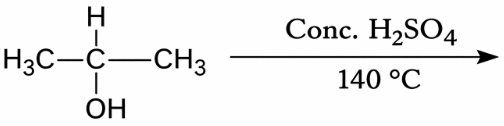

- A A
- B B
- C C
- D D
Answer & Solution
Correct Answer
(C) C
Step-by-step Solution
Detailed explanation
Tertiary alkyl halide + strong base \(\rightarrow\) E2 elimination. Major product: \( (CH_3)_2 C=CH_2 \).
See the Complete Solution
Get step-by-step explanations for this and 2.5 Lakh+ more JEE, NEET & CET questions.
- Unlock all solutions
- Practice the full chapter
- Track accuracy across PYQs
4.8 rated on Google Play · 14,000+ reviews
More questions from CHEMISTRY
- Read the passage carefully and answer the questions
The carbonyl group of aldehydes and ketones is highly polar. The positively charged carbon is readily attacked by electron-rich nucleophile and the negatively charged oxygen atom is attacked by an electro-deficient electrophile. Aldehydes and ketones undergo nucleophilic addition reactions in the presence of acid or a base. The mechanism involves attack of a nucleophile on the electron deficient carbonyl carbon to form a tetrahedral intermediate. A new bond is formed between the carbon and oxygen. Protonation of the anion furnished by the reaction medium yields a neutral addition product. The addition product is same whether the reaction is catalyzed by acid or a base. For example in the presence of base aldehydes and ketones react with hydrogen cyanide to form cyanohydrin.
Which of the following reactions is not a nucleophilic addition reaction of aldehydes and ketones?CUET 2025 Hard - Match List I with List II
\multicolumn1|c|\(LIST\)\(I\) \multicolumn1|c|\( LIST\)\(II\) A. \(Cu\) I. \(+ 3\) B. \(Sc\) II. \(+ 7\) C. \(Mn\) III. \(+ 2\) D.\(Fe\) IV. \(+ 1\)
Choose the correct answer from the options given below:CUET 2023 Hard - Read the Passage carefully and answer the questions
When a ligand is bound to a metal ion through a single donor atom, it is said to be a unidentate ligand but when it bind through two donor atoms, then it is said to be didentate ligand and when several donor atoms are present in a single ligand, it is said to be a polydentate ligand. When a di- or polydentate ligand uses its two or more donor atoms simultaneously to bind a single metal ion, it is said to be a chelate ligand. The number of such ligating groups is called the denticity of the ligand. ligand which has two different donor atoms and either of the two ligetes in the complex is called ambidentate ligands. The number of ligand donor atoms to which the metal is directly bonded, is called coordination number of the metal ion in the complex. Complexes in which a metal is bound to only one kind of donor groups are known as homoleptic and in which a metal is bound to more than one kind of donor groups are known as heteroleptic complexes.
Which of the following molecule/ion is not expected to behave as a ligand?CUET 2025 Easy - What is the product of nitration of Benzoic acid?CUET 2025 Medium
- Arrange the following in increasing order of their molarity when their equal weights are dissolved in 250 mL of water.
(A) glucose \(\left(180 g mol ^{-1}\right)\)
(B) sodium carbonate (106 g mol-1)
(C) sodium hydroxide \(\left(40 g mol ^{-1}\right)\)
(D) acetic acid \(\left(60 g mol ^{-1}\right)\)
Choose the correct answer from the options given below:CUET 2025 Medium - Match List-I with List-II
Choose the correct answer from the options given below:List-I (Components of binary solution) List-II (Deviation from Raoult's Law) (A) Ethanol and water (I) Positive (B) Chloroform and acetone (II) No deviation (C) n-Hexane and n-heptane (III) Negative (D) Carbon disulphide and acetone (IV) Large positive (D) Carbon disulphide and acetone (IV) Large positive CUET 2025 Hard
More PYQs from CUET
- A bar magnet falls freely from a height of 9.8 m through a metal ring. Its acceleration will be equal toCUET 2023 Medium
- The untranslated regions are present on an mRNA at:CUET 2023 Medium
- Resolving power of a telescope can be increased by increasing:CUET 2023 Hard
- Gabriel phthalimide synthesis method is used for the preparation of :CUET 2025 Easy
- A parallel beam of light of wave length 500 nm in incident normally on a single slit of width \( 10^{-6} \, \text{m} \). The light is focused by a convex lens on a screen placed in focal plane.CUET 2023 Medium
- Match List - I with List - II.
List-I (Birth control methods) List-II (Features) (A) Diaphragms (I) Removal of vas deferens (B) Lactational amenorrhea (II) Increase phagocytosis of sperms (C) Vasectomy (III) Absence of menstrual cycle and ovulation following parturition (D) IUDs (IV) Cover the cervix and blocks the entry of sperm
Choose the correct answer from the options given below :CUET 2023 Easy