


AP EAMCET · PHYSICS · Magnetic Effects of Current
The magnetic moment of an electron moving in a circular orbit of radius \(R\) with a time period T is
- A \(\frac{2 \pi \mathrm{Re}}{\mathrm{T}}\)
- B \(\frac{\pi \mathrm{eR}}{\mathrm{T}}\)
- C \(\frac{\pi e \mathrm{R}^2}{\mathrm{~T}}\)
- D \(\pi \mathrm{R}^2 \mathrm{eT}\)
Answer & Solution
Correct Answer
(C) \(\frac{\pi e \mathrm{R}^2}{\mathrm{~T}}\)
Step-by-step Solution
Detailed explanation
\(\mu = IA\) \(I = \frac{e}{T}\) \(A = \pi R^2\) \(\mu = \frac{e}{T} \cdot \pi R^2 = \frac{\pi e R^2}{T}\)
See the Complete Solution
Get step-by-step explanations for this and 2.5 Lakh+ more JEE, NEET & CET questions.
- Unlock all solutions
- Practice the full chapter
- Track accuracy across PYQs
4.8 rated on Google Play · 14,000+ reviews
More questions from PHYSICS
- A sphere of mass \(4 \mathrm{~kg}\) is attached to one end of a steel wire of length \(1 \mathrm{~m}\) and radius \(1 \mathrm{~mm}\). It is whirled in a vertical circle with an angular velocity \(10 \mathrm{rad} \mathrm{s}^{-1}\). If the sphere is at the lowest point of its path, the elongation in the wire is ____
\(\left(\mathrm{g}=10 \mathrm{~ms}^{-2}, \mathrm{Y}_{\text {steel }}=20 \times 10^{10} \mathrm{Nm}^{-2}\right)\)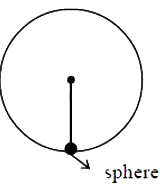 AP EAMCET 2017 Medium
 - A body of mass 30 kg moving with a velocity \(20 \mathrm{~ms}^{-1}\) undergoes one dimensional elastic collision with another ball of same mass moving in the opposite direction with a velocity of \(30 \mathrm{~ms}^{-1}\). After collision the velocities of first and second bodies respectively areAP EAMCET 2024 Medium
- The instantaneous velocity of a point \(B\) of the given rod of length \(0.5 \mathrm{~m}\) is \(3 \mathrm{~m} / \mathrm{s}\) in the represented direction. The angular velocity of the rod for minimum velocity of end \(A\) is
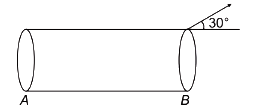 AP EAMCET 2005 Medium
 - A coil has 1000 turns and \(500 \mathrm{~cm}^2\) as its area. The plane of the coil is placed at right angles to a magnetic induction field of \(2 \times 10^{-5} \mathrm{~Wb} / \mathrm{m}^2\). The coil is rotated through \(180^{\circ}\) in \(0.2 \mathrm{~s}\). The average emf induced in the coil, in \(\mathrm{mV}\), isAP EAMCET 2003 Easy
- Two towns \(A\) and \(B\) are connected by a regular bus service with a bus leaving in either direction every \(T\) min. A man cycling with a speed of \(20 \mathrm{~km} / \mathrm{h}\) from \(A\) to \(B\) notices that a bus travelling in the direction of his motion goes past him every \(18 \mathrm{~min}\) and every \(6 \mathrm{~min}\) he notices a bus travelling in the opposite direction go past him. Assuming that, the buses travel with a constant speed. Find \(T\) and the constant speed of the buses.AP EAMCET 2021 Medium
- Two springs A and B fixed at the top and are stretched by \(8 \mathrm{~cm}\) and \(16 \mathrm{~cm}\) respectively, when loads of \(20 \mathrm{~N}\) and \(10 \mathrm{~N}\) are suspended at the lower ends. The ratio of the spring constants of the springs \(A\) and \(B\) isAP EAMCET 2023 Easy
More PYQs from AP EAMCET
- What is the value ofAP EAMCET 2021 Medium
- In compton scattering process, the incident \(X\)-radiation is scattered at an angle \(60^{\circ}\). The wavelength of the scattered radiation is \(0.22 Ã…\). The wavelength of the incident \(X\)-radiation in \(Ã…\) units isAP EAMCET 2002 Medium
- If \(\int f(x) d x=\psi(x)\), then \(\int x^5 f\left(x^3\right) d x=\)AP EAMCET 2023 Hard
- Two cars of masses \(\mathrm{m}_1\) and \(\mathrm{m}_2\), joined back to back by a massless compressed spring are at rest on a horizontal rough road. When the compression of the spring is suddenly removed, the cars move away from each other and come to rest due to friction. If the frictional force is same on them, their stopping times are in the ratioAP EAMCET 2017 Easy
- If the differential equation obtained by eliminating A,B from \(y=\left(\sin ^{-1} x\right)^2+A \cos ^{-1} x+B\) is \(\left(a-x^2\right) y^{\prime \prime}-x y^{\prime}=b\), then \(\frac{b+a}{b-a}=\)AP EAMCET 2022 Medium
- A particle of mass \(4 M\) which is initially at rest explodes into three pieces of masses \(M\), \(M\) and \(2 M\). The equal masses move along \(X\) and \(Y\)-axes with velocities \(4 \mathrm{~ms}^{-1}\) and \(6 \mathrm{~ms}^{-1}\), respectively. The magnitude of the velocity of the heavier mass isAP EAMCET 2018 Easy