


AP EAMCET · PHYSICS · Oscillations
A particle is executing simple harmonic motion with amplitude A. At a distance ' \(x\) ' from the mean position, when the particle is moving towards extreme position it receives a blow in the direction of motion which instantaneously doubles its velocity. The new amplitude of the particle is (Frequency is constant during the motion)
- A \(A\)
- B \(\sqrt{A^2-x^2}\)
- C \(\sqrt{2 \mathrm{~A}^2-3 \mathrm{x}^2}\)
- D \(\sqrt{4 A^2-3 x^2}\)
Answer & Solution
Correct Answer
(D) \(\sqrt{4 A^2-3 x^2}\)
Step-by-step Solution
Detailed explanation
\( v = \omega \sqrt{A^2 - x^2} \) \( v' = 2v \) \( 2 \omega \sqrt{A^2 - x^2} = \omega \sqrt{(A')^2 - x^2} \) \( 4(A^2 - x^2) = (A')^2 - x^2 \) \( 4A^2 - 4x^2 = (A')^2 - x^2 \) \( (A')^2 = 4A^2 - 3x^2 \) \( A' = \sqrt{4A^2 - 3x^2} \)
See the Complete Solution
Get step-by-step explanations for this and 2.5 Lakh+ more JEE, NEET & CET questions.
- Unlock all solutions
- Practice the full chapter
- Track accuracy across PYQs
4.8 rated on Google Play · 14,000+ reviews
More questions from PHYSICS
- Four capacitors with capacitances , and are connected as shown and are connected to a volt source. The potential difference between points and is:
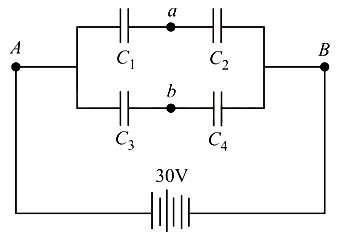 AP EAMCET 2021 Medium
 - If \(A\) represents Boltzmann constant, \(B\) represents Planck's constant and \(C\) represents speed of light in vacuum, then the quantity having the dimensions of \(A^4 B^{-3} C^{-2}\) isAP EAMCET 2018 Medium
- The average kinetic energy of \(\mathrm{H}_2\) molecules at \(300 \mathrm{~K}\) is \(E\). At the same temperature the average kinetic energy of \(\mathrm{O}_2\) molecule isAP EAMCET 2020 Easy
- Match Column A (layers in the ionosphere for skywave propagation) with Column B (their height range)
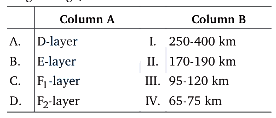
\(\begin{array}{llll}\mathrm{A} & \mathrm{B} & \mathrm{C} & \mathrm{D}\end{array}\)AP EAMCET 2012 Easy - A ball falls freely from rest from a height of 6.25 m on to a hard horizontal surface. If the ball reaches a height of 81 cm after second bounce from the surface, the coefficient of restitution isAP EAMCET 2024 Medium
- The length and area of cross-section of a copper wire are respectively 30 m and \(6 \times 10^{-7} \mathrm{~m}^2\). If the resistivity of copper is \(1.7 \times 10^{-8} \Omega \mathrm{~m}\), then the resistance of the wire isAP EAMCET 2025 Easy
More PYQs from AP EAMCET
- The rate constant, k of a zero order reaction \(2 \mathrm{NH}_3(\mathrm{~g})\) \(\underset{1130 \mathrm{~K}}{\stackrel{\mathrm{Pt}}{\longrightarrow}} \mathrm{N}_2(\mathrm{~g})+3 \mathrm{H}_2(\mathrm{~g})\) is \(\mathrm{y} \times 10^{-4} \mathrm{~mol} \mathrm{~L}^{-1} \mathrm{~s}^{-1}\). The rate of formation of hydrogen (in \(\mathrm{mol} \mathrm{L}^{-1} \mathrm{~s}^{-1}\) ) isAP EAMCET 2017 Easy
- \(\int\left[\log (\log x)+\frac{1}{(\log x)^2}\right] d x=\)AP EAMCET 2020 Hard
- As per molecular orbital theory the pair of molecules which do not exist isAP EAMCET 2022 Hard
- The following configuration of gates is equivalent to
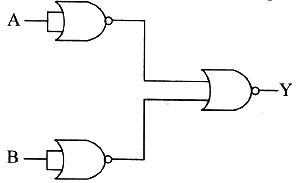 AP EAMCET 2024 Easy
 - In the complex plane \(C\), the set \(\left\{z \in C: \arg \left(\frac{z-1}{z+1}\right)=\frac{\pi}{4}\right\}\) representsAP EAMCET 2019 Hard
- What are X and Y in the following reaction sequence ?
\(\mathrm{C}_6 \mathrm{H}_5 \mathrm{~N}_2^{+} \mathrm{Cl}^{-} \xrightarrow{\mathrm{X}} \mathrm{C}_6 \mathrm{H}_5 \mathrm{CN} \xrightarrow[\text { (ii) } \mathrm{H}_2 \mathrm{O}]{\text { (i) } \mathrm{CH}_3 \mathrm{MgBr}} \mathrm{Y}\)AP EAMCET 2025 Medium