


AP EAMCET · PHYSICS · Mechanical Properties of Solids
A load of \(1 \mathrm{~kg}\) weight is a attached to one end of a steel wire of area of cross-section \(3 \mathrm{~mm}^2\) and Young's modulus \(10^{11} \mathrm{~N} / \mathrm{m}^2\). The other end is suspended vertically from a hook on a wall, then the load is pulled horizontally and released. When the load passes through its lowest position the fractional change in length is \(\left(g=10 \mathrm{~m} / \mathrm{s}^2\right)\)
- A \(0.3 \times 10^{-4}\)
- B \(0.3 \times 10^{-3}\)
- C \(0.3 \times 10^{3}\)
- D \(0.3 \times 10^{4}\)
Answer & Solution
Correct Answer
(A) \(0.3 \times 10^{-4}\)
Step-by-step Solution
Detailed explanation
\(\begin{aligned} Y & =\frac{m g l}{A \Delta l} \\ \Rightarrow \quad \frac{\Delta l}{l} & =\frac{m g}{A Y}\end{aligned}\) \(\begin{aligned} \therefore \quad \frac{\Delta l}{l} & =\frac{1 \times 10}{3 \times 10^{-6} \times 10^{11}} \\ & =0.3 \times 10^{-4}\end{aligned}\)
See the Complete Solution
Get step-by-step explanations for this and 2.5 Lakh+ more JEE, NEET & CET questions.
- Unlock all solutions
- Practice the full chapter
- Track accuracy across PYQs
4.8 rated on Google Play · 14,000+ reviews
More questions from PHYSICS
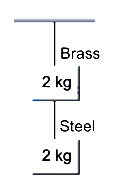
- If the ratio of lengths, radii and Young's modulus of steel and brass wires shown in the figure are \(a, b\) and \(c\) respectively, the ratio between the increase in lengths of brass and steel wires would be
 AP EAMCET 2009 Medium
 - The distance of closest approach of an alpha particle to a nucleus when the alpha particle moves towards the nucleus with linear momentum \(\mathrm{P}\) is \(\mathrm{d}\). The distance of closest approach of alpha particle to nucleus, if the linear momentum of the alpha particle is \(1.5 \mathrm{P}\)AP EAMCET 2023 Hard
- A pressure of \(1 \mathrm{~mm}\) of mercury is equivalent toAP EAMCET 2020 Easy
- Which of the following statement is correct?
(A) Becquerel, who discovered natural radioactivity, belongs to France.
(B) Marconi, who discovered wireless telegraphy, was an American.
(C) Newton was an American, who discovered the laws of motion.
(D) Einstein belongs to England, who simplifies the laws of photoelectric effects.AP EAMCET 2020 Easy - If the engine of a long train moving with constant acceleration crosses a tree with velocity ' \(u\) ' and the last compartment of the train crosses the same tree with velocity ' \(v\) ', then the velocity with which the middle compartment crosses the same tree isAP EAMCET 2023 Hard
- Tyre of a bicycle has volume . Initially the tube is filled of its volume by air at atmospheric pressure . When a rider is on the bicycle, the area of contact of tyre with road is . The mass of rider with bicycle is . If a pump delivers a volume of air in each stroke then the number of strokes required to inflate the tyre isAP EAMCET 2018 Hard
More PYQs from AP EAMCET
- The circumcentre of the triangle formed by the points \((3,4,5),(2,3,1)\) and \((-1,6,1)\) isAP EAMCET 2017 Easy
- A vessel that can withstand a pressure of \(100 \mathrm{~atm}\) is filled with hydrogen at \(27^{\circ} \mathrm{C}\) up to a pressure of \(20 \mathrm{~atm}\). If the vessel is heated, then the temperature at which it explodes isAP EAMCET 2023 Easy
- The common tangent to the parabola \(y^2=32 x\) and \(x^2=256 y\) will beAP EAMCET 2020 Easy
- Three point charges \(1 \mathrm{C},-2 \mathrm{C}\) and \(-2 \mathrm{C}\) are placed at the vertices of an equilateral triangle of side 1 metre. The work done by an external force to increase the separation of the charges to 2 metre in joule is ( \(\varepsilon_0=\) permittivity of air)AP EAMCET 2004 Easy
- If \(f(x)=\left\{\begin{array}{cc}\frac{2 x e^{\frac{1}{2 x}}-3 x e^{\frac{-1}{2 x}}}{e^{\frac{1}{2 x}}+4 e^{\frac{-1}{2 x}}} & \text { if } x \neq 0 \\ 0 & \text { if } x=0\end{array}\right.\)
is a real valued function thenAP EAMCET 2024 Medium - For an isothermal and free expansion of an ideal gas, which of the following is true?
1. For an adiabatic change, heat \((q)\) is non zero.
2. For an adiabatic change, heat \((q)\) is zero.
3. For an isothermal reversible change, heat (q) is zero.
4. For an isothermal process, the temperature changes.AP EAMCET 2020 Medium