


AP EAMCET · Maths · Indefinite Integration
\(\int \frac{\sin (x-a)}{\sin (x-b)} d x=A x+B \log |\sin (x-b)|+C \Rightarrow(A, B)=\)
- A \((\cos (b-a), \sin (b-a))\)
- B \((\cos (b-a), \sin (a-b))\)
- C \((-\cos (b-a), \sin (b-a))\)
- D \((-\cos (b-a), \sin (a-b))\)
Answer & Solution
Correct Answer
(A) \((\cos (b-a), \sin (b-a))\)
Step-by-step Solution
Detailed explanation
No solution. Refer to answer key.
See the Complete Solution
Get step-by-step explanations for this and 2.5 Lakh+ more JEE, NEET & CET questions.
- Unlock all solutions
- Practice the full chapter
- Track accuracy across PYQs
4.8 rated on Google Play · 14,000+ reviews
More questions from Maths
- The number of numbers lying between 1000 and 10000 such that every number contains the digits 3 and 7 only once without repetition isAP EAMCET 2024 Medium
- \(\cos 6^{\circ} \sin 24^{\circ} \cos 72^{\circ}=\)AP EAMCET 2024 Easy
- \[
\frac{\cos x}{1+\sin x}+\tan x=
\]AP EAMCET 2022 Easy - In \(\triangle \mathrm{ABC}\), if \(\mathrm{r}\) is the inradius and \(\mathrm{r}_1, \mathrm{r}_2, \mathrm{r}_3\) are the ex-radii, then \(\frac{1}{4}\left[b^2 \sin 2 C+c^2 \sin 2 B\right]=\)AP EAMCET 2023 Medium
- If the line joining the points \(A(7, p, 2)\) and \(B(q,-2,5)\) is parallel to the line joining the points \(C(2,-3,5)\) and \(D(-6,-15,11)\), then the value of \(p^2+q^2\) is equal toAP EAMCET 2021 Easy
- In a \(\triangle A B C\)
\[
\frac{(a+b+c)(b+c-a)(c+a-b)(a+b-c)}{4 b^2 c^2}
\]
equalsAP EAMCET 2009 Easy
More PYQs from AP EAMCET
- If the product of the perpendicular distances from any point on the hyperbola \(\frac{x^2}{a^2}-\frac{y^2}{b^2}=1\) to its asymptotes is 6 and eccentricity of the hyperbola is \(\sqrt{3}\), then the length of the conjugate axis of the hyperbola isAP EAMCET 2022 Medium
- All the words that can be formed using alphabets A, H, L, U, R are written as in dictionary (no alphabet is repeated). Then the rank of the word RAHUL is.......AP EAMCET 2020 Easy
- Match the following List I with List II.
\(\begin{array}{|c|c|c|}
\hline & \text { List I } & \text { List II } \\
\hline \text { (A) } & \text { Transverse wave (i) } & \begin{array}{l}
\text {Vibrations parallel to the } \\
\text {direction of propagation }
\end{array} \\
\hline \text { (B) } & \begin{array}{l}
\text {Longitudinal wave }
\end{array} & \begin{array}{l}
\text {Vibrations perpendicular to } \\
\text {the direction of propagation }
\end{array} \\
\hline \text { (C) } & \text { Beats } & \begin{array}{l}
\text {Superposition of waves } \\
\text {travelling in the opposite directions }
\end{array} \\
\hline \text { (D) } & \text { Stationary waves (iv) } & \begin{array}{l}
\text {Superposition of waves } \\
\text {travelling in same direction }
\end{array} \\
\hline
\end{array}\)
The correct answer isAP EAMCET 2019 Easy - Truth table for the given circuit is
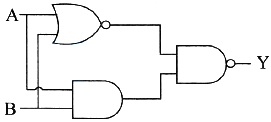 AP EAMCET 2024 Easy
 - A source of sound \(S\) in the form of a block kept on a smooth horizontal surface is connected to a spring, as shown in the figure. If the spring oscillates with an amplitude of \(50 \mathrm{~cm}\) along horizontal between the wall and the observer \(O\), the maximum frequency heard by the observer is \(12.5 \%\) more than the minimum frequency heard by him. If the mass of the source of sound is \(100 \mathrm{~g}\), the force constant of the spring is (Speed of sound in air is \(340 \mathrm{~ms}^{-1}\) )
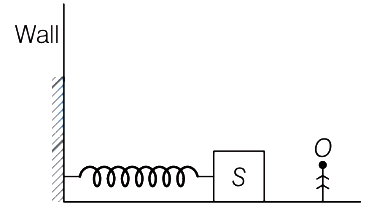 AP EAMCET 2019 Hard
 - The radii and Young's moduli of two uniform wires \(A\) and \(B\) are in the ratio \(2: 1\) and \(1: 2\) respectively. Both wires are subjected to the same longitudinal force. If the increase in length of the wire \(A\) is one percent, the percentage increase in length of the wire \(B\) isAP EAMCET 2005 Medium