


AP EAMCET · Maths · Vector Algebra
The distance of a point \(\overrightarrow{\mathrm{a}}\) from the plane \(\overrightarrow{\mathrm{r}} \cdot \overrightarrow{\mathrm{m}}=\mathrm{q}\) is given by \(\frac{|\vec{a} \cdot \vec{m}-q|}{|m|}\). If the distance of the point \(\hat{i}+2 \hat{j}+3 \hat{k}\) from the plane \(\vec{r} \cdot(2 \hat{i}+6 \hat{j}-9 \hat{k})=-1\) is \(p\) and the distance of the origin from this plane is \(\mathrm{q}\), then \(\mathrm{p}-\mathrm{q}=\)
- A \(6\)
- B \(5\)
- C \(2\)
- D \(1\)
Answer & Solution
Correct Answer
(D) \(1\)
Step-by-step Solution
Detailed explanation
Distance from point \(\vec{i}+2 \vec{j}+3 \vec{k}\) from the plane \(\begin{aligned} & \vec{r} \cdot(2 \vec{i}+b \vec{j}-9 \vec{k})=-1 \text { is qp } \\ & \Rightarrow \frac{|2+12-27+1|}{\sqrt{4+36+81}}=\frac{12}{11}=p \end{aligned}\) and distance from origin to the given plane…
See the Complete Solution
Get step-by-step explanations for this and 2.5 Lakh+ more JEE, NEET & CET questions.
- Unlock all solutions
- Practice the full chapter
- Track accuracy across PYQs
4.8 rated on Google Play · 14,000+ reviews
More questions from Maths
- \(\lim _{x \rightarrow 0} \frac{\tan (x)+4 \tan (2 x)-3 \tan (3 x)}{x^2 \tan (x)}\) is equal toAP EAMCET 2021 Medium
- Which of the following is not a property of a Binomial distribution?AP EAMCET 2022 Medium
- The equation of the common tangent to the parabolas \(y^2=32 x\) and \(x^2=256 y\) isAP EAMCET 2017 Medium
- If \(z_1=(2,-1)\) and \(z_2=(6,3)\), then \(\operatorname{amp}\left(\frac{z_1-z_2}{z_1+z_2}\right)=\)AP EAMCET 2023 Easy
- Define \(f: R \rightarrow R\) by \(f(x)=\max \{x+1,1-x, 2\}\). Then, \(f\) isAP EAMCET 2021 Easy
- If the circle \(x^2+y^2+8 x-4 y+c=0\) touches the circle \(x^2+y^2+2 x+4 y-11=0\) externally and cuts the circle \(x^2+y^2-6 x+8 y+k=0\) orthogonally, then \(\mathrm{k}=\)AP EAMCET 2018 Medium
More PYQs from AP EAMCET
- A particle of mass \(m\) is suspended from a ceiling through a string of length \(L\). If the particle moves in a horizontal circle of radius \(r\) as shown in the figure, then the speed of the particle is
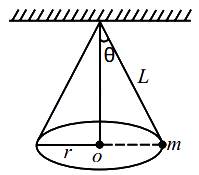 AP EAMCET 2016 Hard
 - A mixture of sodium oxide and calcium oxide are dissolved in water, and saturated with excess carbon dioxide gas. The resulting solution is ...... It contains ......... :AP EAMCET 2003 Easy
- If two stones are projected at angle ' \(\theta\) ' and \((90-\theta)\) respectively with horizontal with a speed of \(20 \mathrm{~ms}^{-1}\). If second stone rises 10 m higher than the first stone, then the angle of projection ' \(\theta\) ' is (acceleration clue to gravity \(=10 \mathrm{~ms}^{-2}\) )AP EAMCET 2024 Medium
- 1 mole of an ideal gas is allowed to expand isothermally and reversibly from 1 L to 5 L at 300 K. The change in enthalpy (in kJ ) is \(\left(\mathrm{R}=8.3 \mathrm{~J} \mathrm{~K}^{-1} \mathrm{~mol}^{-1}\right)\)AP EAMCET 2025 Easy
- A plane \(x\) passes through the point \((1,1,1)\). If \(b, c, a\) are the direction ratios of a normal to the plane, where \(a, b, c(a < b < c)\) are the factors of 2001 , then the equation of the plane isAP EAMCET 2002 Medium
- The values of such that the matrix has no inverse, areAP EAMCET 2018 Easy