


AP EAMCET · Maths · Pair of Lines
Suppose the axes are to be rotated through an angle \(\theta\) so as to remove the \(x y\) form from the equation \(3 x^2+2 \sqrt{3} x y\) \(+y^2=0\). Then in the new coordinate system the equation \(x^2+y^2+2 x y=2\) is transformed to
- A \((2+\sqrt{3}) x^2+(2-\sqrt{3}) y^2+2 x y=4\)
- B \((2+\sqrt{3}) x^2+(2+\sqrt{3}) y^2-2 x y=4\)
- C \(x^2+y^2-2(2-\sqrt{3}) x y=4(2-\sqrt{3})\)
- D \(x^2+y^2+2(2+\sqrt{3}) x y=4(2+\sqrt{3})\)
Answer & Solution
Correct Answer
(A) \((2+\sqrt{3}) x^2+(2-\sqrt{3}) y^2+2 x y=4\)
Step-by-step Solution
Detailed explanation
Let axes be rotated through an angle \(\theta\), then old coordinates are \(\begin{aligned} & x=X \cos \theta-Y \sin \theta \\ & y=X \sin \theta+Y \cos \theta \end{aligned}\) Putting given equation \(3 x^2+2 \sqrt{3} x y+y^2=0\)…
See the Complete Solution
Get step-by-step explanations for this and 2.5 Lakh+ more JEE, NEET & CET questions.
- Unlock all solutions
- Practice the full chapter
- Track accuracy across PYQs
4.8 rated on Google Play · 14,000+ reviews
More questions from Maths
- If the volume of the tetrahedron formed by the coterminous edges \(\mathbf{a}, \mathbf{b}\) and \(\mathbf{c}\) is 4 , then the volume of the parallelopiped formed by the coterminous edges \(\mathbf{a} \times \mathbf{b}, \mathbf{b} \times \mathbf{c}\) and \(\mathbf{c} \times \mathbf{a}\) isAP EAMCET 2017 Medium
- If two cards are drawn randomly from a pack of 52 playing cards, then the mean of the probability distribution of number of kings isAP EAMCET 2024 Easy
- \((\sqrt{3}+i)^7+(\sqrt{3}-i)^7\) is equal toAP EAMCET 2010 Hard
- If the extreme value of the function \(f(x)=\frac{4}{\sin x}+\frac{1}{1-\sin x}\) in \(\left[0, \frac{\pi}{2}\right]\) is \(m\) and it exists at \(\mathrm{x}=\mathrm{k}\), then \(\cos \mathrm{k}=\)AP EAMCET 2025 Medium
- If \((2,-1,2)\) and \((K, 3,5)\) are the triads of direction ratios of two lines and the angle between them is \(45^{\circ}\), then the value of \(K\) isAP EAMCET 2015 Easy
- The orthogonal projection of \(\mathbf{a}\) on \(\mathbf{b}\) isAP EAMCET 2002 Easy
More PYQs from AP EAMCET
- The solution of the differential equation \(\frac{d y}{d x}=\frac{x y+y}{x y+x}\) isAP EAMCET 2008 Medium
- IUPAC name of the following molecule is
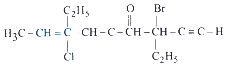 AP EAMCET 2023 Medium
 - In a \(\triangle A B C,(a+b+c)(b+c-a)=\lambda b c\), thenAP EAMCET 2015 Medium
- If a body cools from a temperature of \(62^{\circ} \mathrm{C}\) to \(50^{\circ} \mathrm{C}\) in 10 minutes and to \(42^{\circ} \mathrm{C}\) in the next 10 minutes, then the temperature of the surroundings isAP EAMCET 2025 Easy
- The set of values of \(k\) for which the system of simultaneous equations \(\mathrm{x}+\mathrm{y}+\mathrm{kz}=1,2 \mathrm{x}+2 \mathrm{y}=3\) and \(\mathrm{x}+2 \mathrm{y}+2 \mathrm{kz}=\) \(\mathrm{k}\) has no real solution isAP EAMCET 2022 Easy
- Find the solution of the following differential equation \(\left\{x \cos \left(\frac{y}{x}\right)+y \sin \left(\frac{y}{x}\right)\right\} y\)
\[
d x=\left\{y \sin \left(\frac{y}{x}\right)-x \cos \left(\frac{y}{x}\right)\right\} x d y
\]AP EAMCET 2020 Hard