


AP EAMCET · Maths · Sequences and Series
\(p, x_1, x_2 \ldots, x_n\) and \(q, y_1, y_2, \ldots, y_{\mathrm{n}}\) are two arithmetic progressions with common differences a and \(\mathrm{b}\) respectively. If \(\alpha\) and \(\beta\) are the arithmetic means of \(x_1, x_2, \ldots x_n\), and \(y_1, y_2, \ldots, y_n\) respectively. Then the locus of \(P(\alpha, \beta)\) is
- A \(\mathrm{a}(x-p)=\mathrm{b}(y-q)\)
- B \(\mathrm{b}(x-p)=\mathrm{a}(y-q)\)
- C \(\alpha(x-p)=\beta(y-q)\)
- D \(p(x-\alpha)=q(y-\beta)\)
Answer & Solution
Correct Answer
(B) \(\mathrm{b}(x-p)=\mathrm{a}(y-q)\)
Step-by-step Solution
Detailed explanation
It is given that \(p, x_1, x_2, x_3 \ldots x_n\) and \(q, y_1, y_2, y_3 \ldots y_n\) are in A.P. whose common difference are \(a\) and \(b\) respectively. \[ \begin{aligned} \therefore \quad x_1 & =p+a, x_n=p+n a \\ y_1 & =q+b, y_n=q+n b \end{aligned} \] Also, given \(\alpha\)…
See the Complete Solution
Get step-by-step explanations for this and 2.5 Lakh+ more JEE, NEET & CET questions.
- Unlock all solutions
- Practice the full chapter
- Track accuracy across PYQs
4.8 rated on Google Play · 14,000+ reviews
More questions from Maths
- Number of circles intersecting \(x^2+y^2=4\), \(x^2+y^2-2 x-3=0\) and \(x^2+y^2-2 y-3=0\) orthogonally isAP EAMCET 2022 Hard
- The solution of the differential equation \(2 \frac{d y}{d x}-\frac{y}{x}=\frac{y^2}{x^2}\), given that \(y=2\) when \(x=1\), isAP EAMCET 2017 Medium
- The coefficient of \(x^3 y^4 z^5\) in the expansion of \((x y+y z+x z)^6\) isAP EAMCET 2005 Medium
- \(\int \frac{2 x^2-3}{\left(x^2-4\right)\left(x^2+1\right)} d x=\mathrm{Atan}^{-1} x+\mathrm{B} \log (x-2)+\mathrm{C} \log (x+2)\)
then \(6 A+7 B-5 C=\)AP EAMCET 2024 Medium - Find the equation of the ellipse which passes through the points \((-3,1)\) and \((2,-2)\), whose center lies at \((0,0)\) and major axis lies along the \(X\)-axis.AP EAMCET 2021 Medium
- For \(a, b, h>0\), if the slope of one of the lines represented by \(a^2 x^2+2 h x y+b^2 y^2=0\) is twice that of the other, then the value of \(\frac{h}{a b}\) isAP EAMCET 2022 Hard
More PYQs from AP EAMCET
- The polar of a point with respect to the circle \(x^2+y^2-\) \(10 x+12 y-3=0\) which is not a tangent and not a chord of contact isAP EAMCET 2023 Hard
- A particle moves in the \(x-y\) plane under the action of a force,
\(\mathbf{F}=K\left[\frac{x}{\left(x^2+y^2\right)^{\frac{3}{2}}} \hat{\mathbf{i}}+\frac{y}{\left(x^2+y^2\right)^{\frac{3}{2}}} \hat{\mathbf{j}}\right]\) where, \(K\) is a constant. Work done by the force when the particle moves from \((0, a)\) to \((a, 0)\) along a circular path of radius \(a\) about the origin isAP EAMCET 2019 Easy - The sag developed in a bar of length ' 1 ', breath 'b' and thickness ' \(\mathrm{d}\) ' when subjected to a load of ' \(w\) ' at center is (Y - Young's modulus of the material of the bar)
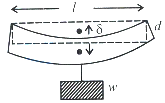 AP EAMCET 2023 Hard
 - Time period of a simple pendulum of length ' \(L\) ' is \(T_1\). Time period of a uniform rod of same length ' \(L\) ' suspended from one end and oscillating in a vertical plane is \(T_2\). Amplitude of oscillation is small in both the cases. Then \(\frac{T_1}{T_2}\) isAP EAMCET 2017 Medium
- Three screws are drawn at random from a lot of 50 screws containing 5 defective ones. Then the probability of the event that all 3 screws drawn are non-defective, assuming that the drawing is (a) with replacement (b) without replacement respectively isAP EAMCET 2023 Medium
- If the two circles \((x-1)^2+(y-3)^2=r^2\) and \(x^2+y^2-8 x+2 y+8=0\) intersect in two different points, then what can we conclude about \(r\) ?AP EAMCET 2020 Medium