


AP EAMCET · Maths · Quadratic Equation
Let \(\phi(x)=\frac{x}{\left(x^2+1\right)(x+1)}\). If \(a, b\) and \(c\) are the roots of the equation \(x^3-3 x+\lambda=0,(\lambda \neq 0)\). Then, \(\phi(a) \phi(b) \phi(c)=\)
- A \(\lambda\)
- B \(\frac{-\lambda}{(\lambda+2)\left(\lambda^2+16\right)}\)
- C \(\frac{\lambda}{(\lambda+2)}\)
- D \(\frac{\lambda}{(\lambda+2)\left(\lambda^2+16\right)}\)
Answer & Solution
Correct Answer
(D) \(\frac{\lambda}{(\lambda+2)\left(\lambda^2+16\right)}\)
Step-by-step Solution
Detailed explanation
\begin{aligned} & \text {Given, } \phi(x)=\frac{x}{\left(x^2+1\right)(x+1)} \\ & \therefore \phi(a) \phi(b) \phi(c)=\frac{a b c}{(1+a)(1+b)(1+c)\left(1+a^2\right)\left(1+b^2\right)\left(1+c^2\right)} \\ & =\frac{a b c}{(1+a+b+c+a b+b c+c a+a b c)\left(1+a^2+b^2+c^2\right.} \\ &…
See the Complete Solution
Get step-by-step explanations for this and 2.5 Lakh+ more JEE, NEET & CET questions.
- Unlock all solutions
- Practice the full chapter
- Track accuracy across PYQs
4.8 rated on Google Play · 14,000+ reviews
More questions from Maths
- \(\int_0^{\pi / 4} \frac{d x}{\cos ^3(x) \cdot \sqrt{2 \sin (2 x)}}=\)AP EAMCET 2020 Medium
- In how many ways can balls be placed in tins if any number of balls can be placed in any tin?AP EAMCET 2021 Easy
- \(\int \frac{x+1}{(x-2) \sqrt{1-x}} d x=\)AP EAMCET 2025 Medium
- The perpendicular bisector of line segment joining the points \(P(1,4)\) and \(Q(k, 3)\) has \(y\)-intercept -4 . Then a possible value of \(k\) among the following isAP EAMCET 2021 Medium
- \(\int e^{4 x^2+8 x-4}(x+1) \cos \left(3 x^2+6 x-4\right) d x=\)AP EAMCET 2024 Medium
- The coefficient of \(x^5\) in the expansio of \((1+x)^{21}+(1+x)^{22}+\ldots+(1+x)^{30}\) isAP EAMCET 2017 Medium
More PYQs from AP EAMCET
- Let \(x, y\) be real numbers such that \(x \neq y\) and \(x y \neq 1\). If \(a x+b \sec \left(\tan ^{-1} x\right)=c\) and \(a y+b \sec \left(\tan ^{-1} y\right)=c\), then \(\frac{x+y}{1-x y}=\)AP EAMCET 2018 Medium
- As shown in the figure, a force \(F\) is applied on a block of mass \(\sqrt{3} \mathrm{~kg}\) placed on a rough horizontal surface. The maximum value of F for the block not to move is (Coefficient of static friction between the block and the surface is \(\frac{1}{2 \sqrt{3}}\) and acceleration due to gravity \(=10 \mathrm{~m} \mathrm{~s}^{-2}\) )
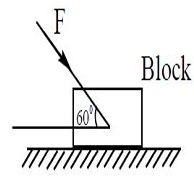 AP EAMCET 2025 Medium
 - In which of the following salts, only cationic hydrolysis is involved?AP EAMCET 2016 Easy
- Using Kjeldahl's method over of a soil sample, the ammonia evolved could neutralize of . Then, the percentage of nitrogen present in the sample isAP EAMCET 2021 Medium
- Two balls are drawn from an urn containing 7 white, 6 red and 8 black balls one after the other without replacement. Then the probability that atleast one of them is white, isAP EAMCET 2018 Easy
- Electric potential due to a space is given by \(\phi(x, y, z)=\phi_0 \frac{x_0}{x}\); when \(x_0=5 \mathrm{~m}\) and \(\phi_0=8 V\). Find the electric field at \((10 \mathrm{~m}, 5 \mathrm{~m}, 5 \mathrm{~m})\)AP EAMCET 2022 Easy