


AP EAMCET · Maths · Application of Derivatives
Let \(f\) be a polynomial function defined on \([2,7]\). If \(f(2)=3\) and \(f^{\prime}(x) \leq 5\) for all \(x\) in \((2,7)\), then the maximum possible value attained by \(f\) at \(x=7\) is
- A 7
- B 14
- C 18
- D 28
Answer & Solution
Correct Answer
(D) 28
Step-by-step Solution
Detailed explanation
Since, the polynomial function are continuous and differentiable in interval \(R\). So, according to Lagranage's mean value theorem…
See the Complete Solution
Get step-by-step explanations for this and 2.5 Lakh+ more JEE, NEET & CET questions.
- Unlock all solutions
- Practice the full chapter
- Track accuracy across PYQs
4.8 rated on Google Play · 14,000+ reviews
More questions from Maths
- If the function \(y=\sin x(1+\cos x)\) is defined in the interval \([-\pi, \pi]\), then \(y\) is strictly increasing in the intervalAP EAMCET 2025 Medium
- If \((1, a),(b, 2)\) are conjugate points with respect to the circle \(x^2+y^2=25\), then \(4 a+2 b=\)AP EAMCET 2025 Medium
- If is a tangent drawn to the curve at where are constants, thenAP EAMCET 2019 Easy
- If \(x_1\) and \(x_2\) are the real roots of the equation \(x^2-k x+c=0\), then the distance between the points \(A\left(x_1, 0\right)\) and \(B\left(x_2, 0\right)\) isAP EAMCET 2014 Easy
- The number of ways of arranging 8 men and 4 women around a circular table such that no two women can sit together isAP EAMCET 2007 Medium
- The variance of the following continuous frequency distribution is
\(\begin{array}{lllll} \hline \text { Class Interval } & 0-10 & 10-20 & 20-30 & 30-40 \\ \hline \text { Frequency } & 2 & 3 & 4 & 1 \\ \hline \end{array}\)AP EAMCET 2019 Easy
More PYQs from AP EAMCET
- If \((1+x)^n=p_0+p_1 x+p_2 x^2+\ldots+p_n x^n\), then \(p_0+p_3+p_6+\ldots=\)AP EAMCET 2017 Hard
- Two identical condensers \(M\) and \(N\) are connected in series with a battery. The space between the plates of \(M\) is completely filled with a dielectric medium of dielectric constant 8 and a copper plate of thickness \(\frac{d}{2}\) is introduced between the plates of \(N\). ( \(d\) is the distance between the plates). Then potential differences across \(M\) and \(N\) are, respectively, in the ratioAP EAMCET 2011 Hard
- If \(A=\left[\begin{array}{lll}a & b & c \\ d & e & f \\ l & m & n\end{array}\right]\) is a matrix such that \(|A|>0\) and \(A d j A=\left[\begin{array}{ccc}0 & 4 & -6 \\ 10 & 8 & 0 \\ 2 & 4 & -4\end{array}\right]\), then \(\frac{\mathrm{cd}}{\mathrm{fb}}+\frac{\ln }{\mathrm{em}}=\)AP EAMCET 2025 Medium
- A particle starts from rest and moves in a straight line. It travels a distance 2 L with uniform acceleration and then moves with a constant velocity a further distance of L. Finally, it comes to rest after moving a distance of 3L under uniform retardation. Then the ratio of average speed to the maximum speed \(\left(\frac{\bar{V}}{V_m}\right)\) of the particle isAP EAMCET 2024 Medium
- \(\int \frac{d x}{\sqrt{x-x^2}}\) is equal toAP EAMCET 2012 Hard
- The correct order of reactivity of the following compounds, towards electrophilic substitution reactions is
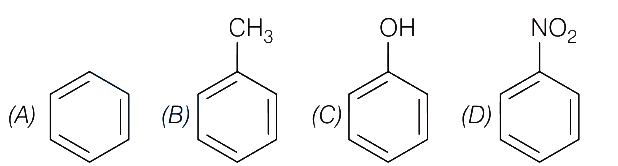 AP EAMCET 2019 Hard