


AP EAMCET · Maths · Circle
The lengths of the intercepts made by a circle \(\mathrm{S}\) on \(\mathrm{X}\) and \(\mathrm{Y}\) - axes are \(\frac{2 \sqrt{13}}{3}\) and \(\frac{2 \sqrt{22}}{3}\) respectively. If the radius of the circle \(\mathrm{S}\) is \(\frac{\sqrt{38}}{3}\) and its centre \(\mathrm{C}\) lies in the second quadrant, then \(\mathrm{C}=\)
- A \(\left(\frac{-5}{3}, \frac{4}{3}\right)\)
- B \(\left(\frac{-4}{3}, \frac{5}{3}\right)\)
- C \(\left(\frac{-6}{5}, \frac{7}{5}\right)\)
- D \(\left(\frac{-7}{5}, \frac{6}{5}\right)\)
Answer & Solution
Correct Answer
(B) \(\left(\frac{-4}{3}, \frac{5}{3}\right)\)
Step-by-step Solution
Detailed explanation
Let equation of the circle be \(x^2+y^2+2 g x+2 f y+c=0\) ... (i) Now length of intercepts made by \(\mathrm{x}\) axis is \(2 \sqrt{\mathrm{g}^2-\mathrm{c}}=\frac{2 \sqrt{13}}{3} \Rightarrow \mathrm{g}^2-\mathrm{c}=\frac{13}{9}\) ... (ii) Similarly,…
See the Complete Solution
Get step-by-step explanations for this and 2.5 Lakh+ more JEE, NEET & CET questions.
- Unlock all solutions
- Practice the full chapter
- Track accuracy across PYQs
4.8 rated on Google Play · 14,000+ reviews
More questions from Maths
- If \(A\) is an invertible matrix of order \(n\), then the determinant of \(\operatorname{adj} A\) is equal to :AP EAMCET 2006 Medium
- \(\cos 20^{\circ}+\cos 30^{\circ}+\cos 40^{\circ}=\)AP EAMCET 2017 Hard
- Find the value of \(k\) if \(\int \cos ^k(x) \sin (x) d x=\frac{-1}{4}\) \(\cos ^4(x)+c\)AP EAMCET 2021 Medium
- If \(z\) is a complex number, then curves \(|z|=1\), \(|z-2|=1\) and \(|z-1|=0\) have a common point atAP EAMCET 2021 Medium
- If \(\frac{x^2}{(2 x-1)(x+2)(x-3)}\) \(=A+\frac{B}{2 x-1}+\frac{C}{x+2}+\frac{D}{x-3}\), then \(A\) is equal toAP EAMCET 2005 Easy
- If \(a, b, c\) are distinct positive real numbers, then the value of the determinant \(\left|\begin{array}{lll}a & b & c \\ b & c & a \\ c & a & b\end{array}\right|\) isAP EAMCET 2016 Easy
More PYQs from AP EAMCET
- The system \(2 x+3 y+z=5,3 x+y+5 z=7\) and \(x+4 y-2 z=3\) hasAP EAMCET 2015 Hard
- If the altitude of a triangle are in arithmetic progression, then the sides of the triangles are inAP EAMCET 2002 Medium
- \(\mathrm{K}_{\mathrm{c}}\) for the reaction
\(\mathrm{A}_2(\mathrm{~g}) \stackrel{\mathrm{T}(\mathrm{~K})}{\rightleftharpoons} \mathrm{B}_2(\mathrm{~g})\)
is 39.0. In a closed one litre flask, one mole of \(\mathrm{A}_2(\mathrm{~g})\) was heated to \(\mathrm{T}(\mathrm{K})\). What are the concentrations of \(\mathrm{A}_2(\mathrm{~g})\) and \(\mathrm{B}_2(\mathrm{~g})\) (in \(\mathrm{mol}^{-1}\) ) respectively at equilibrium?AP EAMCET 2024 Easy - If \(f:[0,3] \rightarrow[0,3]\) is defined by \(f(x)\) \(=\left\{\begin{array}{ll}1+x, & 0 \leq x \leq 2 \\ 3-x, & 2 < x \leq 3\end{array}\right.\), then fof isAP EAMCET 2018 Medium
- If the direction ratios of two lines are given by 3lm − 4ln + mn = 0 and l + 2m + 3n = 0, then the angle between the lines isAP EAMCET 2021 Medium
- As shown in the figure, if the values of the electric potential at three points \(A, B\) and \(C\) in a uniform electric field \((\bar{E})\) are \(V_A, V_B\), and \(V_C\) respectively, then
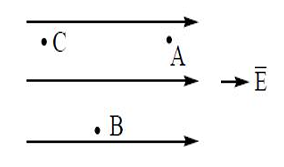 AP EAMCET 2025 Easy