


AP EAMCET · Maths · Three Dimensional Geometry
If the line joining the points \(\hat{\mathbf{i}}+\hat{\mathbf{j}}\) and \(3 \hat{\mathbf{i}}+\hat{\mathbf{j}}-\hat{\mathbf{k}}\) meets the plane that passes through the point \(2 \hat{\mathbf{i}}+4 \hat{\mathbf{j}}\) and parallel to the vectors \(3 \hat{\mathbf{j}}+5 \hat{\mathbf{k}}\) and \(3 \hat{\mathbf{i}}-\hat{\mathbf{k}}\) at, \(P\), then the position vector of the point \(P\) is
- A \(-27 \hat{\mathbf{i}}+\hat{\mathbf{j}}+14 \hat{\mathbf{k}}\)
- B \(29 \hat{\mathbf{i}}+\hat{\mathbf{j}}-14 \hat{\mathbf{k}}\)
- C \(-14 \hat{\mathbf{i}}+89 \hat{\mathbf{j}}+3 \hat{\mathbf{k}}\)
- D \(2 \hat{\mathbf{i}}+5 \hat{\mathbf{j}}-7 \hat{\mathbf{k}}\)
Answer & Solution
Correct Answer
(B) \(29 \hat{\mathbf{i}}+\hat{\mathbf{j}}-14 \hat{\mathbf{k}}\)
Step-by-step Solution
Detailed explanation
Equation of line joining points \((\hat{\mathbf{i}}+\hat{\mathbf{j}})\) and \((3 \hat{\mathbf{i}}+\hat{\mathbf{j}}-\hat{\mathbf{k}})\) in cartesian form is \[ \frac{x-1}{2}=\frac{y-1}{0}=\frac{z}{-1}=r(\text { let }) \] Then, point on line Eq. (i) is \(p(2 r+1,1,-r)\). Now,…
See the Complete Solution
Get step-by-step explanations for this and 2.5 Lakh+ more JEE, NEET & CET questions.
- Unlock all solutions
- Practice the full chapter
- Track accuracy across PYQs
4.8 rated on Google Play · 14,000+ reviews
More questions from Maths
- If \(a=\operatorname{Im}\left(\frac{1+z^2}{2 i z}\right)\) and \(z\) is any non zero complex number such that \(|z|=1\), then
\(a=\)AP EAMCET 2025 Medium - If the median of a \(\triangle A B C\) through \(A\) is perpendicular to \(A C\), then \(\frac{\tan A}{\tan C}=\)AP EAMCET 2018 Easy
- \(\int_0^4 \frac{x+2}{\sqrt{4 x-x^2}} d x=\)AP EAMCET 2022 Medium
- If the points whose position vectors are \(2 \hat{\mathbf{i}}+\hat{\mathbf{j}}+\hat{\mathbf{k}}, 6 \hat{\mathbf{i}}-\hat{\mathbf{j}}+2 \hat{\mathbf{k}}\) and \(14 \hat{\mathbf{i}}-5 \hat{\mathbf{j}}+p \hat{\mathbf{k}}\) are collinear, then the value of \(p\) is
are collinear, then the value of \(p\) isAP EAMCET 2007 Easy - The angle between a line with direction ratios and the line joining the points and isAP EAMCET 2019 Easy
- \(\sum_{k=1}^6\left[\sin \frac{2 k \pi}{7}-i \cos \frac{2 k \pi}{7}\right]\) is equal toAP EAMCET 2015 Medium
More PYQs from AP EAMCET
- If \(S_n=1^3+2^3+\ldots+n^3\) and \(T_n=1+2+\ldots+n\), thenAP EAMCET 2007 Easy
- Benzoic acid molecules undergo dimerisation in benzene. 2.44 g of benzoic acid when dissolved in 30 g of benzene caused depression in freezing point of 2 K. What is the percentage of association of it ?
(Given \(\mathrm{K}_f\left(\mathrm{C}_6 \mathrm{H}_6\right)=5 \mathrm{~K} \mathrm{~kg} \mathrm{~mol}^{-1}\); molar mass of benzoic acid \(=122 \mathrm{~g} \mathrm{~mol}^{-1}\) )AP EAMCET 2025 Medium - In a test a student either guesses or copies or knows the answer to answer a multiple choice question with four choices. The probability that he makes a guess is \(1 / 3\) and the probability that he copies the answer is \(1 / 6\). The probability that his answer is correct, given that he copied it is \(1 / 8\). The probability that he knew the answer to the question, given that he answered it correctly isAP EAMCET 2023 Hard
- The maximum potential energy due to electrostatic repulsion between two hydrogen nucleus is nearly (radius of the nucleus Fermi)AP EAMCET 2018 Medium
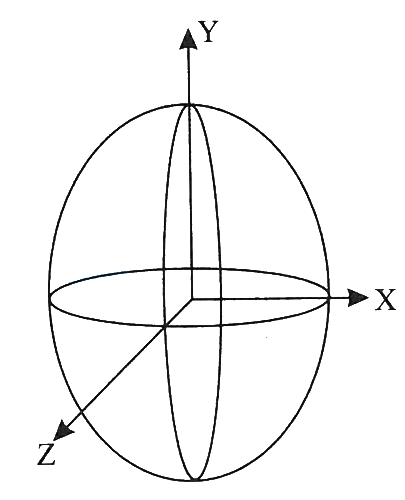
- Three rings, each with equal radius ' \(r\) ' are placed mutually perpendicular to each other and each having centre at the origin of coordinate system. ' I ' is current passing through each ring. The magnetic field value at the common centre is
 AP EAMCET 2024 Medium
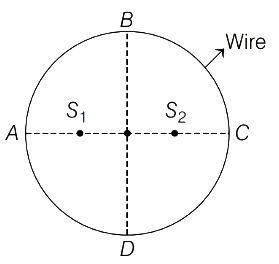
 - Two point sources \(S_1\) and \(S_2\) separated by a distance \(10 \mu \mathrm{m}\) emit light waves of wavelength \(4 \mu \mathrm{m}\) in phase. A circular wire of radius \(40 \mu \mathrm{m}\) is placed around the sources as shown in figure, then ( \(O\) is the centre of the circle and \(O S_1=O S_2\) )
 AP EAMCET 2018 Medium