


AP EAMCET · Maths · Quadratic Equation
If \(\frac{\mathrm{k}}{\mathrm{kx}+3}+\frac{3}{3 \mathrm{x}-\mathrm{k}}=\frac{12 \mathrm{x}+5}{(\mathrm{kx}+3)(3 \mathrm{x}-\mathrm{k})} \forall \mathrm{x} \in \mathrm{R}\)
\(-\left\{\frac{\{3\}}{\mathrm{k}}, \frac{\mathrm{k}}{3}\right\}\), then both the roots of the equation \(\mathrm{kx}^2-7 \mathrm{x}+3=0\) are
- A Rational numbers
- B Irrational numbers
- C Complex numbers
- D Integers
Answer & Solution
Correct Answer
(A) Rational numbers
Step-by-step Solution
Detailed explanation
Given, \[ \begin{aligned} & \frac{k}{(k x+3)}+\frac{3}{(3 x-k)}=\frac{12 x+5}{(k x+3)(3 x-k)} \\ & \Rightarrow k(3 x-k)+3(k x+3)=12 x+5 \\ & \Rightarrow 6 x k-k^2+9=12 x+5 \end{aligned} \] Comparing both side, we get \[ \Rightarrow 6 k=12 \Rightarrow k=2 \] Hence,…
See the Complete Solution
Get step-by-step explanations for this and 2.5 Lakh+ more JEE, NEET & CET questions.
- Unlock all solutions
- Practice the full chapter
- Track accuracy across PYQs
4.8 rated on Google Play · 14,000+ reviews
More questions from Maths
- \[
\begin{aligned}
& \text { If the } \\
& a x^2+2 h x y+b y^2+2 g x+2 f y+c=0
\end{aligned} \text { equation }
\]
represents a pair of straight lines, then the square of the distance of their point of intersection from the origin isAP EAMCET 2013 Medium - Let \(\mathbf{u}\) and \(\mathbf{v}\) be two non-zero vectors. Then the magnitude of the cross product \(\mathbf{u} \times \mathbf{v}\) is alwaysAP EAMCET 2020 Easy
- The ratio in which the plane divides the line joining and isAP EAMCET 2021 Easy
- \(\tan \left(-\frac{23 \pi}{3}\right)-\cot \left(\theta-\frac{13 \pi}{3}\right)=\)AP EAMCET 2020 Medium
- If \(\quad \int \sin ^{-1}\left(\frac{2 x}{1+x^2}\right) d x=f(x)-\log \left(1+x^2\right)\) then \(f(x)\) is equal toAP EAMCET 2005 Medium
- A circle with centre at \((2,4)\) is such that the line \(x+y+2=0\) cuts a chord of length 6 . The radius of the circle isAP EAMCET 2014 Medium
More PYQs from AP EAMCET
- A slab B rests on a frictionless floor as shown in the figure. A block A rests on top of the slab- B. The coefficients of static and kinetic friction between the block A and the slab B are and respectively. When block-A is acted upon by a horizontal force of , as shown, find the resulting acceleration of the slab- B.
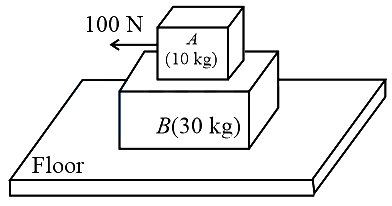 AP EAMCET 2021 Hard
 - The value \((s)\) of \(x\) for which the function
\(f(x)=\left\{\begin{array}{cc}
1-x, & x < 1 \\
(1-x)(2-x), & 1 \leq x \leq 2 \\
3-x, & x>2
\end{array}\right.\)
fails to be continuous is(are)AP EAMCET 2016 Easy - If \(y=\frac{\log x}{x}\), then \(\frac{d^2 y}{d x^2}\) at \(x=1\)AP EAMCET 2022 Medium
- The time required (in hours) to reduce \(3 \mathrm{~mol} \mathrm{of}\) \(\mathrm{Fe}^{3+}\) ions to \(\mathrm{Fe}^{2+}\) ions with 2.0 amperes of current is \(\left(1 \mathrm{~F}=96500 \mathrm{C} \mathrm{mol}^{-1}\right)\)AP EAMCET 2023 Easy
- \(\int \frac{d x}{\sin (x-a) \cos (x-b)}=\)AP EAMCET 2023 Medium
- A circle passes through the point \((3,4)\) and cuts the circle \(x^2+y^2=a^2\) orthogonally; the locus of its centre is a straight line. If the distance of this straight line from the origin is 25 , then \(a^2\) is equal toAP EAMCET 2012 Medium