


AP EAMCET · Maths · Determinants
If \(f(x)=\left|\begin{array}{ccc}x-3 & 2 x^2-18 & 3 x^3-81 \\ x-5 & 2 x^2-50 & 4 x^3-500 \\ 1 & 2 & 3\end{array}\right|\), then \(f(\mathrm{l}) f(3)+f(3) f(5)+f(5) f(\mathrm{l})\) is equal to
- A \(f(1)\)
- B \(f(3)\)
- C \(f(1)+f(3)\)
- D \(f(1)+f(5)\)
Answer & Solution
Correct Answer
(B) \(f(3)\)
Step-by-step Solution
Detailed explanation
\(f(x)=(x-3)(x-5)\left|\begin{array}{ccc}1 & 2(x+3) & 3\left(x^2+9+3 x\right) \\ 1 & 2(x+5) & 4\left(x^2+25+5 x\right) \\ 1 & 2 & 3\end{array}\right|\) \(\Rightarrow \quad f(3)=f(5)=0\) So, \(f(1) f(3)+f(3) \cdot f(5)+f(5) f(1)=0=f(3)\)
See the Complete Solution
Get step-by-step explanations for this and 2.5 Lakh+ more JEE, NEET & CET questions.
- Unlock all solutions
- Practice the full chapter
- Track accuracy across PYQs
4.8 rated on Google Play · 14,000+ reviews
More questions from Maths
- If one root of the cubic equation \(x^3+36=7 x^2\) is double of another, then the number of negative roots areAP EAMCET 2022 Medium
- If \(\int\left(3 t^2 \sin \frac{1}{t}-t \cos \frac{1}{t}\right) d t=f(t) \sin \left(\frac{1}{t}\right)+c\), then \(f(2)=\)AP EAMCET 2025 Medium
- If \(\triangle A B C, \cos A+\cos B+\cos C=\)AP EAMCET 2024 Hard
- AP EAMCET 2022 Hard
- The foci of the ellipse \(9 x^2+25 y^2=225\) areAP EAMCET 2022 Easy
- If \(y=\log _2\left(\log _2 x\right)\), then \(\frac{d y}{d x}=\)AP EAMCET 2018 Easy
More PYQs from AP EAMCET
- Three moles of an ideal monoatomic gas undergoes a cyclic process as shown in the figure. The temperature of the gas in different states marked as 1, 2, 3 and 4 are \(400 \mathrm{~K}, 700 \mathrm{~K}, 2500 \mathrm{~K}\) and \(1100 \mathrm{~K}\) respectively. The work done by the gas during the process 1-2-3-4-1 is (universal gas constant is \(R\) )
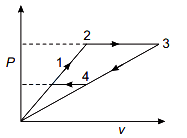 AP EAMCET 2013 Medium
 - When a body moves in a circular path, no work is done by the force, sinceAP EAMCET 2020 Easy
- A metal has work function \(2.5 \mathrm{eV}\). If a radiation of frequency \(32 \times 10^{15} \mathrm{~Hz}\) is incident on this metal surface, then the maximum kinetic energy of ejected photoelectrons is (Planck's constant, \(h=6.6 \times 10^{-34} \mathrm{~J}-\mathrm{s}\) )AP EAMCET 2022 Easy
- The conjugate base of phosphorus acid is \(x\). The conjugate base of oleum is \(y\). What are \(x\) and \(y\), respectively?AP EAMCET 2025 Medium
- In any \(\triangle A B C, b^2 \sin 2 C+c^2 \sin B\) is equal toAP EAMCET 2021 Medium
- If AgCl is doped with \(1 \times 10^{-4}\) mole percent of \(\mathrm{CdCl}_2\), the number of cation vacancies ( \(\mathrm{in}\) \(\mathrm{mol}^{-1}\) ) isAP EAMCET 2025 Medium