


AP EAMCET · Maths · Quadratic Equation
If \(\alpha, \beta\) are the roots of the equation \(x^2-2 x+4=0\) and for any \(n \in \mathrm{N}, \alpha^n+\beta^n=k \cos \frac{n \pi}{3}\) then \(k=\)
- A \(2^n\)
- B \(2^{n+1}\)
- C \(2^n-1\)
- D \(2^n+1\)
Answer & Solution
Correct Answer
(B) \(2^{n+1}\)
Step-by-step Solution
Detailed explanation
\(x = \frac{2 \pm \sqrt{(-2)^2 - 4(1)(4)}}{2} = \frac{2 \pm \sqrt{-12}}{2} = 1 \pm i\sqrt{3}\) \(\alpha = 1 + i\sqrt{3} = 2 \left(\cos \frac{\pi}{3} + i \sin \frac{\pi}{3}\right)\)…
See the Complete Solution
Get step-by-step explanations for this and 2.5 Lakh+ more JEE, NEET & CET questions.
- Unlock all solutions
- Practice the full chapter
- Track accuracy across PYQs
4.8 rated on Google Play · 14,000+ reviews
More questions from Maths
- A line segment \(A M=a\) moves in the \(X O Y\) plane such that \(A M\) is parallel to the \(X\)-axis. If \(A\) moves along the circle \(x^2+y^2=a^2\), then the locus of \(M\) isAP EAMCET 2011 Medium
- The general solution of \(\cot \frac{x}{2}-\cot x=\operatorname{cosec} \frac{x}{2}\) isAP EAMCET 2024 Medium
- \[
\int_{-4 \pi}^{4 \pi} \tan ^9 x \sin ^6 x \cos ^3 x d x=
\]AP EAMCET 2023 Easy - \(\lim _{x \rightarrow \infty} \frac{(3-x)^{25}(6+x)^{35}}{(12+x)^{38}(9-x)^{22}}=\)AP EAMCET 2025 Medium
- From a point \(\mathrm{P}(-4,0)\), two tangents are drawn to the circle \(x^2+y^2-4 x-6 y-12=0\) touching the circle at \(A\) and \(B\). If the equation of the circle passing through \(P, A\) and \(B\) is \(x^2+y^2+2 g x+2 f y+c=0\), then \((g, f)=\)AP EAMCET 2025 Medium
- A line has slope and -intercept 4. The distance between the origin and the line is equal toAP EAMCET 2021 Easy
More PYQs from AP EAMCET
- Which of the following statement is not correct?AP EAMCET 2022 Easy
- For the circle \(C\) with the equation \(x^2+y^2-16 x-12 y+64=0\) match the List I with the List II given below.
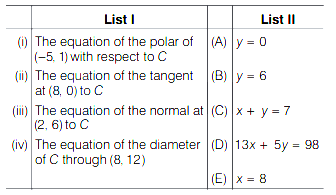
The correct match is
\(\begin{array}{llll}(\mathrm{i}) & (\mathrm{ii}) & (\mathrm{iii}) & (\mathrm{iv})\end{array}\)AP EAMCET 2013 Medium - An organic compound of molecular formula has six carbon atoms in a ring system, two non-conjugate double bonds and two bromo groups at positions. Then the compound isAP EAMCET 2021 Easy
- 0.1 mole of potassium permanganate was heated at \(300^{\circ} \mathrm{C}\). What is the weight (ing) of the residue?
\((\mathrm{Mn}=55 \mathrm{u} ; \mathrm{K}=39 \mathrm{u} ; \mathrm{O}=16 \mathrm{u})\)AP EAMCET 2024 Medium - A current \(I=10 \mathrm{~A}\) is passed through the part of a circuit shown in the figure. What will be the potential difference between \(A\) and \(B\) when \(I\) is decreased at constant rate of \(10^2 \mathrm{As}^{-1}\) at the beginning ?
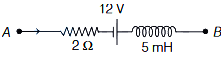 AP EAMCET 2020 Hard
 - How many ' \(\mathrm{mL}\) ' of perhydrol is required to produce sufficient oxygen which can be used to completely convert \(2 \mathrm{~L}\) of \(\mathrm{SO}_2\) gas to \(\mathrm{SO}_3\) gas?AP EAMCET 2009 Easy