


AP EAMCET · Maths · Application of Derivatives
If an open cylinder of given surface area has maximum volume, then its radius is
- A Height of the cylinder
- B Height of the cylinder/2
- C 2 times height of the cylinder
- D 3 times height of the cylinder
Answer & Solution
Correct Answer
(A) Height of the cylinder
Step-by-step Solution
Detailed explanation
Cylinder is open, radius of base \(=R\), height \(=H\) Surface area \(A=2 \pi R H+\pi R^2\)…
See the Complete Solution
Get step-by-step explanations for this and 2.5 Lakh+ more JEE, NEET & CET questions.
- Unlock all solutions
- Practice the full chapter
- Track accuracy across PYQs
4.8 rated on Google Play · 14,000+ reviews
More questions from Maths
- If \(y=A t^2+\frac{B}{t}\) (A,B are parameters) is general solution of the differential equation \(f(t) y^{\prime \prime}(t)+g(t) y^{\prime}(t)+h(t) y=0\) then \(2 f(t)+t^2 h(t)=\)AP EAMCET 2025 Hard
- For any natural number \(n,\left(15 \times 5^{2 n}\right)+\left(2 \times 2^{3 n}\right)\) is divisible byAP EAMCET 2018 Easy
- \(\lim _{x \rightarrow \frac{\pi}{2}} \frac{1-\tan \frac{x}{2}}{1+\tan \frac{x}{2}} \cdot \frac{1-\sin x}{(\pi-2 x)^3}=\)AP EAMCET 2022 Medium
- The equation of the circle passing through \((0,0)\) and which makes intercepts \(a\) and \(b\) on the coordinate axes isAP EAMCET 2020 Easy
- The equation of the circle of radius 5 and touching the co-ordinate axes in third quadrant isAP EAMCET 2002 Easy
- The sum of the fourth powers of the roots of the equation \(x^3+x+1=0\) isAP EAMCET 2008 Medium
More PYQs from AP EAMCET
- Let \(\theta\) be the angle between the circles \(S \equiv x^2+y^2+2 x-2 y+c=0\) and \(S^1 \equiv x^2+y^2-6 x-8 y+9=0\). If \(c\) is an integer and \(\cos \theta=\frac{5}{16}\) then the radius of the circle \(\mathrm{S}=0\) isAP EAMCET 2025 Medium
- A system goes from to via two processes and shown in the figure. If and are the changes in internal energies in the processes I and Il respectively
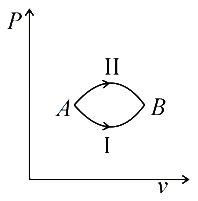 AP EAMCET 2020 Easy
 - In \(\triangle \mathrm{ABC}\), if \(\cos \mathrm{A} \cdot \cos \mathrm{B} \cdot \cos \mathrm{C}=\frac{1}{5}\), then \(\tan \mathrm{A} \tan \mathrm{B}+\) \(\tan \mathrm{B} \tan \mathrm{C}+\tan \mathrm{C} \tan \mathrm{A}=\)AP EAMCET 2023 Medium
- Calculate the number of protons, neutrons and electrons in \({ }_{16}^{32} \mathrm{~S}^{2-}\).AP EAMCET 2020 Easy
- In which of the following the electron gain enthalpy of elements is correctly arranged?AP EAMCET 2019 Easy
- Which reaction(s) among the following produce dinitrogen?
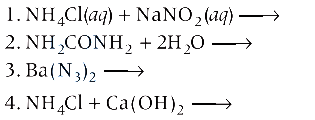 AP EAMCET 2021 Medium