


AP EAMCET · Maths · Probability
If \(\mathrm{A}, \mathrm{B}\) and \(\mathrm{C}\) are three events of a random experiment with \(\mathrm{P}(\mathrm{A})=0.4, \mathrm{P}(\mathrm{B})=0.3\) and \(\mathrm{P}(\mathrm{A} \cap \mathrm{B})=0.2\), then the probability that neither A nor B occurs is
- A \(0.5\)
- B \(0.15\)
- C \(0.13\)
- D \(0.12\)
Answer & Solution
Correct Answer
(A) \(0.5\)
Step-by-step Solution
Detailed explanation
Given, \(\mathrm{P}(\mathrm{A})=0.4, \mathrm{P}(\mathrm{B})=0.3\) \(\begin{aligned} & P(A \cap B)=0.2 \\ & \text { Now, } P(A \cup B)=P(A)+P(B)-P(A \cap B) \\ & \Rightarrow P(A \cup B)=0.4+0.3-0.2=0.5 \end{aligned}\) Since, probability of neither A nor B occurs…
See the Complete Solution
Get step-by-step explanations for this and 2.5 Lakh+ more JEE, NEET & CET questions.
- Unlock all solutions
- Practice the full chapter
- Track accuracy across PYQs
4.8 rated on Google Play · 14,000+ reviews
More questions from Maths
- The distribution of a random variable \(X\) is given below
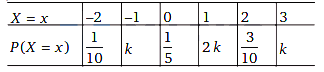
The value of \(k\) isAP EAMCET 2008 Medium - The coefficient of \(x^5\) in \(\left(3+x+x^2\right)^6\) isAP EAMCET 2024 Easy
- Let \(\vec{a}=\hat{i}+\hat{j}+\hat{k}, \vec{b}=\hat{i}+\hat{j}-2 \hat{k}, \vec{c}=\hat{i}-2 \hat{j}+3 \hat{k}\) and \(\overrightarrow{\mathrm{d}}=-4 \hat{\mathrm{i}}+5 \hat{\mathrm{j}}-3 \hat{\mathrm{k}}, \overrightarrow{\mathrm{d}}=x(\overrightarrow{\mathrm{b}} \times \overrightarrow{\mathrm{c}})-\frac{7}{9}(\overrightarrow{\mathrm{c}} \times \overrightarrow{\mathrm{a}})+\mathrm{z}(\overrightarrow{\mathrm{a}} \times \overrightarrow{\mathrm{b}})\), then \(x=\)AP EAMCET 2023 Easy
- In an entrance test there are multiple choice questions. There are four possible answers to each question, of which one is correct. The probability that a student know the answer to a question is \(9 / 10\). If he gets the correct answer to a question, then the probability that he was guessing isAP EAMCET 2012 Medium
- Let \(\mathrm{A}=(2,0,-1), \mathrm{B}=(1,-2,0), \mathrm{C}=(1,2,-1)\) and \(\mathrm{D}=(0,-1,-2)\) be four points. If \(\theta\) is the acute angle between the plane determined by \(A, B, C\) and the plane determined by \(\mathrm{A}, \mathrm{C}, \mathrm{D}\), then \(\tan \theta=\)AP EAMCET 2025 Medium
- The equation of a circle passing through the point \((2,8)\), touching the lines \(4 x-3 y-24=0\) and \(4 x+3 y-42=0\) and having the \(x\) coordinate of its centre less than or equal to 8 isAP EAMCET 2019 Medium
More PYQs from AP EAMCET
- The capacitance of a spherical capacitor is 100 pF. If the spacing between the two spheres is 1 cm, then the radius of the inner sphere of the capacitor isAP EAMCET 2025 Medium
- If \(f(t)=\int_{-t}^t \frac{e^{-|x|}}{2} d x\), then \(\lim _{t \rightarrow \infty} f(t)\) is equalAP EAMCET 2007 Easy
- If is such that for all and thenAP EAMCET 2018 Easy
- \(\int_0^{\frac{\pi}{2}} \frac{\cos x d x}{\sqrt{1+\cos x \sin x}}=\)AP EAMCET 2018 Medium
- Choose the correct option regarding the following.
Assertion Actinides exhibit a larger number of oxidation states than lanthanides.
Reason There is a large energy gap between \(5 f, 6 d\) and \(7 s\) sub-shells.AP EAMCET 2020 Easy - A prism \((\mu=1.5)\) has the refracting angle of \(30^{\circ}\). The deviation of a monochromatic ray incident normally on its one surface will be (given, \(\sin 48^{\circ} 36^{\prime}=0.75\))AP EAMCET 2020 Medium