


AP EAMCET · Maths · Straight Lines
For any value of \(\theta\), if the straight lines \(x \sin \theta+(1-\cos \theta) y=a \sin \theta\) and \(x \sin \theta-(1+\cos \theta) y+a \sin \theta=0\) intersect at \(P(\theta)\), then the locus of \(P(\theta)\) is a
- A straight line
- B circle
- C parabola
- D hyperbola
Answer & Solution
Correct Answer
(B) circle
Step-by-step Solution
Detailed explanation
Given, equations of straight lines are \(x \sin \theta+(1-\cos \theta) y=a \sin \theta\) ...(i) and \(x \sin \theta-(1+\cos \theta) y=-a \sin \theta\) Subtracting Eq. (ii) from Eq. (i), we get…
See the Complete Solution
Get step-by-step explanations for this and 2.5 Lakh+ more JEE, NEET & CET questions.
- Unlock all solutions
- Practice the full chapter
- Track accuracy across PYQs
4.8 rated on Google Play · 14,000+ reviews
More questions from Maths
- The locus of a point which is at a distance of units from in -plane isAP EAMCET 2021 Medium
- If the function \(f:[-1,1] \rightarrow R\) defined by \(f(x)=\left\{\begin{array}{cc}2^x+1, & \text { for } x \in[-1,0) \\ 1, & \text { for } x=0 \\ 2^x-1, & \text { for } x \in(0,1]\end{array}\right.\) then, in \([-1,1], f(x)\) hasAP EAMCET 2019 Medium
- The parabola with focus at \((4,-3)\) and vertex at \((4,-1)\) isAP EAMCET 2022 Easy
- If \(\tan \mathrm{h}^{-1}(x+i y)=\frac{1}{2} \tan \mathrm{h}^{-1}\left(\frac{2 x}{1+x^2+y^2}\right)+\frac{i}{2} \tan ^{-1}\left(\frac{2 y}{1-x^2-y^2}\right)\), where \(x, y \in \mathbf{R}\), then \(\tan \mathrm{h}^{-1}(i y)=\)AP EAMCET 2020 Hard
- If the equations \(2 a x^2-3 b x+4 c=0\) and \(3 x^2-4 x+5=0\) have a common root, then \(\frac{a+b}{b+c}\) is equal to \((a, b, c \in \boldsymbol{R})\)AP EAMCET 2020 Easy
- A variable plane passes through a fixed point \((1,2,3)\). Then, the foot of the perpendicular from the origin to the plane lies onAP EAMCET 2013 Easy
More PYQs from AP EAMCET
- \(\int_0^2 x^8\left(\frac{4}{x^2}-1\right)^{5 / 2} d x=\)AP EAMCET 2025 Medium
- If \(x=a\left\{\cos \theta+\log \tan \left(\frac{\theta}{2}\right)\right\}\) and \(y=a \sin \theta\), then \(\frac{d y}{d x}\) is equal toAP EAMCET 2008 Medium
- A uniform metal wire carries a current of \(2 \mathrm{~A}\) when an ideal cell of \(3.4 \mathrm{~V}\) is connected across it. The wire has mass \(8.92 \times 10^{-3} \mathrm{~kg}\), density \(8.92 \times 10^3 \mathrm{kgm}^{-3}\) and resistivity \(1.7 \times 10^{-8} \Omega \mathrm{m}\). Then the length of the wire isAP EAMCET 2023 Medium
- The output current versus time curve of a rectifier is shown in the figure. The average value of output current in this case is
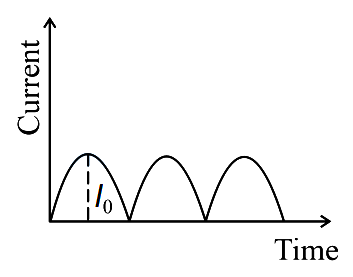 AP EAMCET 2021 Medium
 - \(\triangle A B C\), if \(a, b, c\) are its sides and \(\angle C=60^{\circ}\), find the value of \(\frac{a}{b+c}+\frac{b}{c+a}\)AP EAMCET 2020 Medium
- Correct order of basic strength of metallic hydroxidesAP EAMCET 2023 Medium