


AP EAMCET · Chemistry · Aldehydes and Ketones
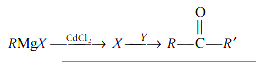
\(X\) and \(Y\) in the following reaction sequence are
- A \(R \mathrm{CdCl}\) & \(R^{\prime} \mathrm{COCl}\)
- B \(R_2 \mathrm{Cd}\) & \(\left(R^{\prime} \mathrm{CO}\right)_2\)
- C \(R_2 \mathrm{Cd}\) & \(R^{\prime} \mathrm{COCl}\)
- D \(R_2 \mathrm{MgCdCl}_2\) & \(R \mathrm{COO} R^{\prime}\)
Answer & Solution
Correct Answer
(C) \(R_2 \mathrm{Cd}\) & \(R^{\prime} \mathrm{COCl}\)
Step-by-step Solution
Detailed explanation
Reaction of Grignard reagent with \(\mathrm{CdCl}_2\) gives an organocadmium compound which yield a ketone when treated with an acid chloride.
See the Complete Solution
Get step-by-step explanations for this and 2.5 Lakh+ more JEE, NEET & CET questions.
- Unlock all solutions
- Practice the full chapter
- Track accuracy across PYQs
4.8 rated on Google Play · 14,000+ reviews
More questions from Chemistry
- \(8 \mathrm{~g}\) of a metal reacted with oxygen to form \(9 \mathrm{~g}\) of its oxide. What is the weight (in \(\mathrm{g}\) ) of the metal required to react with \(8 \mathrm{~g}\) of hydrogen? \((\mathrm{H}=1.0)\)AP EAMCET 2017 Easy
- A mixture of three compounds \(A, B, C\) is passed through a column of \(\mathrm{Al}_2 \mathrm{O}_3\) by using alcohol as eluant. The order in which they are eluted out of the column is \(C, B, A\). Which of the following statement is true?AP EAMCET 2020 Easy
- Which of the following statements are correct?
i. \(\left[\mathrm{Mn}(\mathrm{CN})_6\right]^{3-},\left[\mathrm{MnCl}_6\right]^{3-}\) both are paramagnetic
ii. Both \(\left[\mathrm{NiCl}_4\right]^{2-},\left[\mathrm{Ni}(\mathrm{CO})_4\right]\) are tetrahedral and diamagnetic
iii. \(\left[\mathrm{Co}\left(\mathrm{NH}_3\right)_6\right]^{3+}\) is inner orbital complex, but \(\left[\mathrm{Ni}\left(\mathrm{NH}_3\right)_6\right]^{2+}\) is outer orbital complexAP EAMCET 2023 Medium - If \(\Delta \mathrm{G}\) and \(\Delta \mathrm{S}\) for the reaction \(\mathrm{A}(\mathrm{g}) \rightarrow \mathrm{B}(\mathrm{g})+2 \mathrm{C}(\mathrm{g})\) at \(2000 \mathrm{~K}\) are \(-40 \mathrm{~kJ} \mathrm{~mol}^{-1}\) and \(0.22 \mathrm{~kJ} \mathrm{~K}^{-1} \mathrm{~mol}^{-1}\) respectively, the change in internal energy for the same reaction approximately (in \(\mathrm{kJ} \mathrm{mol}^{-1}\) ) isAP EAMCET 2023 Medium
- Calcium carbide \(+\mathrm{D}_2 \mathrm{O} \longrightarrow \underline{X}+\mathrm{Ca}(\mathrm{OD})_2\).
The hybridisation of carbon atom(s) in \(X\)AP EAMCET 2022 Medium - What are X and Y in the following reaction sequence ?
\(\mathrm{C}_6 \mathrm{H}_5 \mathrm{~N}_2^{+} \mathrm{Cl}^{-} \xrightarrow{\mathrm{X}} \mathrm{C}_6 \mathrm{H}_5 \mathrm{CN} \xrightarrow[\text { (ii) } \mathrm{H}_2 \mathrm{O}]{\text { (i) } \mathrm{CH}_3 \mathrm{MgBr}} \mathrm{Y}\)AP EAMCET 2025 Medium
More PYQs from AP EAMCET
- The lines represented by the equation \(x^2-y^2-x+3 y-2=0\) are :AP EAMCET 2006 Medium
- If \(\int \frac{d x}{\cos ^4 x+\sin ^4 x}=\frac{1}{\sqrt{2}} \tan ^{-1}[g(x)]+C\), then \(g(x)\) equalsAP EAMCET 2021 Medium
- The least positive integer greater than 1 that divides \(49^n+16 n-1\) for all positive integers \(n\) isAP EAMCET 2017 Hard
- The plane of a dip circle is set in the geographic meridian and the apparent dip is \(\delta_1\). It is then set in a vertical plane perpendicular to the geographic meridian. The apparent dip angle is \(\delta_2\). The declination \(\theta\) at the place isAP EAMCET 2020 Hard
- If \(x\) is a cube root of unity other than 1 , then \(\left(x+\frac{1}{x}\right)^2+\left(x^2+\frac{1}{x^2}\right)^2+\ldots+\left(x^{12}+\frac{1}{x^{12}}\right)^2=\)AP EAMCET 2019 Easy
- If the mid-points of the sides \(B C, C A\) and \(A B\) of a triangle \(A B C\), are respectively \((2,1)\), \((-1,-2)\) and \((3,3)\), then the equation of the side \(B C\) isAP EAMCET 2019 Easy