


AP EAMCET · Chemistry · Coordination Compounds
Which of the following complex ion shows geometrical isomerism?
- A \(\left[\mathrm{Cr}\left(\mathrm{H}_2 \mathrm{O}\right)_4 \mathrm{Cl}_2\right]^{+}\)
- B \(\left[\mathrm{Pt}\left(\mathrm{NH}_3\right)_3 \mathrm{Cl}\right]^{+}\)
- C \(\left[\mathrm{Co}\left(\mathrm{NH}_3\right)_6\right]^{3+}\)
- D \(\left[\mathrm{Co}(\mathrm{CN})_5(\mathrm{NC})\right]^{3-}\)
Answer & Solution
Correct Answer
(A) \(\left[\mathrm{Cr}\left(\mathrm{H}_2 \mathrm{O}\right)_4 \mathrm{Cl}_2\right]^{+}\)
Step-by-step Solution
Detailed explanation
\(\left[\mathrm{Cr}\left(\mathrm{H}_2 \mathrm{O}\right)_4 \mathrm{Cl}_2\right]^{+}\)shows geometrical isomerism. It is complex compounds of \(\left[M a_4 b_2\right]\) type.…
See the Complete Solution
Get step-by-step explanations for this and 2.5 Lakh+ more JEE, NEET & CET questions.
- Unlock all solutions
- Practice the full chapter
- Track accuracy across PYQs
4.8 rated on Google Play · 14,000+ reviews
More questions from Chemistry
- Which of the following molecules can be represented as \(A B_2 E_2\), where \(A\)-central atom, \(B\)-bond pairs of electrons, \(E\)-lone pairs of electrons?AP EAMCET 2020 Easy
- Calculate the density of an aqueous solution of KI, if its molarity and molality are \(1.44 \mathrm{M}\) and \(1.5 \mathrm{~mol} \mathrm{~kg}^{-1}\) respectively.AP EAMCET 2020 Medium
- Among the ions \(\mathrm{O}^{2-}, \mathrm{Na}^{+}, \mathrm{F}^{-}, \mathrm{N}^{3-}, \mathrm{Mg}^{2+}\) the ions with smallest and largest radii are respectivelyAP EAMCET 2022 Easy
- Which of the following types of isomerism is exhibited by
\[
\left[\mathrm{Co}\left(\mathrm{NH}_3\right)_5\left(\mathrm{NO}_2\right)\right]\left(\mathrm{NO}_3\right)_2
\]
i. Optical ii. Linkage iii. Ionization
iv. CoordinationAP EAMCET 2023 Medium - The oxides of nitrogen obtained by the reaction of nitric acid with
(i) \(\mathrm{P}_4 \mathrm{O}_{10}\), (ii) \(\mathrm{P}_4\) respectively areAP EAMCET 2025 Medium - What is the concentration (in \(\mathrm{mol} \mathrm{L}^{-1}\) ) of the product after \(20 \mathrm{~s}\) in the following reaction. Given that \(A \longrightarrow 3 B\), rate \(=k[\mathrm{~A}]^0\)
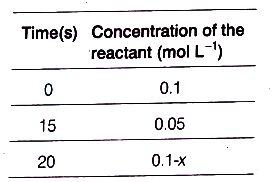 AP EAMCET 2022 Easy
More PYQs from AP EAMCET
- If and satisfies , then at isAP EAMCET 2022 Medium
- Effective nuclear charge is maximum in case ofAP EAMCET 2021 Easy
- A wheel which is initially at rest is subjected to a constant angular acceleration about its axis. It rotates through an angle of \(15^{\circ}\) in time \(t\) sec. The increase in angle through which it rotates in the next \(2 t \mathrm{sec}\) isAP EAMCET 2014 Medium
- The locus of the centre of the circle, which cuts the circle \(x^2+y^2-20 x+4=0\) orthogonally and touches the line \(x=2\), isAP EAMCET 2014 Medium
- A particle is moving along a line according to the law \(S=t^3-3 t^2+4 t-2\) where \(\mathrm{S}\) is measured in metres and \(t\) is measured in seconds. Then the velocity (in \(\mathrm{mt} / \mathrm{sec}\) ) of the particle when its acceleration is zero isAP EAMCET 2017 Medium
- If \(\operatorname{Tan}^{-1}\left[\frac{1}{1+2}\right]+\operatorname{Tan}^{-1}\left[\frac{1}{1+(2)(3)}\right]+\operatorname{Tan}^{-1}\left[\frac{1}{1+(3)(4)}\right]+\cdots \cdots+\operatorname{Tan}^{-1}\left[\frac{1}{1+n(n+1)}\right]=\operatorname{Tan}^{-1} \theta\), then \(\theta=\)AP EAMCET 2020 Medium