


AP EAMCET · Chemistry · Chemical Kinetics
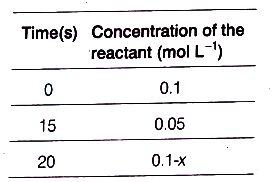
What is the concentration (in \(\mathrm{mol} \mathrm{L}^{-1}\) ) of the product after \(20 \mathrm{~s}\) in the following reaction. Given that \(A \longrightarrow 3 B\), rate \(=k[\mathrm{~A}]^0\)
- A \(6.6 \times 10^{-2}\)
- B \(1.32 \times 10^{-1}\)
- C \(1.98 \times 10^{-1}\)
- D \(2.2 \times 10^{-2}\)
Answer & Solution
Correct Answer
(C) \(1.98 \times 10^{-1}\)
Step-by-step Solution
Detailed explanation
For the zero order reaction, \(A \longrightarrow 3 B\) the half-life is given by the formula \(t_{1 / 2}=A_0 / 2 k\) where, \(A_0\) is the initial concentration and \(k\) is the rate constant. After \(15 \mathrm{~s}\) the concentration of…
See the Complete Solution
Get step-by-step explanations for this and 2.5 Lakh+ more JEE, NEET & CET questions.
- Unlock all solutions
- Practice the full chapter
- Track accuracy across PYQs
4.8 rated on Google Play · 14,000+ reviews
More questions from Chemistry
- Which of the following statements are correct for classification of elements?
I. The properties of elements are periodic functions of their atomic numbers.
II. Non-metallic elements are less in number than the metallic elements.
III. The first ionisation energies of elements along a period do not vary in a regular manner.
IV. The ground state electronic configuration of \(\mathrm{Pd}(Z=46)\) is \([\mathrm{Kr}] 4 d^8 5 s^2\).AP EAMCET 2019 Easy - From the following, identify the reactions which are responsible for depletion of ozone layer.
\(\begin{aligned}
& \mathrm{Cl} \dot{\mathrm{O}}(g)+\mathrm{NO}_2(g) \rightarrow \mathrm{ClONO}_2(g) \\
& \mathrm{CF}_2 \mathrm{Cl}_2(g) \xrightarrow{\text { uv }} \mathrm{Cl}(g)+\dot{\mathrm{CF}}_2 \mathrm{Cl}(g) \\
& \dot{\mathrm{Cl}}(g)+\mathrm{CH}_4(g) \rightarrow \mathrm{HCl}(g)+\dot{\mathrm{C}} \mathrm{H}_3(g) \\
& \dot{\mathrm{C}} \mathrm{l}(\mathrm{g})+\mathrm{O}_3(g) \rightarrow \mathrm{Cl} \dot{\mathrm{O}}(g)+\mathrm{O}_2(g) \\
& \mathrm{Cl} \dot{\mathrm{O}}(g)+\mathrm{O}(g) \rightarrow \dot{\mathrm{C}} \mathrm{l}(g)+\mathrm{O}_2(g)
\end{aligned}\)AP EAMCET 2017 Easy - Manganese dioxide on heating with concentrated hydrochloric acid gives a greenish yellow gas, X. With excess of ammonia \(\mathrm{X}\) gives \(\mathrm{Y}\) and \(\mathrm{Z}\). \(\mathrm{Y}\) and \(\mathrm{Z}\) respectively areAP EAMCET 2023 Medium
- How many of the following polymers given, come under the category of condensation polymers? Bakelite, Teflon, Nylon-6, Dacron, Polyisoprene, Melamine, NeopreneAP EAMCET 2019 Easy
-

This reaction is known asAP EAMCET 2016 Medium - Assertion (A) The aggregate of carboxylate ions of fatty acids form a spherical shape.
Reason (R) Soap helps in emulsification and washing away of oils.AP EAMCET 2022 Medium
More PYQs from AP EAMCET
- Let If is independent of , then the relation between and isAP EAMCET 2019 Medium
- If the sum of the roots of the quadratic equations is 1 and sum of the squares of the roots is 13 , then find that equation.AP EAMCET 2020 Easy
- Observe the following reaction
\(\begin{aligned} & \text { a } \mathrm{P}_4(\mathrm{~s})+\mathrm{b}^{-} \mathrm{OH}(\mathrm{aq})+\mathrm{H}_2 \mathrm{O}(\mathrm{l}) \rightarrow \\ & \qquad \mathrm{cPH}_3(\mathrm{~g})+\mathrm{dH}_2 \mathrm{PO}_2^{-}(\mathrm{aq})\end{aligned}\)
\(\mathrm{a}, \mathrm{b}, \mathrm{c}\) and \(\mathrm{d}\) are respectivelyAP EAMCET 2023 Medium - If \(f(x)= \begin{cases}\frac{\sin (1+[x])}{[x]}, & \text { for }[x] \neq 0 \\ 0, & \text { for }[x]=0\end{cases}\)
where \([x]\) denotes the greatest integer not exceeding \(x\), then \(\lim _{x \rightarrow 0^{-}} f(x)\) is equal toAP EAMCET 2007 Medium - \(\int \frac{d x}{(x-1) \sqrt{x^2-1}}\) is equal toAP EAMCET 2015 Medium
- The radius of the circle which cuts the circles \(x^2+y^2-4 x\) \(-4 y+7=0, x^2+y^2+4 x-4 y+6=0\) and \(x^2+y^2+4 x+\) \(4 y+5=0\) orthogonally isAP EAMCET 2024 Medium