


AP EAMCET · Chemistry · Thermodynamics (C)
Which of the following are extensive properties?

- A \(A, B, C\) and \(E\)
- B \(A, B\) and \(D\)
- C A, B, C only
- D \(D\) and \(E\) only
Answer & Solution
Correct Answer
(C) A, B, C only
Step-by-step Solution
Detailed explanation
An extensive property is a property that depends on the amount of matter in a sample. Heat capacity, entropy and Gibbs' energy are the extensive properties in thermodynamics.
See the Complete Solution
Get step-by-step explanations for this and 2.5 Lakh+ more JEE, NEET & CET questions.
- Unlock all solutions
- Practice the full chapter
- Track accuracy across PYQs
4.8 rated on Google Play · 14,000+ reviews
More questions from Chemistry
- \(\mathrm{SiCl}_4\) on hydrolysis forms ' \(X\) ' and \(\mathrm{HCl}\). Compound ' \(X\) ' loses water at \(1000^{\circ} \mathrm{C}\) and gives ' \(Y\) '. Compounds ' \(X\) ' and ' \(Y\) ' respectively areAP EAMCET 2009 Medium
- The solubility ' \(\mathrm{S}\) ' of \(\mathrm{Zr}_3\left(\mathrm{PO}_4\right)_4\) in terms of its solubility product, \(\mathrm{K}_{\mathrm{sp}}\) isAP EAMCET 2017 Medium
- Which sol is used as intramuscular injection?AP EAMCET 2024 Medium
- The oxidation number of an element in a compound is evaluated on the basis of certain rules. Which of the following rules is not correct?
1. The oxidation number of hydrogen is always +1.
2. The algebraic sum of all the oxidation numbers of all elements in a compound is zero.
3. An element in the free or the uncombined state bears oxidation number zero.
4. In all its compounds, the oxidation number of fluorine is -1.AP EAMCET 2020 Easy - Which of the following is an example of interstitial hydride?AP EAMCET 2007 Easy
- (i) \(\mathrm{H}_3 \mathrm{PO}_4(a q) \rightleftharpoons \mathrm{H}^{+}(a q)+\mathrm{H}_2 \mathrm{PO}_4^{-}(a q)\)
(ii) \(\mathrm{H}_2 \mathrm{PO}_4^{-}(a q) \rightleftharpoons \mathrm{H}^{+}(a q)+\mathrm{HPO}_4^{2-}(a q)\)
(iii) \(\mathrm{HPO}_4^{2-}(a q) \rightleftharpoons \mathrm{H}^{+}(a q)+\mathrm{PO}_4^{3-}(a q)\)
The equilibrium constants for the above reactions at a certain temperature are \(K_1, K_2\) and \(K_3\) respectively. The equilibrium constant for the reaction \(\mathrm{H}_3 \mathrm{PO}_4(a q) \rightleftharpoons 3 \mathrm{H}^{+}(a q)+\mathrm{PO}_4^{3-}(a q)\) in terms of \(K_1, K_2\) and \(K_3\) isAP EAMCET 2017 Medium
More PYQs from AP EAMCET
- Consider a circular ring of radius \(1,4 \mathrm{~cm}\) lying on the surface of a liquid. If a vertical force of \(0.022 \mathrm{~N}\) greater than the weight of the ring is required to lift this ring from the liquid surface, then the surface tension of the liquid isAP EAMCET 2022 Medium
- p-Chlorotoluene is the major product in which of the following reactions ?
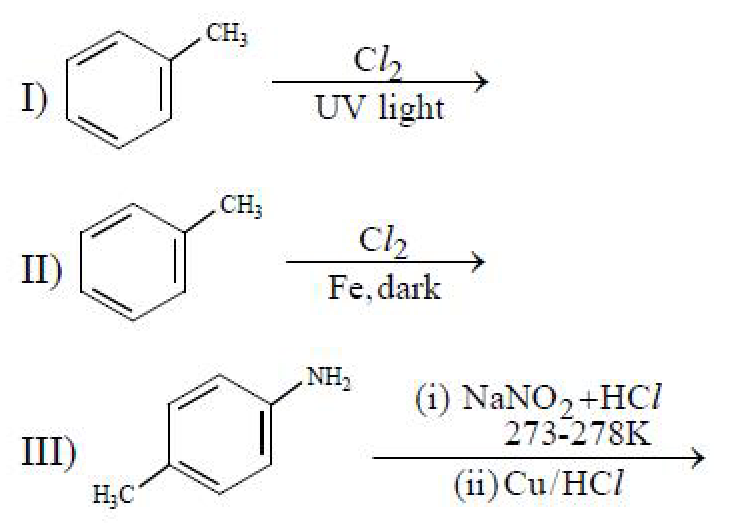 AP EAMCET 2025 Medium
 - Let the equation \(\mathrm{ax}^2+2 \mathrm{hxy}+\mathrm{by}^2+2 \mathrm{gx}+2 \mathrm{fy}+\mathrm{c}=0\) represent a point circle other than the origin. Then which one of the following conditions must hold?AP EAMCET 2023 Easy
- The centre of the circle that passes through the point \((0,1)\) and touches the curve \(y=x^2\) at \((2,4)\) isAP EAMCET 2022 Medium
- The coefficient of \(x^{10}\) in the expansion of \(\left(x+\frac{2}{x}-5\right)^{12}\) isAP EAMCET 2025 Medium
- \(\Delta W=0\), for the processAP EAMCET 2021 Easy