


AP EAMCET · Chemistry · Structure of Atom
The formula for calculating 'spin only' magnetic moment is
- A \(n(n+2)\)
- B \(\sqrt{n(n-2)}\)
- C \(\sqrt{n(n+2)}\)
- D \(n(n-2)\)
Answer & Solution
Correct Answer
(C) \(\sqrt{n(n+2)}\)
Step-by-step Solution
Detailed explanation
The formula used to calculate the spin only magnetic moment can be written in two forms, the first based on the number of unpaired electrons \(n\) and the second based on the total electron spin quantum number \(s\). Since, for each unpaired electron, \(n=1\) and…
See the Complete Solution
Get step-by-step explanations for this and 2.5 Lakh+ more JEE, NEET & CET questions.
- Unlock all solutions
- Practice the full chapter
- Track accuracy across PYQs
4.8 rated on Google Play · 14,000+ reviews
More questions from Chemistry
- \(\mathrm{a}, \mathrm{b}, \mathrm{c}, \mathrm{d}\) are electromagnetic radiations. Frequencies of \(\mathrm{a}, \mathrm{b}\) are \(3 \times 10^{15} \mathrm{~Hz}\), \(2 \times 10^{14} \mathrm{~Hz}\), respectively, whereas wavelength of c, d are \(400 \mathrm{~nm}, 750 \mathrm{~nm}\), respectively. The increasing order of their energies isAP EAMCET 2025 Medium
- The number of electron that can be present in sub-shells having \(m_s\) value of \(\frac{-1}{2}\), for \(n\) up to 3 .AP EAMCET 2020 Easy
- Match the following.
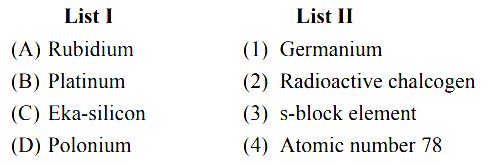 AP EAMCET 2015 Medium
 - Which element among the following is most probable to have the following values?
\(\begin{aligned} \Delta_i H_1 & =419 \mathrm{~kJ} \mathrm{~mol}^{-1} \\ \Delta_i H_2 & =305 \mathrm{~kJ} \mathrm{~mol}^{-1} \\ \Delta_{\mathrm{eg}} H & =-48 \mathrm{~kJ} \mathrm{~mol}^{-1}\end{aligned}\)AP EAMCET 2021 Easy - Calculate \(\Delta G^{\circ}\) for the following cell reaction.
\(\begin{aligned} & \mathrm{Zn}(\mathrm{s})+\mathrm{Ag}_2 \mathrm{O}(\mathrm{s})+\mathrm{H}_2 \mathrm{O}(l) \longrightarrow \\ & \mathrm{Zn}^{2+}(\mathrm{aq})+2 \mathrm{Ag}(\mathrm{s})+2^{-} \mathrm{OH}(\mathrm{aq}) \\ & E_{\mathrm{Ag}^{+} / \mathrm{Ag}}^{\circ}=+0.80 \mathrm{~V} \text { and } E_{\mathrm{Zn}^{2+} / \mathrm{Zn}}^{\circ}=-0.76 \mathrm{~V}\end{aligned}\)AP EAMCET 2015 Medium - The reaction
\(\mathrm{Ar}_2 \stackrel{\ominus}{\mathrm{C}} \stackrel{\oplus}{\mathrm{Cl}}+\mathrm{Cu}+\mathrm{HCl} \longrightarrow \mathrm{ArCl}+\mathrm{N}_2+\mathrm{CuCl}\)
is known asAP EAMCET 2019 Easy
More PYQs from AP EAMCET
- A large number of positive charges each of magnitude \(q\) are placed along the \(X\)-axis at the origin and at every \(1 \mathrm{~cm}\) distance in both the directions. The electric flux through a spherical surface of radius \(2.5 \mathrm{~cm}\) centred at the origin isAP EAMCET 2022 Medium
- In a \(p-n\) junction diode, the thickness of deplection layer is \(2 \times 10^{-6} \mathrm{~m}\) and barrier potential is \(0.3 \mathrm{~V}\). The intensity of the electric field at the junction isAP EAMCET 2011 Easy
- For the following cell reaction,
\(\begin{gathered}
\mathrm{Ag}\left|\mathrm{Ag}^{+}\right| \mathrm{AgCl}\left|\mathrm{Cl}^{\ominus}\right| \mathrm{Cl}_2, \mathrm{Pt} \\
\Delta G_f^{\circ}(\mathrm{AgCl})=-109 \mathrm{~kJ} / \mathrm{mol} \\
\Delta G_f^{\circ}\left(\mathrm{Cl}^{\ominus}\right)=-129 \mathrm{~kJ} / \mathrm{mol} \\
\Delta G_f^{\circ}\left(\mathrm{Ag}^{+}\right)=78 \mathrm{~kJ} / \mathrm{mol}
\end{gathered}\)
\(E^{\circ}\) of the cell isAP EAMCET 2009 Easy - Which of the following does not belong to an ideal solution?AP EAMCET 2023 Easy
- The distance between an object and its real image formed by a lens is ' \(\mathrm{D}\) '. If the magnification is ' \(m\) ', the focal length of the lens isAP EAMCET 2017 Easy
- If \(3 x+y+k=0\) is a tangent to the circle \(x^2+y^2=10\), then \(k=\ldots . . .\).AP EAMCET 2020 Easy