


AP EAMCET · Chemistry · p Block Elements (Group 15, 16, 17 & 18)
The formation of molecular orbitals can be described by the linear combination of atomic orbitals. Which one of the following correctly represents the formation of bonding molecular orbital from the atomic orbitals having wave functions and
- A
- B
- C
- D
Answer & Solution
Correct Answer
(C)
Step-by-step Solution
Detailed explanation
The formation of molecular orbitals may be described by the linear combination of atomic orbitals that can take place by addition and by subtraction of wave functions of individual atomic orbitals.
See the Complete Solution
Get step-by-step explanations for this and 2.5 Lakh+ more JEE, NEET & CET questions.
- Unlock all solutions
- Practice the full chapter
- Track accuracy across PYQs
4.8 rated on Google Play · 14,000+ reviews
More questions from Chemistry
- Correct order of basic strength of metallic hydroxidesAP EAMCET 2023 Medium
- The compound that is used in smoke screens isAP EAMCET 2022 Medium
- Which of the following reagent is used to find out carbon-carbon multiple bonds?AP EAMCET 2015 Easy
- The process of converting a precipitate into colloidal solution is known asAP EAMCET 2023 Easy
- Which one of the following is an isotonic pair of solutions?AP EAMCET 2013 Easy
- In ruby and emerald, the metal ion(s) present is/areAP EAMCET 2022 Medium
More PYQs from AP EAMCET
- In the reaction,
\(\mathrm{C}_2 \mathrm{H}_5 \mathrm{OC}_2 \mathrm{H}_5+\mathrm{CO} \underset{150^{\circ} \mathrm{C}, 500 \text { atm pressure }}{\stackrel{\mathrm{BF}_3}{\longrightarrow}} X\)
What is \(X\) ?AP EAMCET 2003 Hard - The bond lengths of and molecules are and respectively. The correct order of their bond lengths isAP EAMCET 2022 Hard
- If \(x^2+y^2+z^2 \neq 0, \quad x=c y+b z, \quad y=a z+c x\) and \(z=b x+a y\), then \(a^2+b^2+c^2+2 a b c\) is equal toAP EAMCET 2002 Medium
- The length of the latusrectum of the parabola \(20\left(x^2+y^2-6 x-2 y+10\right)=(4 x-2 y-5)^2\), isAP EAMCET 2019 Easy
- Use the data from table to estimate the enthalpy of formation of \(\mathrm{CH}_3 \mathrm{CHO}\).
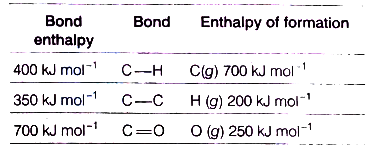 AP EAMCET 2022 Medium
 - Consider the cell reaction, at 300 K
\(\mathrm{A}(s)+\mathrm{B}^{2+}(a q) \rightleftharpoons \mathrm{A}^{2+}(a q)+\mathrm{B}(s)\)
Its \(\mathrm{E}^{\circ}\) is 1.0 V . The \(\Delta_{\mathrm{r}} \mathrm{H}^{\circ}\) of the reaction is \(-163 \mathrm{~kJ} \mathrm{~mol}^{-1}\). What is \(\Delta_{\mathrm{r}} \mathrm{S}^{\circ}\) (in J K\({ }^{-1}\) ) of the reaction?
\(\left(\mathrm{F}=96500 \mathrm{C} \mathrm{~mol}^{-1}\right)\)AP EAMCET 2024 Medium