


AP EAMCET · Chemistry · Thermodynamics (C)
The atomisation enthalpy of \(\mathrm{CH}_4\) is \(1660 \mathrm{~kJ} \mathrm{~mol}^{-1}\). The \(\mathrm{C}-\mathrm{H}\) bond enthalpy of each successive step in
\(\mathrm{CH}_4 \rightarrow \mathrm{CH}_3 \rightarrow \mathrm{CH}_2 \rightarrow \mathrm{CH}\) are \(+15,+30\) and \(+45 \mathrm{~kJ} \mathrm{~mol}^{-1}\) higher than the mean bond enthalpy of \(\mathrm{CH}\) bonds, respectively. The bond enthalpy of the last \(\mathrm{C}-\mathrm{H}\) unit is
- A \(400 \mathrm{~kJ} \mathrm{~mol}^{-1}\)
- B \(325 \mathrm{~kJ} \mathrm{~mol}^{-1}\)
- C \(475 \mathrm{~kJ} \mathrm{~mol}^{-1}\)
- D \(385 \mathrm{~kJ} \mathrm{~mol}^{-1}\)
Answer & Solution
Correct Answer
(B) \(325 \mathrm{~kJ} \mathrm{~mol}^{-1}\)
Step-by-step Solution
Detailed explanation
The atomisation enthalpy of \(\mathrm{CH}_4\) is \(1660 \mathrm{~kJ} \mathrm{~mol}^{-1}\). \(\mathrm{CH}_4(g) \longrightarrow \mathrm{C}(g)+4 \mathrm{H}(g) ; \quad \Delta_a H=1660 \mathrm{kJmol}^{-1}\)…
See the Complete Solution
Get step-by-step explanations for this and 2.5 Lakh+ more JEE, NEET & CET questions.
- Unlock all solutions
- Practice the full chapter
- Track accuracy across PYQs
4.8 rated on Google Play · 14,000+ reviews
More questions from Chemistry
- Calculate the equilibrium constant of the reaction, \(\mathrm{Cu}(s)+2 \mathrm{Ag}^{+}(a q) \longrightarrow \mathrm{Cu}^{2+}(a q)+2 \mathrm{Ag}(s)\), given that for the reaction \(E_{\text {cell }}=0.46 \mathrm{~V}\).AP EAMCET 2020 Hard
- Which of the following is correct?AP EAMCET 2004 Easy
- A solution is prepared by dissolving \(10 \mathrm{~g}\) of a non-volatile solute (molar mass, ' \(M^{\prime} \mathrm{g} \mathrm{mol}^{-1}\) ) in \(360 \mathrm{~g}\) of water. What is the molar mass in \(\mathrm{g} \mathrm{mol}^{-1}\) of solute if the relative lowering of vapour pressure of solution is \(5 \times 10^{-3}\) ?AP EAMCET 2019 Medium
- The correct order of covalent radii of \(\mathrm{Si}, \mathrm{Ge}, \mathrm{Sn}\) is:AP EAMCET 2023 Easy
- \(20 \mathrm{~mL}\) of \(0.1 \mathrm{M} \mathrm{HCl}\) is added to the \(30 \mathrm{~mL}\) of \(0.1 \mathrm{M}\) \(\mathrm{NaOH}\). To this solution extra \(50 \mathrm{~mL}\) of water was added. What is the molarity of the final solution formed?AP EAMCET 2023 Easy
- At 298 K, the following reaction takes place for a cell at the hydrogen electrode
\(\mathrm{H}^{+}(\mathrm{aq})+\mathrm{e}^{-} \longrightarrow \frac{1}{2} \mathrm{H}_2(1\) bar \()\)
The solution pH is 10.0. What is the hydrogen electrode potential in volts ?
\(\left(\frac{2.303 \mathrm{RT}}{\mathrm{~F}}=0.06 \mathrm{~V}\right)\)AP EAMCET 2025 Medium
More PYQs from AP EAMCET
- If the mean of 10 observations is 50 and the sum of the squares of the deviations of the
observations from the mean is 250, then the coefficient of variation of thoseobservations isAP EAMCET 2016 Medium - A machine which is \(70 \%\) efficient raises a \(10 \mathrm{~kg}\) body through a certain distance and spends \(100 \mathrm{~J}\) energy. The body is then released. On reaching the ground, the kinetic energy of the body will beAP EAMCET 2020 Medium
- The stepwise stability constants of a complex are given below. What is its overall reaction stability constant \(\left(\beta_4\right)\) ?
\(\begin{aligned}
& M+L \rightleftharpoons M L ; K_1=1.0 \times 10^4 \\
& M L+L \rightleftharpoons M L_2 ; K_2=1.0 \times 10^3 \\
& M L_2+L \rightleftharpoons M L_3 ; K_3=1.0 \times 10^3 \\
& M L_3+L \rightleftharpoons M L_4 ; K_4=1.0 \times 10^2
\end{aligned}\)
(Overall reaction : \(M+4 L \rightleftharpoons M L_4\) )AP EAMCET 2019 Medium - If \(z=x+i y\) and if the point \(P\) in the Argand diagram represents \(z\), then the locus of the point \(P\) satisfying the equation \(2|z-2-3 i|=3|z+i-2|\) is a circle with centreAP EAMCET 2025 Medium
- Current through the branch \(B D\), in the given circuit is
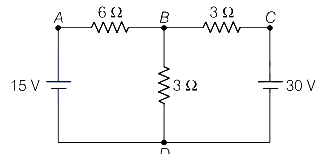 AP EAMCET 2021 Easy
 - A light wave has a frequency of \(4 \times 10^{14} \mathrm{~Hz}\) and a wavelength of \(5 \times 10^{-7} \mathrm{~m}\) in a medium. The refractive index of the medium isAP EAMCET 2020 Easy