


AP EAMCET · Chemistry · General Organic Chemistry
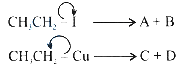
Species A, B, C, D formed in the following bond cleavages respectively are
- A \(\mathrm{CH}_3 \mathrm{CH}_2^{+}, \mathrm{I}^{-}, \mathrm{CH}_3 \mathrm{CH}_2^{-}, \mathrm{Cu}^{+}\)
- B \(\mathrm{CH}_3 \mathrm{CH}_2^{+}, \mathrm{I}^{-}, \mathrm{CH}_3 \mathrm{CH}_2^{+}, \mathrm{Cu}^{-}\)
- C \(\mathrm{CH}_3 \mathrm{CH}_2^{-}, \mathrm{I}^{+}, \mathrm{CH}_3 \mathrm{CH}_2^{+}, \mathrm{Cu}^{-}\)
- D \(\mathrm{CH}_3 \mathrm{CH}_2^{-}, \mathrm{I}^{+}, \mathrm{CH}_3 \mathrm{CH}_2^{-}, \mathrm{Cu}^{+}\)
Answer & Solution
Correct Answer
(A) \(\mathrm{CH}_3 \mathrm{CH}_2^{+}, \mathrm{I}^{-}, \mathrm{CH}_3 \mathrm{CH}_2^{-}, \mathrm{Cu}^{+}\)
Step-by-step Solution
Detailed explanation
Iodine is good living group so it generate the carbocation. Here; Cu is giving electron to the carbon atom so it act as a reducing agent. So a carbanion is form.
See the Complete Solution
Get step-by-step explanations for this and 2.5 Lakh+ more JEE, NEET & CET questions.
- Unlock all solutions
- Practice the full chapter
- Track accuracy across PYQs
4.8 rated on Google Play · 14,000+ reviews
More questions from Chemistry
- If \(\mathrm{BaCl}_2\) ionizes to an extent of \(80 \%\) in aqueous solution, the value of van't Hoff factor isAP EAMCET 2010 Easy
- Observe the following solutions
I. Black coffee
II. \(0.2 \mathrm{M} \mathrm{NaOH}\)
III. Lemon Juice
IV. Lime water V. Human Saliva VI. Tomato Juice
The number of solutions having \(\mathrm{pH}\) range of \(1-7\) and \(7-14\), in the above list, is respectively.AP EAMCET 2023 Easy - Magnesium is burnt in the air to form and . When is hydrolyzed, and are formed. is the reactant in the manufacture of nitric acid by Ostwald's process. What is ?AP EAMCET 2019 Easy
- Isobars are atoms withAP EAMCET 2020 Easy
- Cobalt (III) chloride forms a green coloured complex ' X ' with \(\mathrm{NH}_3\). Number of moles of AgCl formed when excess of \(\mathrm{AgNO}_3\) solution is added to 100 mL of 1 M solution of ' X ' isAP EAMCET 2024 Medium
- The method for preparation of water gas isAP EAMCET 2024 Medium
More PYQs from AP EAMCET
- Let and be roots of the equation and let and be the roots of the equation If are in then and areAP EAMCET 2021 Easy
- If the pair of straight lines given by \(A x^2+2 H x y+B y^2=0\left(H^2>A B\right)\) forms an equilateral triangle with line \(a x+b y+c=0\), then \((A+3 B)(3 A+B)\) is equal to :AP EAMCET 2003 Medium
- Let \(\mathrm{V}_1\) be the potential at the center of the square of side \(1 \mathrm{~m}\) when the charges at the 4 corners are \(2 \mathrm{C}\) each. If the same charges are placed at the corners of a square of side \(2 \mathrm{~m}\), then the potential at the centre of this square is \(\mathrm{V}_2\). The value of \(\frac{V_2}{V_1}\) isAP EAMCET 2022 Medium
- A circular well of diameter 2 m has water upto the ground level. If the bottom of the well is at a depth of 14 m, the time taken in seconds to empty the well using a 1.4 kW motor is (Acceleration due to gravity \(=10 \mathrm{~m} \mathrm{~s}^{-2}\) )AP EAMCET 2025 Medium
- Expansion during heating:AP EAMCET 2021 Easy
- The general solution of the differential equation \(\left(1+\sin ^2 x\right) \frac{d y}{d x}+y \sin 2 x\) \(=\cos x+\sin ^2 x \cos x\) isAP EAMCET 2025 Medium