


AP EAMCET · Chemistry · Thermodynamics (C)
Observe the following reactions
I. \(\quad \mathrm{CaCO}_3(\mathrm{~s}) \rightarrow \mathrm{CaO}(\mathrm{s})+\mathrm{CO}_2(\mathrm{~g})\)
II. \(\quad \mathrm{Cl}_2(\mathrm{~g}) \rightarrow 2 \mathrm{Cl}(\mathrm{g})\)
III. \(\mathrm{H}_2 \mathrm{O}(1) \rightarrow \mathrm{H}_2 \mathrm{O}(\mathrm{s})\)
Identify the reactions in which entropy increases
- A I, II, III
- B I, II Only
- C I, III Only
- D II, III Only
Answer & Solution
Correct Answer
(B) I, II Only
Step-by-step Solution
Detailed explanation
When the number of gaseous atom increases entropy is increases. So in reaction I and II gaseous molecule produced so entropy increase.
See the Complete Solution
Get step-by-step explanations for this and 2.5 Lakh+ more JEE, NEET & CET questions.
- Unlock all solutions
- Practice the full chapter
- Track accuracy across PYQs
4.8 rated on Google Play · 14,000+ reviews
More questions from Chemistry
- Which one of the following salts give an acidic solution in water?AP EAMCET 2007 Easy
- The correct order of bond angles of the following is
\(\begin{array}{cccc}\mathrm{H}_2 \mathrm{O} & \mathrm{NH}_3 & \mathrm{CH}_4 & \mathrm{SO}_2 \\ \text { I } & \text { II } & \text { III } & \text { IV }\end{array}\)AP EAMCET 2023 Medium - A compound \(\left(M \mathrm{O}_2\right)\) of group I element \((M)\) hydrolysed to form \(M^{+}, \mathrm{OH}^{-}, X\) and \(Y\). When \(X\) reacts with \(\mathrm{I}_2\) in basic medium the products formed are \(\mathrm{I}^{-}\), water and \(Y\). Then \(X\) and \(Y\) are respectivelyAP EAMCET 2019 Medium
- Which one of the following electrolytes is used in Down's process of extracting sodium metal?AP EAMCET 2003 Medium
- Which of the following is a biodegradable polymer of polyamide class?AP EAMCET 2020 Easy
- Consider the reactions
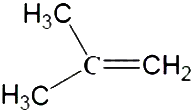 \(\xrightarrow[\text { (2) } \mathrm{Zn} / \mathrm{H}_2 \mathrm{O}]{\text { (1) } \mathrm{O}_3} \mathrm{X}+\mathrm{Y}\)
\(\mathrm{X}+\mathrm{Y} \xrightarrow[\text { (2) } \Delta]{\text { (1) dil. } \mathrm{NaOH}} \mathrm{Z}\)
The IUPAC name of ' \(Z\) ' isAP EAMCET 2024 Medium
More PYQs from AP EAMCET
- Let \(P, Q\) be the foci of an ellipse and let \(R\) be one end of its minor axis. If \(\triangle P Q R\) is an equilateral triangle, then the eccentricity of the ellipse is equal toAP EAMCET 2020 Easy
- For all \(n \in N, \frac{3^n-1}{2} \geq\)AP EAMCET 2025 Hard
- \(\mathrm{BF}_3\) reacts with \(\mathrm{NaH}\) at \(450 \mathrm{~K}\) to form \(\mathrm{NaF}\) and \(X\). When \(X\) reacts with \(\mathrm{LiH}\) in diethyl ether, \(Y\) is formed. What is \(Y\) ?AP EAMCET 2018 Medium
- \(\int \frac{2-\sin x}{2 \cos x+3} d x=\)AP EAMCET 2024 Medium
- The uniform electric field intensity between the two plates of a parallel plate capacitor is \(1 \times 103 \mathrm{Vm}^{-1}\) acting vertically upwards as shown in the figure.
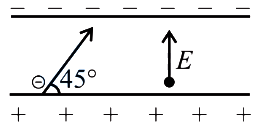
The plates are sufficiently long and have separation \(2 \mathrm{~cm}\). A particle of negative charge \(1 \mu \mathrm{C}\) and mass \(2 \mathrm{~g}\) is projected at an angle \(45^{\circ}\) with the electric field from the lower plate with a velocity ' \(u\) '. The maximum velocity acquired by the particle, if it is not hit the upper plate isAP EAMCET 2017 Hard - A lamp delivers a luminous flux of \(100 \mathrm{~W}\) to an absorber of area \(\mathrm{l} \mathrm{cm}^2\). The force due to radiation pressure isAP EAMCET 2019 Easy