


AP EAMCET · Chemistry · Electrochemistry
Observe the following Ellingham diagram, and identify the incorrect statement regarding it
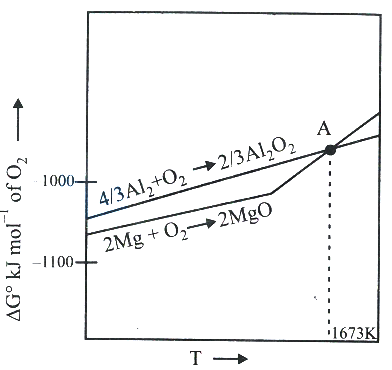
- A At point ' \(\mathrm{A}\) ' for the reduction of \(\mathrm{Al}_2 \mathrm{O}_3\) by \(\mathrm{Mg}\), \(\Delta \mathrm{G}^{\circ}=0\)
- B Below \(1673 \mathrm{~K}, \mathrm{Mg}\) can reduce \(\mathrm{Al}_2 \mathrm{O}_3\) to \(\mathrm{Al}\)
- C Below \(1673 \mathrm{~K}, \mathrm{Al}\) can reduce \(\mathrm{MgO}\) to \(\mathrm{Mg}\)
- D Above \(1673 \mathrm{~K}, \mathrm{Al}\) can reduce \(\mathrm{MgO}\) to \(\mathrm{Mg}\)
Answer & Solution
Correct Answer
(C) Below \(1673 \mathrm{~K}, \mathrm{Al}\) can reduce \(\mathrm{MgO}\) to \(\mathrm{Mg}\)
Step-by-step Solution
Detailed explanation
Since the \(\frac{4}{3} \mathrm{Al}+\mathrm{O}_2 \rightarrow \frac{2}{3} \mathrm{Al}_2 \mathrm{O}_3\) line lies above the \(2 \mathrm{Mg}+\mathrm{O}_2 \rightarrow 2 \mathrm{MgO}\) line, \(\mathrm{Al}\) cannot reduce \(\mathrm{MgO}+\mathrm{Mg}\) below \(1673 \mathrm{~K}\). This…
See the Complete Solution
Get step-by-step explanations for this and 2.5 Lakh+ more JEE, NEET & CET questions.
- Unlock all solutions
- Practice the full chapter
- Track accuracy across PYQs
4.8 rated on Google Play · 14,000+ reviews
More questions from Chemistry
- If the wave number of radiation emitted for the electron transition from an excited state to ground state of hydrogen is \(\frac{5 \mathrm{x}}{36} \mathrm{~m}^{-1}\), the wave number of radiation absorbed for the electron transition from the above excited state to next immediate excited state in \(\mathrm{m}^{-1}\) is:AP EAMCET 2017 Hard
- If the radius of electron orbit in the excited state of hydrogen atom is \(476.1 \mathrm{pm}\), the energy of electron in that excited state in \(\mathrm{J}\) is (Radius and energy of electron in the first orbit of hydrogen atom are \(52.9 \mathrm{pm}\) and \(-2.18 \times 10^{-18} \mathrm{~J}\) respectively)AP EAMCET 2018 Medium
- The adsorption of a gas on a solid surface follows Freundlich adsorption isotherm.
At \(\mathrm{T}(\mathrm{K})\), the gas pressure is 2 atm. What is the value of \(\frac{x}{\mathrm{~m}} ? \quad(\mathrm{n}=2\) and \(k=\) constant)AP EAMCET 2025 Medium - Dipole moment order of which of the following pairs of molecules is not correct?AP EAMCET 2018 Easy
- Which of the following conditions are not suitable for a spontaneous reaction?AP EAMCET 2022 Easy
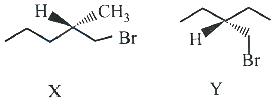
- Below shown molecules are
 AP EAMCET 2023 Easy
More PYQs from AP EAMCET
- Which of the following is lung irritant?AP EAMCET 2024 Easy
- Two cylinders \(A\) and \(B\) fitted with pistons, contain equal number of moles of an ideal monoatomic gas at \(400 \mathrm{~K}\). The piston of \(A\) is free to move while that of \(B\) is held fixed. Same amount of heat energy is given to the gas in each cylinder. If the rise in temperature of the gas in \(A\) is \(42 \mathrm{~K}\), the rise in temperature of the gas in \(B\) is \((\gamma=5 / 3)\)AP EAMCET 2007 Medium
- Identify the correct statements from the following.
(A) The ionic product of water at \(100^{\circ} \mathrm{C}\) is \( < 10^{-14}\).
(B) \(\mathrm{pH}\) of a solution decreases with increasing temperature.
(C) \(\mathrm{NaH}_2 \mathrm{PO}_4\) on hydrolysis gives a basic solution.
(D) \(\mathrm{NH}_3\) can act both as Bronsted acid and base.AP EAMCET 2022 Medium - Assertion (A) Finely divided charcoal can act as an adsorbent.
Reason (R) Finely divided material has small surface area.AP EAMCET 2022 Easy - Assertion (A) : For every chemical reaction at equilibrium, standard Gibbs energy change of the reaction is zero
Reason (R) : At constant temperature and pressure chemical reactions are spontaneous in the direction of decreasing Gibbs energy.AP EAMCET 2017 Easy - Match the following.
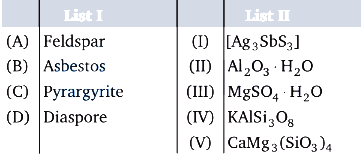
The correct answer is
(A) (B) (C) (D)AP EAMCET 2009 Easy