


AP EAMCET · Chemistry · s Block Elements
\(\mathrm{KO}_2\), reacts with water to form \(A, B\) and \(C\).
\(B\) forms \(C\) when it reacts with iodine in basic medium. What are \(B\) and \(C\) respectively?
- A \(\mathrm{KOH}, \mathrm{H}_2 \mathrm{O}_2\)
- B \(\mathrm{K}_2 \mathrm{O}_2, \mathrm{H}_2 \mathrm{O}_2\)
- C \(\mathrm{KOH}, \mathrm{O}_2\)
- D \(\mathrm{H}_2 \mathrm{O}_2, \mathrm{O}_2\)
Answer & Solution
Correct Answer
(D) \(\mathrm{H}_2 \mathrm{O}_2, \mathrm{O}_2\)
Step-by-step Solution
Detailed explanation
(i) When \(\mathrm{KO}_2\) reacts with water, it gives \((A)\), \((B)\) and \((C)\) as follows: (ii) When \((B)\), i.e. \(\mathrm{H}_2 \mathrm{O}_2\) reacts with iodine in basic medium, it gives \((C)\), i.e. \(\mathrm{O}_2\), as shown below : \(\because \mathrm{KOH}\) can not…
See the Complete Solution
Get step-by-step explanations for this and 2.5 Lakh+ more JEE, NEET & CET questions.
- Unlock all solutions
- Practice the full chapter
- Track accuracy across PYQs
4.8 rated on Google Play · 14,000+ reviews
More questions from Chemistry
- The formula of tris (ethane - 1, 2- diamine) cobalt (III) sulphate is:AP EAMCET 2023 Medium
- 15 moles of \(\mathrm{H}_2\) and 5.2 moles of \(\mathrm{I}_2\) are mixed and allowed to attain equilibrium at 773 K . At equilibrium, the number of moles of HI is found to be 10 . The equilibrium constant for the dissociation of HI isAP EAMCET 2024 Medium
- A solution containing \(4.5 \mathrm{mM}\) of \(\mathrm{MnO}_4^{-}\)and \(15 \mathrm{mM}\) of \(\mathrm{Mn}^{2+}\) shows \(\mathrm{pH}\) of 2 . The potential of half-cell reaction is ...... .
(Given, \(\log 15=1.76\) and \(\log 45=1.653\) and standard potential of \(\mathrm{MnO}_4^{-} \longrightarrow \mathrm{Mn}^{2+}\) ) is \(1.51 \mathrm{~V}\) )AP EAMCET 2020 Hard - \(\mathrm{K}_{\mathrm{H}}\) values for \(\mathrm{H}_2, \mathrm{CO}_2, \mathrm{CH}_4\) and \(\mathrm{O}_2\) at \(298 \mathrm{~K}\) are \(71.18,1.67,41.85\) and \(34.86 \mathrm{Kbar}\). respectively. Arrange these gases in the increasing order of their solubility.AP EAMCET 2020 Medium
- What is the shape of \(\mathrm{I}_3^{-}\)ion?AP EAMCET 2020 Easy
- Identify the correct statement(s) from the following
a) Dipole moment of \(\mathrm{NH}_3\) is more than \(\mathrm{NF}_3\)
b) \(\mathrm{SF}_4\) is square planar
c) \(\mathrm{SnCl}_4\) is more covalent than \(\mathrm{SnCl}_2\)
d) \(\mathrm{In}_2 \mathrm{SO}_4\) sulphur atom has expanded octetAP EAMCET 2017 Easy
More PYQs from AP EAMCET
- The RMS velocity ( \(\mathrm{u}_{\mathrm{rms}}\) ) of one mole of an ideal gas was measured at different temperatures and the following graph is obtained. What is the slope \((\mathrm{m})\) of straight line?
\(\left(x \text {-axis }=\mathrm{T}(\mathrm{~K}) ; y \text {-axis }=\left(\mathrm{u}_{\mathrm{rms}}\right)^2 ; \mathrm{M}=\text { molar mass } ; \mathrm{R}=\right.\text { gas }\)
constant)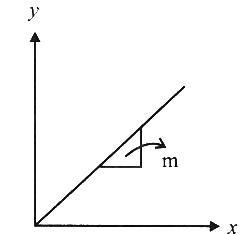 AP EAMCET 2024 Easy
 - What is the slag formed in the extraction of iron?AP EAMCET 2018 Easy
- If the intercepts made by a variable circle on the X -axis and Y -axis are 8 and 6 units respectively, then the locus of the centre of the circle isAP EAMCET 2025 Medium
- If \(P\) is a variable point which is at a distance of 2 units from the line \(2 x-3 y+1=0\) and \(\sqrt{13}\) units from the point \((5,6)\), then the equation of the locus of P isAP EAMCET 2025 Hard
- If \(-\frac{2}{3} < x < \frac{2}{3}\), then the value of the \(5^{\text {th }}\) term in the expansion of \(\frac{1}{\sqrt[3]{2-3 x}}\) when \(x=\frac{1}{2}\) isAP EAMCET 2025 Medium
- The reagent used for the distinction of \(1^{\circ}, 2^{\circ}\) and \(2^{\circ}\) amines isAP EAMCET 2018 Medium