


AP EAMCET · Chemistry · Hydrocarbons
Identify the reagents \((X, Y, Z)\) used in the conversion of 3-methylaniline to 3-nitrotoluene.
\(\begin{array}{lll}X & Y & Z\end{array}\)
- A \(\mathrm{NaNO}_2, \mathrm{HCl} \quad \mathrm{HBF}_4 \quad \mathrm{NaNO}_2, \mathrm{Cu}, \Delta\)
- B \(\mathrm{NaNO}_3, \mathrm{HCl} 273 \mathrm{~K} \quad \mathrm{HF} \quad \mathrm{NaNO}_3, \mathrm{Cu}, \Delta\)
- C \(\mathrm{NaNO}_2, \mathrm{HCl} \quad \mathrm{C}_2 \mathrm{H}_5 \mathrm{OH} \quad \mathrm{NaNO}_3, \Delta\)
- D \(\mathrm{NaNO}_3, \mathrm{HCl} \quad \mathrm{NaOH} \quad \mathrm{C}_6 \mathrm{H}_5 \mathrm{NO}_2\)
Answer & Solution
Correct Answer
(A) \(\mathrm{NaNO}_2, \mathrm{HCl} \quad \mathrm{HBF}_4 \quad \mathrm{NaNO}_2, \mathrm{Cu}, \Delta\)
Step-by-step Solution
Detailed explanation
When 3-methyl aniline is converted to 3-nitrotoluene, the following steps are involved. Hence, \(\begin{aligned} & (X)=\mathrm{NaNO}_2, \mathrm{HCl}, 273 \mathrm{~K} \\ & (Y)=\mathrm{HBF}_4,(Z)=\mathrm{NaNO}_2, \mathrm{Cu}, \Delta .\end{aligned}\) Hence, option (a) is the…
See the Complete Solution
Get step-by-step explanations for this and 2.5 Lakh+ more JEE, NEET & CET questions.
- Unlock all solutions
- Practice the full chapter
- Track accuracy across PYQs
4.8 rated on Google Play · 14,000+ reviews
More questions from Chemistry
- Gold crystallises in fcc lattice. The edge length of the unit cell is \(4 Å\). The closest distance between gold atoms is ' \(x\) ' \(Å\) and density of gold is ' \(y\) ' \(\mathrm{g} \mathrm{cm}^{-3}\). What are \(x\) and \(y\) respectively?
\(\left(\right.\) Molar mass of gold \(\left.=197 \mathrm{~g} \mathrm{~mol}^{-1} ; \mathrm{N}=6 \times 10^{23} \mathrm{~mol}^{-1}\right)\)AP EAMCET 2025 Medium - Aluminium (III) chloride forms a dimer because aluminiumAP EAMCET 2021 Easy
- The work functions \(\left(W_0\right)\) of \(\mathrm{K}, \mathrm{Na}, \mathrm{Li}, \mathrm{Mg}\) and \(\mathrm{Cu}\) are \(2.25,2.30,2.42,3.70\) and \(4.80 \mathrm{eV}\) respectively. How many of these metals do not undergo photoelectric effect when a radiation of wavelength \(450 \mathrm{~nm}\) is allowed to fall on them? \(\left(1 \mathrm{eV}=1.602 \times 10^{-19} \mathrm{~J}\right)\)AP EAMCET 2018 Medium
- Consider the following:
Statement-I : Kolbe's electrolysis of sodium propionate gives n-hexane as product
Statement-II : In Kolbe's process \(\mathrm{CO}_2\) is liberated at anode and \(\mathrm{H}_2\) is liberated at cathode
Correct answer isAP EAMCET 2025 Medium - Addition of an electron to an antibonding molecular orbitalAP EAMCET 2021 Medium
- Which of the following statement is incorrect?
(i) \(\mathrm{NaCl}\) being an ionic compound is a good conductor of electricity in the solid state.
(ii) In canonical structures there is no difference in the arrangement of atoms.
(iii) Hybrid orbitals form stronger bonds than pure orbitals.
(iv) VSEPR theory can explain the square planar geometry of \(\mathrm{XeF}_4\).AP EAMCET 2020 Medium
More PYQs from AP EAMCET
- The value of work function of a metal \(\mathrm{X}\) is \(3.1 \mathrm{eV}\). The threshold frequency of it (in \(\mathrm{Hz})\left(\mathrm{h}=6.62 \times 10^{-34} \mathrm{Js}\right)\)AP EAMCET 2022 Easy
- Two points charges are kept in air with a separation between them. The force between them is \(F_1\), if half of the space between the charges is filled with a dielectric constant 4 and the force between them is \(F_2\). If \(\frac{1}{3} \mathrm{rd}\) of the space between the charges is filled with dielectric of dielectric constant 9. Then \(\frac{F_1}{F_2}\) isAP EAMCET 2018 Medium
- \(\sec h^{-1}\left(\frac{1}{2}\right)-\operatorname{cosec} h^{-1}\left(\frac{3}{4}\right)\) equals toAP EAMCET 2014 Hard
- \(\lim _{x \rightarrow 0} \frac{\sqrt{1+x^2}-\sqrt{1-x+x^2}}{3^x-1}\) is equal toAP EAMCET 2014 Medium
- The value of \(k\), if \((1,2),(k,-1)\) are conjugate points with respect to the ellipse \(2 x^2+3 y^2=6\) isAP EAMCET 2007 Hard
- Two blocks A and B of masses \(5 \mathrm{~kg}\) and \(10 \mathrm{~kg}\) respectively are placed as shown in the figure. The coefficient of friction between all the surfaces is 0.2 . Then the acceleration of the block B is $\left(\mathrm{g}=10
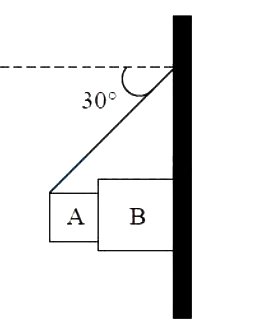 AP EAMCET 2018 Hard