


AP EAMCET · Chemistry · Chemical Kinetics
\(2 \mathrm{FeCl}_3+\mathrm{SnCl}_2 \rightarrow 2 \mathrm{FeCl}_2+\mathrm{SnCl}_2\). This reaction is an example for
- A Third order reaction
- B Zero order reaction
- C First order reaction
- D Second order reaction
Answer & Solution
Correct Answer
(A) Third order reaction
Step-by-step Solution
Detailed explanation
No solution. Refer to answer key.
See the Complete Solution
Get step-by-step explanations for this and 2.5 Lakh+ more JEE, NEET & CET questions.
- Unlock all solutions
- Practice the full chapter
- Track accuracy across PYQs
4.8 rated on Google Play · 14,000+ reviews
More questions from Chemistry
- Which of the following can show geometrical isomerism?AP EAMCET 2020 Medium
- Identify the set of elements in which they are arranged in the increasing order of electron gain enthalpies.AP EAMCET 2017 Easy
- If standard enthalpy of formation \(\left(\Delta_{\mathrm{f}} \mathrm{H}^{\circ}\right)\) of \(\mathrm{CO}_2, \mathrm{H}_2 \mathrm{O}\) and \(\mathrm{CH}_4\) are \(-393,-286\) and \(-74.0 \mathrm{~kJ} \mathrm{~mol}^{-1}\) respectively, the standard enthalpy of combustion of methane in \(\mathrm{kJ} \mathrm{mol}^{-1}\) isAP EAMCET 2017 Medium
- The compound prepared by a substitution reaction of benzene isAP EAMCET 2005 Medium
- \(x\) grams of calcium carbonate was completely burnt in air. The weight of the solid residue formed is \(28 \mathrm{~g}\). What is the value of \(x\) (in grams)?AP EAMCET 2005 Easy
- At \(\mathrm{T}(\mathrm{K})\), the RMS velocity of \(\mathrm{He}\) is equal to \(\mathrm{RMS}\) velocity of \(\mathrm{SO}_2\) at \(127^{\circ} \mathrm{C}\). What is \(\mathrm{T}(\) in \(\mathrm{K}) ?\)AP EAMCET 2017 Medium
More PYQs from AP EAMCET
- Assuming that the incident radiation is capable of ejecting photo electrons from all the given metals, the lowest kinetic energy of the ejected photoelectron is observed with which of the given metals?AP EAMCET 2021 Easy
- A Carnot engine operating between temperatures \(600 \mathrm{~K}\) and \(300 \mathrm{~K}\), absorbs \(800 \mathrm{~J}\) of heat from the source. The mechanical work done per cycle isAP EAMCET 2022 Easy
- Assertion (A):If \(\mathrm{A}=10^{\circ}, \mathrm{B}=16^{\circ}, \mathrm{C}=19^{\circ}\), then \(\tan 2 \mathrm{~A}\) \(\tan 2 \mathrm{~B}+\tan 2 \mathrm{~B} \tan 2 \mathrm{C}+\tan 2 \mathrm{C} \tan 2 \mathrm{~A}=1\).
Reason (R): If \(A+B+C=180^{\circ},=\cot \frac{A}{2} \cdot \cot \frac{B}{2} \cdot \cot \frac{C}{2}\) \(=\cot \frac{\mathrm{A}}{2} \cdot \cot \frac{\mathrm{~B}}{2} \cdot \cot \frac{\mathrm{C}}{2}\)
Which of the following is correct?AP EAMCET 2024 Medium - Identify the incorrect statement about silica.AP EAMCET 2025 Easy
- AP EAMCET 2022 Hard
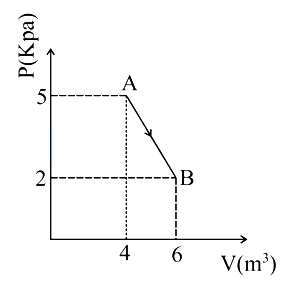
- One mole of an ideal diatomic gas undergoes a transition from to along a path as shown in figure. The change in internal energy of the gas during the transition is
 AP EAMCET 2020 Medium