


WBJEE · Physics · Gravitation
Two particles of mass \(m_{1}\) and \(m_{2}\); approach each other due to their mutual gravitational attraction only. Then,
- A accelerations of both the particles are equal
- B acceleration of the particle of mass \(m_{1}\) is proportional to \(\overline{m_{1}}\)
- C acceleration of the particle of mass \(m_{1}\) is proportional to \(m_{2}\)
- D acceleration of the particle of mass \(m_{1}\) is inversely proportional to \(m_{1}\)
Answer & Solution
Correct Answer
(C) acceleration of the particle of mass \(m_{1}\) is proportional to \(m_{2}\)
Step-by-step Solution
Detailed explanation
The gravitational force acting between the two masses \(m_{1}\) and \(m_{2}\) is given by \[ F_{O}=\frac{G m_{1} m_{2}}{r^{2}} \] Force on mass \(m_{1}\). \[ F_{1}=\frac{G m_{1} m_{2}}{r^{2}}=m_{1} a_{1} \] where, \(a_{1}=\) acceleration…
See the Complete Solution
Get step-by-step explanations for this and 2.5 Lakh+ more JEE, NEET & CET questions.
- Unlock all solutions
- Practice the full chapter
- Track accuracy across PYQs
4.8 rated on Google Play · 14,000+ reviews
More questions from Physics
- \(A\) 10 W electric heater is used to heat a container filled with \(0.5 \mathrm{kg}\) of water. It is found that the temperature of water and the container rises by \(3^{\circ} \mathrm{K}\) in \(15 \mathrm{min}\). The container is then emptied, dried and filled with \(2 \mathrm{kg}\) of oil. The same heater now raises the temperature of container-oil system by \(2^{\circ} \mathrm{K}\) in \(20 \mathrm{min}\). Assuming that there is no heat loss in the process and the specific heat of water is \(4200 \mathrm{d} \mathrm{kg}^{-1} \mathrm{K}^{-1}\), the specific heat of oil in the same unit is equal toWBJEE 2014 Hard
- The light beams of intensities in the ratio of \(9: 1\) are allowed to interfere. What will be the ratio of the intensities of maxima and minima?WBJEE 2010 Easy
- A plano-concave lens is made of glass of refractive index 1.5 and the radius of curvature of its curved face is \(100 \mathrm{~cm}\). What is the power of the lens?WBJEE 2011 Easy
- A steel and a brass wire, each of length \(50 \mathrm{~cm}\) and cross-sectional area \(0.005 \mathrm{~cm}^{2}\) hang from a ceiling and are \(15 \mathrm{~cm}\) apart. Lower ends of the wires are attached to a light horizontal bar. A suitable downward load is applied to the bar so that each of the wires extends in length by \(0.1 \mathrm{~cm}\). At what distance from the steel wire the load must be applied? [Young's modulus of steel is \(2 \times 10^{12}\) dynes \(/ \mathrm{cm}^{2}\) and that of brass is \(1 \times 10^{12}\) dynes \(\left./ \mathrm{cm}^{2}\right]\)WBJEE 2020 Medium
- Six wires, each of resistance \(r\), are connected so as to form a tetrahedron. The equivalent resistance of the combination when current enters through one corner and leaves through some other corner isWBJEE 2017 Hard
- When a semiconducting device is connected in series with a battery and a resistance, a current is found to flow in the circuit. If however, the polarity of the battery is reversed, practically no current flows in the circuit. The device may beWBJEE 2017 Easy
More PYQs from WBJEE
- If \(\sin \theta+\cos \theta=0\) and \(0 < \theta < \pi\), then \(\theta\)WBJEE 2011 Easy
- Let \(z_{1}\) and \(z_{2}\) be two imaginary roots of \(z^{2}+p z+q=0\), where \(p\) and \(q\) are real. The points \(z_{1}, z_{2}\) and origin form an equilateral triangle ifWBJEE 2020 Medium
- If \((\alpha+\sqrt{\beta})\) and \((\alpha-\sqrt{\beta})\) are the roots of the equation \(x^{2}+p x+q=0,\) where \(\alpha, \beta, p\) and \(q\) are real, then the roots of the equation \(\left(p^{2}-4 q\right)\left(p^{2} x^{2}+4 p x\right)-16 q=0\) areWBJEE 2012 Medium
- The convex lens \(\left(L_1\right.\) and \(\left.L_2\right)\) of equal focal length \(f\) are placed at a distance \(\frac{f}{2}\) apart. An object is placed at a distance \(4 f\) in the left of \(L_1\) as shown in figure. The final image is at
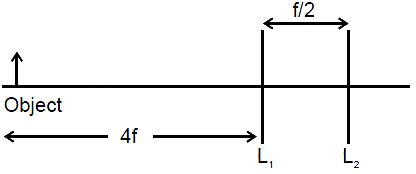 WBJEE 2024 Medium
 - Let \(z_{1}\) and \(z_{2}\) be complex numbers such that \(z_{1} \neq z_{2}\) and \(\left|z_{1}\right|=\left|z_{2}\right| .\) If \(\operatorname{Re}\left(z_{1}\right)>0\) and
\(\operatorname{Im}\left(z_{2}\right) < 0,\) then \(\frac{z_{1}+z_{2}}{z_{1}-z_{2}}\) isWBJEE 2018 Medium - The line joining \(A(b \cos \alpha, b \sin \alpha)\)
and
\(B(a \cos \beta, a \sin \beta),\) where \(a \neq b,\) is produced to the
point \(M(x, y)\) so that \(A M: M B=b: a\). Then, \(x \cos \frac{\alpha+\beta}{2}+y \sin \frac{\alpha+\beta}{2}\) is equal toWBJEE 2012 Easy