


WBJEE · Physics · Dual Nature of Matter
The stopping potential for photoelectrons from a metal surface is \(V_{1}\) when monochromatic light of frequency \(v_1\) is incident on it. The stopping potential becomes \(V_{2}\) when monochromatic light of another frequency is incident on the same metal surface. If \(h\) be the Planck's constant and \(e\) be the charge of an electron, then the frequency of light in the second case is
- A \(v_{1}-\frac{e}{h}\left(V_{2}+V_{1}\right)\)
- B \(v_{1}+v \frac{e}{h}\left(V_{2}+V_{1}\right)\)
- C \(v_{1}-\frac{e}{h}\left(V_{2}-V_{1}\right)\)
- D \(v_{1}+\frac{e}{h}\left(V_{2}-V_{1}\right)\)
Answer & Solution
Correct Answer
(D) \(v_{1}+\frac{e}{h}\left(V_{2}-V_{1}\right)\)
Step-by-step Solution
Detailed explanation
Here, \(h v_{1}=\phi_{0}=e V_{1}\) ...(i) and \(h v_{2}=\phi_{0}+e V_{2}\)...(ii) From Eqs. (i) and (ii), we have \(\begin{aligned} & h\left(v_{2}-v_{1}\right)=e\left(V_{2}-v_{1}\right) \\ \Rightarrow \quad & v_{2}=\frac{e}{h}\left(V_{2}-v_{1}\right)+v_{1} \end{aligned}\)
See the Complete Solution
Get step-by-step explanations for this and 2.5 Lakh+ more JEE, NEET & CET questions.
- Unlock all solutions
- Practice the full chapter
- Track accuracy across PYQs
4.8 rated on Google Play · 14,000+ reviews
More questions from Physics
- Two black bodies \(A\) and \(B\) have equal surface areas and are maintained at temperatures \(27^{\circ} \mathrm{C}\) and \(177^{\circ} \mathrm{C}\) respectively. What will be the ratio of the thermal energy radiated per second by \(A\) to that by \(B ?\)WBJEE 2019 Medium
- A satellite of mass m rotates round the earth in a circular orbit of radius R. If the angular momentum of the satellite
is J, then its kinetic energy (K) and the total energy (E) of the satellite areWBJEE 2024 Easy - A body is projected from the ground with a velocity \(\mathbf{v}=(3 \hat{\mathbf{i}}+10 \hat{\mathbf{j}}) \mathrm{ms}^{-1} .\) The maximum height attained and the range of the body respectively are (given \(g=10 \mathrm{ms}^{-2}\) )WBJEE 2013 Easy
- The number of de-Broglie wavelengths contained in the second Bohr orbit of hydrogen atom isWBJEE 2016 Easy
- Two wires of same radius having lengths \(l_{1}\)
and \(I_{2}\) and resistivities \(\rho_{1}\) and \(\rho_{2}\) are connected in series. The equivalent resistivity will beWBJEE 2016 Medium - The kinetic energy \(\left(\mathrm{E}_{\mathrm{k}}\right)\) of a particle moving along \(X\)-axis varies with its position \((X)\) as shown in the figure. The force acting on the particle at \(X=10 \mathrm{~m}\) is
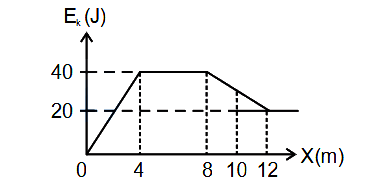 WBJEE 2022 Easy
More PYQs from WBJEE
- Sulphuryl chloride \(\left(\mathrm{SO}_{2} \mathrm{Cl}_{2}\right.\) ) reacts with white phosphorus \(\left(\mathrm{P}_{4}\right)\) to giveWBJEE 2015 Easy
- The chord of the curve \(y=x^{2}+2 a x+b\) joining the points where \(x=\alpha\) and \(x=\beta,\) is parallel to the tangent to the curve at abscissa \(x\) is equal toWBJEE 2017 Medium
- When a certain metal surface is illuminated with light of frequency \(v\), the stopping potential for photoelectric current is \(V_{0}\). When the same surface is illuminated by light of frequency \(\frac{v}{2}\) the stopping potential is \(\frac{V_{0}}{4} .\) The threshold
frequency for photoelectric, emission isWBJEE 2012 Easy - \(\lim _{n \rightarrow \infty} \frac{\sqrt{n}}{\sqrt{\left(n^{3}\right)}}+\frac{\sqrt{n}}{\sqrt{(n+4)^{3}}}+\frac{\sqrt{n}}{\sqrt{(n+8)^{3}}}+\cdots \cdots \cdots+\frac{\sqrt{n}}{\sqrt{[n+4(n-1)]^{3}}}\) isWBJEE 2021 Hard
-
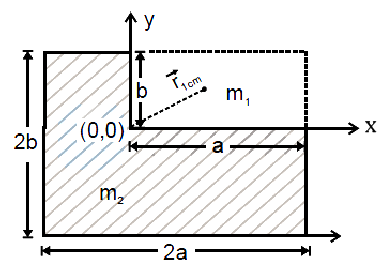
The position of the centre of mass of the uniform plate as shown in the figure isWBJEE 2024 Medium - A photon of wavelength 300 nm interacts with a stationary hydrogen atom in ground state. During the interaction, whole energy the photon is transferred to the electron of the atom. State which possibility is correst. (Consider, Plank constant \(=4 \times 10^{-15} eV_{s},\) velocity of light \(=3 \times 10^{8} \mathrm{m} / \mathrm{s},\) ionisation energy of hydrogen \(=13.6 \mathrm{eV}\) )WBJEE 2015 Hard