


WBJEE · Physics · Ray Optics
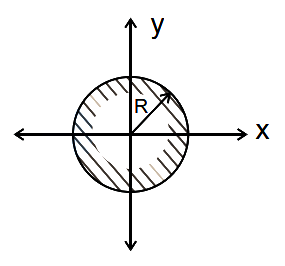
The cross-section of a reflecting surface is represented by the equation \(x^{2}+y^{2}=R^{2}\) as shown in the figure. A ray travelling in the positive \(x\) direction is directed toward positive y direction after reflection from the surface at point \(M\). The coordinate of the point \(\mathrm{M}\) on the reflecting surface is
- A \(\left(\frac{\mathrm{R}}{\sqrt{2}}, \frac{\mathrm{R}}{\sqrt{2}}\right)\)
- B \(\left(-\frac{\mathrm{R}}{2},-\frac{\mathrm{R}}{2}\right)\)
- C \(\left(-\frac{R}{\sqrt{2}}, \frac{R}{\sqrt{2}}\right)\)
- D \(\left(\frac{R}{\sqrt{2}},-\frac{R}{\sqrt{2}}\right)\)
Answer & Solution
Correct Answer
(C) \(\left(-\frac{R}{\sqrt{2}}, \frac{R}{\sqrt{2}}\right)\)
Step-by-step Solution
Detailed explanation
\(x^{2}+y^{2}=R^{2}\) \(2 x+2 y \frac{d y}{d x}=0\) \(\frac{d y}{d x}=-\frac{x}{y}=\tan 45^{\circ}=1\) \(\therefore x=-\frac{R}{\sqrt{2}}\) \(y=+\frac{R}{\sqrt{2}}\)
See the Complete Solution
Get step-by-step explanations for this and 2.5 Lakh+ more JEE, NEET & CET questions.
- Unlock all solutions
- Practice the full chapter
- Track accuracy across PYQs
4.8 rated on Google Play · 14,000+ reviews
More questions from Physics
- The de-Broglie wavelength of an electron moving with a velocity \(c / 2\) ( \(c=\) velocity of light in vacuum) is equal to the wavelength of a photon. The ratio of the kinetic energies of electron and photon isWBJEE 2012 Medium
- Two wires of same radius having lengths \(l_{1}\)
and \(I_{2}\) and resistivities \(\rho_{1}\) and \(\rho_{2}\) are connected in series. The equivalent resistivity will beWBJEE 2016 Medium - If pressure of real gas \(\mathrm{O}_{2}\) in a container is given by \(\mathrm{P}=\frac{\mathrm{RT}}{2 \mathrm{~V}-\mathrm{b}}-\frac{\mathrm{a}}{4 \mathrm{~b}^{2}}\), then the mass of the gas in the container isWBJEE 2021 Medium
- A charged particle moves with constant velocity in a region where no effect of gravity is felt but an electrostatic field \(\overrightarrow{\mathrm{E}}\)
together with a magnetic field \(\vec{B}\) may be present. Then which of the following cases are possible?WBJEE 2020 Easy - A single slit diffraction pattern is obtained using a beam of red light. If red light is replaced by blue light thenWBJEE 2025 Easy
- A body floats in water with \(40 \%\) of its volume outside water. When the same body floats in oil, \(60 \%\) of its volume remains outside oil. The relative density of the oil isWBJEE 2010 Easy
More PYQs from WBJEE
- The solution of the differential equation \(y \frac{d y}{d x}=x\left[\frac{y^{2}}{x^{2}}+\frac{\phi\left(\frac{y^{2}}{x^{2}}\right)}{\phi^{\prime}\left(\frac{y^{2}}{x^{2}}\right)}\right]\) is (where, \(c\) is a constant)WBJEE 2014 Hard
- An alternating current of rms value \(10 \mathrm{~A}\) is passed through a \(12 \Omega\) resistor. The maximum potential difference across the resistor isWBJEE 2009 Easy
- The number of \(\sigma\) and \(\pi\) bonds between two carbon atoms in calcium carbide areWBJEE 2016 Easy
- Let \(f:[1,3] \rightarrow R\) be a continuous function that is differentiable in (1,3) an \(f^{\prime}(x)=|f(x)|^{2}+4\) for all \(x \in(1,3).\) Then,WBJEE 2019 Medium
- The value of \(\lambda\) for which the straight line \(\frac{x-\lambda}{3}=\frac{y-1}{2+\lambda}=\frac{z-3}{-1}\) may lie on the plane \(x-2 y=0,\) isWBJEE 2015 Easy
- If a person can throw a stone to maximum height of \(\mathrm{h}\) metre vertically, then the maximum distance through which it can be thrown horizontally by the same person isWBJEE 2011 Medium