


WBJEE · Physics · Oscillations
In case of a simple harmonic motion, if the velocity is plotted along the \(X\) -axis and the displacement (from the equilibrium position) is plotted along the \(Y\) -axis, the resultant curve happens to be an ellipse with the ratio:
major axis (along X) \(=20 \pi\) minor axis (along \(Y)\)
What is the frequency of the simple harmonic motion?
- A \(100 \mathrm{Hz}\)
- B \(20 \mathrm{Hz}\)
- C \(10 \mathrm{Hz}\)
- D \(\frac{1}{10} \mathrm{Hz}\)
Answer & Solution
Correct Answer
(C) \(10 \mathrm{Hz}\)
Step-by-step Solution
Detailed explanation
In representation of simple harmonic motion in ellipse as velocity along \(X\) -axis and displacement along \(Y\) -axis. \(\frac{\text { Major axis (along } X \text { -axis) }}{\text { Minor axis (along } X \text { -axis) }}=20 \pi\)…
See the Complete Solution
Get step-by-step explanations for this and 2.5 Lakh+ more JEE, NEET & CET questions.
- Unlock all solutions
- Practice the full chapter
- Track accuracy across PYQs
4.8 rated on Google Play · 14,000+ reviews
More questions from Physics
- The ratio of magnetic field and magnetic moment at the centre of a current carrying circular loop is \(x\). When both the current and radius is doubled the ratio will beWBJEE 2010 Medium
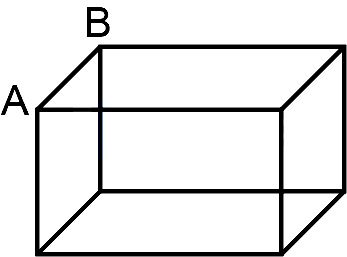
- The effective resistance between \(A\) and \(B\) in the figure is \(\frac{7}{12} \Omega\) if each side of the cube has \(1 \Omega\) resistance. The effective resistance between the same two points, when the link \(A B\) is removed, is
 WBJEE 2016 Medium
 - A spring of force constant \(\mathrm{k}\) is cut into two equal halves. The force constant of each half isWBJEE 2009 Medium
- A stone of relative density \(\mathrm{K}\) is released from rest on the surface of a lake. If viscous effects are ignored, the stone sinks in water with an acceleration ofWBJEE 2011 Easy
- A spherical convex surface of power 5 dioptre separates object and image space of refractive indices \(1.0\) and \(\frac{4}{3}\) respectively. The radius of curvature of the surface isWBJEE 2021 Medium
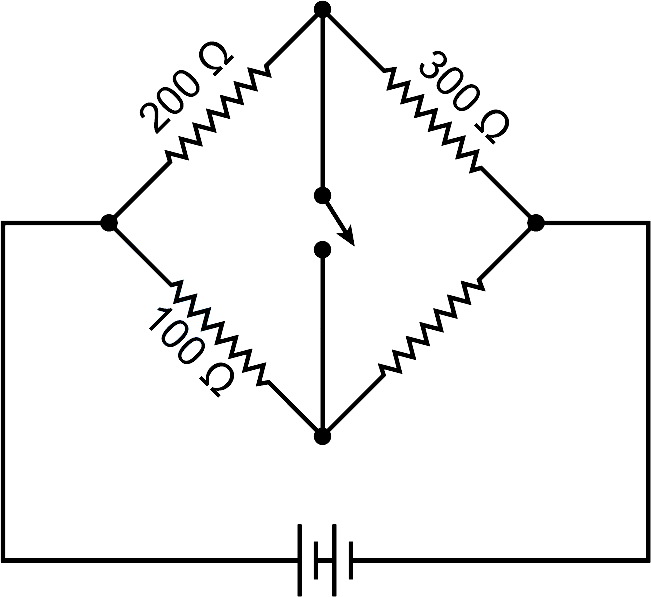
- A non-zero current passes through the galvanometer \(G\) shown in the circuit when the key \(K\) is closed and its value does not change when the key is opened. Then, which of the following statement(s) is/are true?
 WBJEE 2018 Hard
More PYQs from WBJEE
- The conductivity measurement of a coordination compound of cobalt (III) shows that it dissociates into 3 ions in solution. The compound isWBJEE 2019 Hard
- \(\int \frac{\log \sqrt{\mathrm{x}}}{3 \mathrm{x}} \mathrm{dx}\) is equal toWBJEE 2010 Easy
- If the sum of the squares of the roots of the equation \(x^2-(a-2) x-(a+1)=0\) is least for an appropriate value of the variable parameter \(a\), then the value of ' \(a\) ' will beWBJEE 2025 Medium
- \(\left|\begin{array}{lll}a-b & b-c & c-a \\ b-c & c-a & a-b \\ c-a & a-b & b-c\end{array}\right|=\)WBJEE 2011 Easy
- If for a matrix \(A,|A|=6\) and adj \(A=\left[\begin{array}{ccc}1 & -2, & 4 \\ 4 & 1 & 1 \\ -1 & k & 0\end{array}\right]\), then \(k\) is equal toWBJEE 2025 Medium
- \(\mathrm{A}=\{1,2,3,4\}, \mathrm{B}=\{1,2,3,4,5,6\}\) are two sets, and function \(\mathrm{f}: \mathrm{A} \rightarrow \mathrm{B}\) is defined by \(\mathrm{f}(\mathrm{x})=\mathrm{x}+2 \forall \mathrm{x} \in \mathrm{A}\), then the function \(\mathrm{f}\) isWBJEE 2010 Easy