


WBJEE · Physics · Units and Dimensions
If the dimensions of length are expressed as \(\mathrm{G}^{\times} \mathrm{C}^y \mathrm{~h}^{\mathrm{z}}\), where \(\mathrm{G}, \mathrm{C}\) and h are the universal gravitational constant, speed of light and Planck's constant respectively, then
- A \(\mathrm{x}=\frac{1}{2}, \mathrm{y}=\frac{1}{2}\)
- B \(x=\frac{1}{2}, z=\frac{1}{2}\)
- C \(y=\frac{1}{2}, z=\frac{3}{2}\)
- D \(y=-\frac{3}{2}, z=\frac{1}{2}\)
Answer & Solution
Correct Answer
(D) \(y=-\frac{3}{2}, z=\frac{1}{2}\)
Step-by-step Solution
Detailed explanation
\begin{array}{ll}\text { } L=\left[M^{-1} L^3 T^{-2}\right]^x\left[L T^{-1}\right]^y\left[M L^2 T^{-1}\right]^z \\ M^0 L T^0=M^{-x+z} L^{3 x+y+2 z} T^{-2 x-y-2} & \\ -x+z=0 ; \quad 3 x+y+2 z=1 ; \qquad 2 x+y+z=0 \\ x=z ; \quad \qquad 2 z=1 \qquad \qquad \qquad 3x+y=0 \\ \qquad…
See the Complete Solution
Get step-by-step explanations for this and 2.5 Lakh+ more JEE, NEET & CET questions.
- Unlock all solutions
- Practice the full chapter
- Track accuracy across PYQs
4.8 rated on Google Play · 14,000+ reviews
More questions from Physics
- A mouse of mass \(\mathrm{m}\) jumps on the outside edge of a rotating ceiling fan of moment of inertia I and radius \(\mathrm{R}\). The fractional loss of angular velocity of the fan as a result isWBJEE 2023 Medium
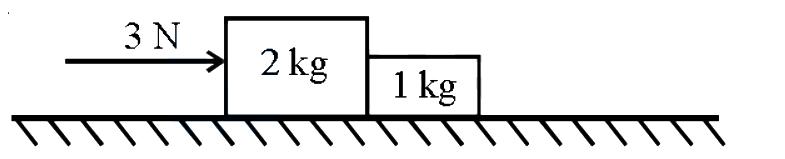
- Two blocks of \(2 \mathrm{~kg}\) and \(1 \mathrm{~kg}\) are in contact on a frictionless table. If a force of \(3 \mathrm{~N}\) is applied on \(2 \mathrm{~kg}\) block, then the force of contact between the two blocks will be :
 WBJEE 2010 Medium
 - At a particular height, the velocity of an ascending body is \(\mathbf{u}\). The velocity at the same height while the body falls freely isWBJEE 2016 Medium
- A beam of monochromatic blue light of wavelength \(4200 Å\) in air travels in water of refractive index \(4 / 3\). Its wavelength in water will be:WBJEE 2009 Medium
- A wire of resistance \(\mathrm{R}\) is elongated \(n\)-fold to make a new uniform wire. The resistance of new wireWBJEE 2010 Medium
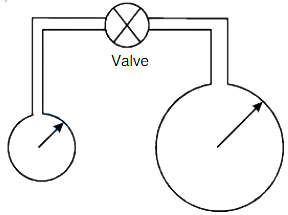
- Two soap bubbles of radii \(r\) and \(2 r\) are arrangement shown in the diagram. The valve is now opened. Then which one of the following will result.
 WBJEE 2013 Medium
More PYQs from WBJEE
- The length of a metal wire is \(L_{1}\) when the tension is \(T_{1}\) and \(L_{2}\) when the tension is \(T_{2}\) The unstretched length of wire isWBJEE 2015 Medium
- Which of the following compounds shows evidence of the strongest hydrogen bonding?WBJEE 2010 Easy
- Two coins are available, one fair and the other two-headed. Choose a coin and toss it once; assume that the unbiased coin is chosen with probability \(\frac{3}{4}\), Given that the outcome is head, the probability that the two-headed coin was chosen, isWBJEE 2012 Easy
- If \(\mathrm{Cl}_{2}\) is passed through hot aqueous \(\mathrm{NaOH}\), the products formed have Cl in different oxidation states. These are indicated asWBJEE 2014 Easy
- Equal volumes of aqueous solution of \(0.1(\mathrm{M}) \mathrm{HCl}\) and \(0.2(\mathrm{M}) \mathrm{H}_2 \mathrm{SO}_4\) are mixed. The concentration of \(\mathrm{H}^{+}\)ions in the resulting solution isWBJEE 2024 Easy
- Let \(y=f(x)\) be any curve on the \(X-Y\) plane \& \(P\) be a point on the curve. Let \(C\) be a fixed point not on the curve. The length \(P C\) is either a maximum or a minimum, thenWBJEE 2024 Medium