


WBJEE · Physics · Rotational Motion
A thin rod \(A B\) is held horizontally so that it can freely rotate in a vertical plane about the end \(A\) as shown in the figure. The potential energy of the rod when it hangs vertically is taken to be zero. The end \(B\) of the rod is released from rest from a horizontal position. At the instant the rod makes an angle \(\theta\) with the horizontal
- A the speed of end \(B\) is proportional to \(\sqrt{\sin \theta}\)
- B the potential energy is proportional to \((1-\cos \theta)\)
- C the angular acceleration is proportional to \(\cos \theta\)
- D the torque about \(A\) remains the same as its initial value
Answer & Solution
Correct Answer
(C) the angular acceleration is proportional to \(\cos \theta\)
Step-by-step Solution
Detailed explanation
Loss in potential energy = gain in kinetic energy \(\Rightarrow \quad m g \frac{L}{2} \sin \theta=\frac{1}{2} I \omega^{2}\) So \(\omega \propto \sqrt{\sin \theta}\) and \(\quad v \propto \sqrt{\sin \theta} \quad\left(\because K=\frac{1}{2} \mathrm{H} \omega^{2}\right)\) The…
See the Complete Solution
Get step-by-step explanations for this and 2.5 Lakh+ more JEE, NEET & CET questions.
- Unlock all solutions
- Practice the full chapter
- Track accuracy across PYQs
4.8 rated on Google Play · 14,000+ reviews
More questions from Physics
- 3 moles of mono-atomic gas \((\gamma=5 / 3)\) is mixed with 1 mole of a diatomic gas \((\gamma=7 / 3) .\) The value of \(\gamma\) for the mixture will beWBJEE 2013 Easy
- A proton and an electron initially at rest are accelerated by the same potential difference. Assuming that a proton is 2000 times heavier than an electron, what will be the relation between the de Broglie wavelength of the proton \(\left(\lambda_{p}\right)\) and that of electron \(\left(\lambda_{c}\right) ?\)WBJEE 2019 Medium
- Consider a black body radiation in a cubical box at absolute temperature \(T\). If the length of each side of the box is doubled and the temperature of the walls of the box and that of the radiation is halved, then the total energyWBJEE 2014 Medium
- Let \(\overline{\mathrm{V}}, \mathrm{V}_{\mathrm{rms}}, \mathrm{V}_{\mathrm{p}}\) denotes the mean speed, root mean square speed and most probable speed of the molecules each of mass \(m\) in an ideal monoatomic gas at absolute temperature T Kelvin. Which statement(s) is/are correct?WBJEE 2025 Medium
-
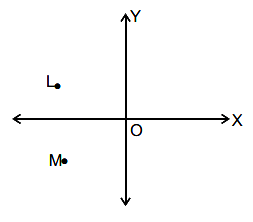
Consider two infinitely long wires parallel to Z-axis carrying same current I in the positive Z direction. One wire passes through the point \(L\) at coordinates \((-1,+1)\) and the other wire passes through the point \(M\) at coordinates \((-1,-1)\). The resultant magnetic field at the origin \(\mathrm{O}\) will beWBJEE 2021 Medium - The ratio of the diameter of the sun to the distance between the earth and the sun is approximately \(0.009 .\) The approximate diameter of the image of the sun formed by a concave spherical mirror of radius of curvature \(0.4 \mathrm{m}\) isWBJEE 2017 Medium
More PYQs from WBJEE
- Let \(\alpha, \beta\) denote the cube roots of unity other than 1 and \(\alpha \neq \beta .\) Let \(S=\sum_{n=0}^{\infty}(-1)^{n}\left(\frac{\alpha}{\beta}\right)^{n} .\) Then the value of \(S\) isWBJEE 2014 Medium
- The number of solutions of the equation \(x+y+z=10\) where \(x, y\) and \(z\) are positive integersWBJEE 2013 Easy
- The value of \(\lim _{n \rightarrow \infty}\left[\frac{n}{n^2+1^2}+\frac{n}{n^2+2^2}+\ldots \ldots . . \frac{n}{n^2+n^2}\right]\) isWBJEE 2009 Medium
- The period of the function \(f(x)=\cos 4 x+\tan 3 x\) isWBJEE 2011 Easy
- If the Earth were to suddenly contract to \(\frac{1}{n}\) th of its present radius without any change in its mass, the duration of the new day will be nearlyWBJEE 2011 Hard
- How much solid oxalic acid (Molecular weight 126 ) has to be weighed to prepare \(100 \mathrm{~mL}\) exactly \(0.1\) (N) oxalic acid solution in water?WBJEE 2022 Easy