


WBJEE · Physics · Nuclear Physics
A nucleus X emits a beta particle to produce a nucleus Y. If their atomic masses are \(\mathrm{M}_{\mathrm{x}}\) and \(\mathrm{M}_{\mathrm{y}}\) respectively, the maximum energy of the beta particle emitted is (where \(m_{e}\) is the mass of an electron and \(c\) is the velocity of light)
- A \(\left(\mathrm{M}_{\mathrm{x}}-\mathrm{M}_{\mathrm{y}}-\mathrm{m}_{\mathrm{e}}\right) \mathrm{c}^{2}\)
- B \(\left(M_{x}-M_{y}+m_{e}\right) \mathrm{c}^{2}\)
- C \(\left(M_{x}-M_{y}\right) \mathrm{c}^{2}\)
- D \(\left(M_{x}-M_{y}-2 m_{e}\right) \mathrm{c}^{2}\)
Answer & Solution
Correct Answer
(C) \(\left(M_{x}-M_{y}\right) \mathrm{c}^{2}\)
Step-by-step Solution
Detailed explanation
Hint: \(\mathrm{m}_{\mathrm{x}}=\mathrm{M}_{\mathrm{x}}-\mathrm{zm}_{\mathrm{e}}\)…
See the Complete Solution
Get step-by-step explanations for this and 2.5 Lakh+ more JEE, NEET & CET questions.
- Unlock all solutions
- Practice the full chapter
- Track accuracy across PYQs
4.8 rated on Google Play · 14,000+ reviews
More questions from Physics
- The equation of state for \(\mathrm{n}\) moles of an ideal gas is \(\mathrm{PV}=\mathrm{nRT}\), where \(\mathrm{R}\) is a constant. The SI unit for \(\mathrm{R}\) isWBJEE 2009 Easy
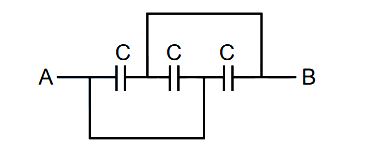
- Find the equivalent capacitance between \(A\) and \(B\) of the following arrangement :
 WBJEE 2022 Easy
 - In a closed circuit there is only a coil of inductance \(L\) and resistance \(100 \Omega\). The coil is situated in a uniform magnetic field. All on a sudden, the magnetic flux linked with the circuit changes by \(5 \mathrm{Weber}\). What amount of charge will flow in the circuit as a result?WBJEE 2022 Easy
- A travelling acoustic wave frequency \(500 \mathrm{Hz}\) is moving along the positive \(x\) -direction with a velocity of \(300 \mathrm{ms}^{-1}\). The phase difference between two points \(x_{1}\) and \(x_{2}\) is \(60^{\circ} .\) Then the minimum separation between the two points isWBJEE 2013 Easy
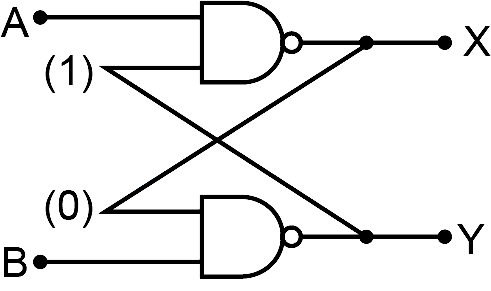
- In the circuit shown, inputs \(A\) and \(B\) are in states 1 and 0 respectively. What is the only possible stable state of the outputs \(X\) and \(Y ?\)
 WBJEE 2018 Easy
 - The displacement of a particle in S.H.M. varies according to the relation \(x=4(\cos \pi t+\sin \pi \mathrm{t})\). The amplitude of the particle isWBJEE 2011 Easy
More PYQs from WBJEE
- Ribose and 2 -deoxyribose can be differentiated byWBJEE 2013 Medium
- A piece of wood from an archaeological sample has 5.0 counts min \(^{-1}\) per gram of \(\mathrm{C} - 14,\) while a fresh sample of wood has a count of \(15.0 \mathrm{min}^{-1} \mathrm{g}^{-1}\). If half-life of \(\mathrm{C}-14\) is \(5770 \mathrm{yr}\) the age of the archaeological sample isWBJEE 2014 Medium
- In an experiment, the length of an object is measured to be \(6.50 \mathrm{~cm}\). This measured value can be written as \(0.0650 \mathrm{~m}\). The number of significant figures on \(0.0650 \mathrm{~m}\) isWBJEE 2023 Easy
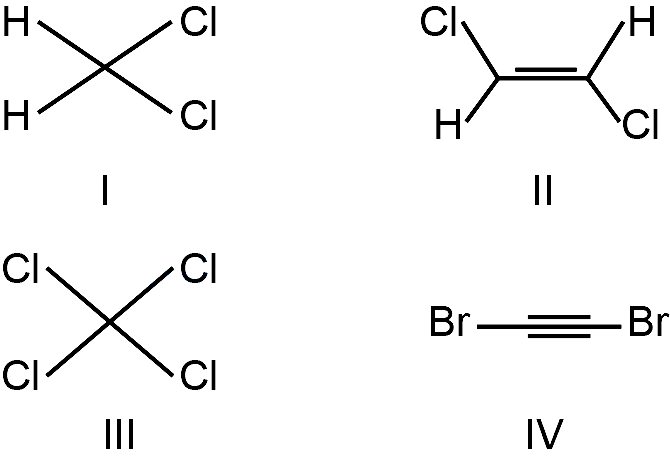
- The compound that will have a permanent dipole moment among the following is
 WBJEE 2014 Easy
 - The general value of the real angle \(\theta\), which satisfies the equation. \((\cos \theta+i \sin \theta)(\cos 2 \theta+i \sin 2 \theta) \ldots(\cos n \theta+t \sin n \theta)=1\) is given by, (assuming \(k\) is an integer)WBJEE 2019 Medium
- A line passing through the point of intersection of \(x+y=4\) and \(x-y=2\) makes an angle \(\tan ^{-1}\left(\frac{3}{4}\right)\) with the \(x\) -axis. It intersects the parabola \(y^{2}=4(x-3)\) at points \(\left(x_{1}, y_{1}\right)\) and \(\left(x_{2}, y_{2}\right)\) respectively. Then, \(\left|x_{1}-x_{2}\right|\) is equal toWBJEE 2013 Hard