


WBJEE · Maths · Differential Equations
The general solution of the differential equation \(\left(1+e^{\frac{x}{y}}\right) d x+\left(1-\frac{x}{y}\right) e^{x / y} d y=0\) is\((C\) is an arbitrary constant \()\)
- A \(x-y e^{\frac{x}{y}}=C\)
- B \(y-x e^{\frac{x}{y}}=C\)
- C \(x+y e^{\frac{x}{y}}=C\)
- D \(y+x e^{\frac{x}{y}}=C\)
Answer & Solution
Correct Answer
(C) \(x+y e^{\frac{x}{y}}=C\)
Step-by-step Solution
Detailed explanation
\(\left(1+e^{\frac{x}{y}}\right) d x+\left(1-\frac{x}{y}\right) e^{x / y} d y=0\) \(\Rightarrow \quad\left(1+e^{x / y}\right) d x=-e^{x / y}\left(1-\frac{x}{y}\right) d y\) \(\Rightarrow \quad \frac{d x}{d y}=\frac{-e^{x / y}(1-x / y)}{\left(1+e^{x / y}\right)}\) ...(i) This is…
See the Complete Solution
Get step-by-step explanations for this and 2.5 Lakh+ more JEE, NEET & CET questions.
- Unlock all solutions
- Practice the full chapter
- Track accuracy across PYQs
4.8 rated on Google Play · 14,000+ reviews
More questions from Maths
- The value of \(\int_0^{\pi / 2} \frac{(\cos x)^{\sin x}}{(\cos x)^{\sin x}+(\sin x)^{\cos x}} d x\) isWBJEE 2022 Easy
- If \(x=1+\frac{1}{2 \times 1 !}+\frac{1}{4 \times 2 !}+\frac{1}{8 \times 3 !}+\ldots\) and
\(y=1+\frac{x^{2}}{1 !}+\frac{x^{4}}{2 !}+\frac{x^{6}}{3 !}+\ldots\)
Then, the value of loge \(y\) isWBJEE 2013 Medium - Ram is visiting a friend. Ram knows that his friend has 2 children and 1 of them is a boy. Assuming that a child is equally likely to be a boy or a girl, then the probability that the other child is a girl, isWBJEE 2014 Medium
- Let \(\alpha\) and \(\beta\) be the roots of \(x^{2}+x+1=0 .\) If \(n\) be a positive integer, then \(\alpha^{n}+\beta^{n}\) isWBJEE 2017 Medium
- If \(A=\left(\begin{array}{cc}\cos \theta & -\sin \theta \\ \sin \theta & \cos \theta\end{array}\right)\) and \(\theta=\frac{2 \pi}{7}\), then \(A^{100}=A \times A \times \ldots .(100\) times \()\) is equal toWBJEE 2024 Easy
- If \(z_{1}=2+3 i\) and \(z_{2}=3+4 i\) be two points on the complex plane. Then, the set of complex number \(z\) satisfying \(\left|z-z_{1}\right|^{2}+\left|z-z_{2}\right|^{2}\)
\(=\left|z_{1}-z_{2}\right|^{2}\) representsWBJEE 2013 Medium
More PYQs from WBJEE
- Amongst the following compounds, the one(s) which readily react with ethanolic KCN.WBJEE 2016 Medium
-
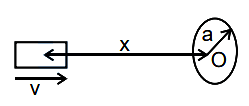
A small bar magnet of dipole moment \(M\) is moving with speed \(v\) along \(x\) direction towards a small closed circular conducting loop of radius ' \(a\) ' with its centre \(O\) at \(x=0\) (see figure). Assume \(x>>a\) and the coil has a resistance \(R\). Then which of the following statemenmt(s) is/are true?WBJEE 2021 Medium - If \(f(x)=\left\{\begin{array}{ll}x^2+3 x+a, & x \leq 1 \\ b x+2, & x\gt1\end{array}, x \in \mathbb{R}\right.\), is everywhere differentiable, thenWBJEE 2025 Medium
- Which of the following statements is correct for a spontaneous polymerization reaction ?WBJEE 2024 Easy
- If \(p, q\) are odd integers, then the roots of the equation \(2 p x^{2}+(2 p+q) x+q=0\) areWBJEE 2017 Easy
- \(\mathrm{CH}_{3}-\mathrm{C} \equiv \mathrm{C} \mathrm{MgBr}\) can be prepared by the
reaction ofWBJEE 2018 Easy