


WBJEE · Maths · Application of Derivatives
Let \(f(x)=(x-2)^{17}(x+5)^{24}\). Then
- A \(f\) does not have a critical point at \(x=2\)
- B \(f\) has a minimum at \(x=2\)
- C \(f\) has neither a maximum nor a minimum at \(x=2\)
- D f has a maximum at \(x=2\)
Answer & Solution
Correct Answer
(C) \(f\) has neither a maximum nor a minimum at \(x=2\)
Step-by-step Solution
Detailed explanation
\(\begin{aligned} & f(x)=(x-2)^{17}(x+5)^{24} \\ \Rightarrow & f^{\prime}(x)=17(x-2)^{16}(x+5)^{24}+24(x-2)^{17}(x+5)^{23}=(x-2)^{16}(x+5)^{23}(17 x+85+24 x-48)=(x-2)^{16}(x+5)^{23}(41 x+37) \end{aligned}\)
See the Complete Solution
Get step-by-step explanations for this and 2.5 Lakh+ more JEE, NEET & CET questions.
- Unlock all solutions
- Practice the full chapter
- Track accuracy across PYQs
4.8 rated on Google Play · 14,000+ reviews
More questions from Maths
- \(\lim _{x \rightarrow 0}\left(\frac{1}{x} \ln \sqrt{\frac{1+x}{1-x}}\right)\) isWBJEE 2022 Medium
- Sand \(T\) are the foci of an ellipse and \(B\) is the end point of the minor axis. If \(S T B\) is equilateral triangle, the eccentricity of the ellipse isWBJEE 2019 Easy
- Let \(A(-1,0)\) and \(B(2,0)\) be two points. \(A\) point \(M\) moves in the plane in such a way that \(\angle M B A=2 \angle M A B .\) Then, the point \(M\) moves alongWBJEE 2017 Medium
- The equation \(r \cos \theta=2 a \sin ^2 \theta\) represents the curveWBJEE 2024 Easy
- Two circle \(S_1=p x^2+p y^2+2 g^{\prime} x+2 f^{\prime} y+d=0\) and \(S_2=x^2+y^2+2 g x+2 f y+d^{\prime}=0\) have a common chord \(P Q\). The equation of \(\mathrm{PQ}\) isWBJEE 2022 Easy
- Let \(A(2 \sec \theta, 3 \tan \theta)\) and \(B(2 \sec \phi, 3 \tan \phi)\) where \(\theta+\phi=\frac{\pi}{2}\) be two points on the hyperbola \(\frac{x^2}{4}-\frac{y^2}{9}=1\). If \((\alpha, \beta)\) is the point of intersection of normals to the hyperbola at \(A\) and \(B\), then \(\beta\) is equal toWBJEE 2023 Medium
More PYQs from WBJEE
- Which of the following statements are true?WBJEE 2023 Easy
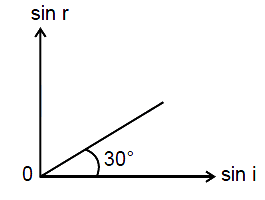
- A ray of monochromatic light is incident on the plane surface of separation between two media \(X\) and \(Y\) with angle of incidence 'i' in medium \(X\) and angle of refraction ' \(r\) ' in medium \(Y\). The given graph shows the relation between sin \(i\) and \(\sin r\). If \(V_x\) and \(V_{\mathrm{Y}}\) are the velocities of the ray in media \(X\) and \(Y\) respectively, then which of the following is true?
 WBJEE 2023 Hard
 - Metallic conductors and semiconductors are heated separately. What are the changes with respect to conductivity?WBJEE 2024 Easy
- Let \(\phi(x)=f(x)+f(1-x)\) and \(f^{\prime \prime}(x) < 0\) in \([0,1]\), thenWBJEE 2020 Medium
- An electrical cable having a resistance of \(0.2 \Omega\) delivers \(10 \mathrm{kw}\) at \(200 \mathrm{~V}\) D.C. to a factory. What is the efficiency of transmission?WBJEE 2009 Easy
- The monomer used to produce orlon isWBJEE 2009 Easy