


WBJEE · Maths · Differentiation
Let \(F(x)=e^{x}, G(x)=e^{-x}\) and \(H(x)=G(F(x)),\) where \(x\) is a real variable. Then, \(\frac{d H}{d x}\) at \(x=0\) is
- A 1
- B -1
- C \(-\frac{1}{e}\)
- D \(-e\)
Answer & Solution
Correct Answer
(C) \(-\frac{1}{e}\)
Step-by-step Solution
Detailed explanation
We have, \(F(x)=e^{x}, G(x)=e^{-x}\) \(\therefore \quad H(x)=G(F(x))\) \(\begin{aligned} &=G\left(e^{x}\right) \\ &=e^{-e^{x}} \\ \frac{d H}{d x} &=e^{-e^{x}} \cdot\left(-e^{x}\right) \\ &=-e^{x} e^{-e^{x}} \end{aligned}\)…
See the Complete Solution
Get step-by-step explanations for this and 2.5 Lakh+ more JEE, NEET & CET questions.
- Unlock all solutions
- Practice the full chapter
- Track accuracy across PYQs
4.8 rated on Google Play · 14,000+ reviews
More questions from Maths
- \(\lim _{x \rightarrow 0^{+}}\left(e^{x}+x\right)^{1 / x}\)WBJEE 2019 Medium
- The line \(y-\sqrt{3} x+3=0\) cuts the parabola \(y^2=x+2\) at the points \(P\) and \(Q\). If the co-ordinates of the point \(X\) are \((\sqrt{3}, 0)\), then the value of \(X P \cdot X Q\) isWBJEE 2025 Medium
- The number of points at which the function \(f(x)=\max \{a-x, a+x, b\},-\infty < x < \infty\) \(0 < a < b\) cannot be differentiable, isWBJEE 2016 Medium
- On the occasion of Dipawali festival each student of a class sends greeting cards to others. If there are 20 students in the class. the number of cards sends by students isWBJEE 2018 Medium
- Let \(\cos ^{-1}\left(\frac{y}{b}\right)=\log _e\left(\frac{x}{n}\right)^n\), then \(A y_2+B y_1+C y=0\) is possible forWBJEE 2023 Hard
- Ram is visiting a friend. Ram knows that his friend has 2 children and 1 of them is a boy. Assuming that a child is equally likely to be a boy or a girl, then the probability that the other child is a girl, isWBJEE 2014 Medium
More PYQs from WBJEE
- Without changing the direction of the axes, the origin is transferred to the point (2,3) . Then the equation \(x^{2}+y^{2}-4 x-6 y+9=0\) changes toWBJEE 2018 Medium
- At STP, the dissociation reaction of water is \(\mathrm{H}_2 \mathrm{O} \rightleftharpoons \mathrm{H}^{+}\)(aq.) \(+\mathrm{OH}^{-}\)(aq.), and the \(\mathrm{pH}\) of water is 7.0. The change of standard free energy \(\left(\Delta \mathrm{G}^{\circ}\right)\) for the above dissociation process is given byWBJEE 2023 Medium
- Avogadro's law is valid forWBJEE 2022 Easy
- The IUPAC name of the compound \(X\) is
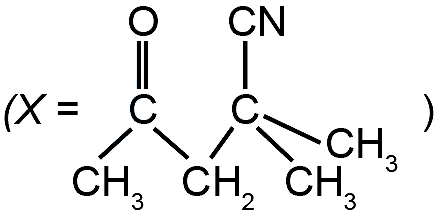 WBJEE 2013 Easy
 - A very long charged solid cylinder of radius 'a' contains a uniform charge density \(\rho\). Dielectric constant of the material of the cylinder is \(\mathrm{k}\). What will be the magnitude of electric field at a radial distance ' \(x^{\prime}(x < a)\) from the axis of the cylinder?WBJEE 2020 Hard
- The area of the region \(\left\{(x, y): x^{2}+y^{2} \leq 1 \leq x+y\right\}\) isWBJEE 2020 Medium