


WBJEE · Maths · Definite Integration
Let \(\mathrm{f}\) be derivable in \([0,1]\), then
- A there exists \(c \in(0,1)\) such that \(\int_0^c f(x) d x=(1-c) f(c)\)
- B there does not exist any point \(d \in(0,1)\) for which \(\int_0^d f(x) d x=(1-d) f(d)\)
- C \(\int_0^c f(x) d x\) does not exist, for any \(c \in(0,1)\)
- D \(\int_0^c f(x) d x\) is independent of \(c, c \in(0,1)\)
Answer & Solution
Correct Answer
(A) there exists \(c \in(0,1)\) such that \(\int_0^c f(x) d x=(1-c) f(c)\)
Step-by-step Solution
Detailed explanation
Let \(g(x)=x \int_0^x f(t) d t-\int_0^x f(t) d t\) Now, \(g(0)=0\) \(g(1)=0\) By Rolle's Theorem \(g^{\prime}(x)=0\) for some \(x \in(0,1)\) \(g^{\prime}(x)=x f(x)+\int_0^x f(t) d t-f(x)=0\)
See the Complete Solution
Get step-by-step explanations for this and 2.5 Lakh+ more JEE, NEET & CET questions.
- Unlock all solutions
- Practice the full chapter
- Track accuracy across PYQs
4.8 rated on Google Play · 14,000+ reviews
More questions from Maths
- If \(\lim _{x \rightarrow 0} \frac{a x e^{x}-b \log (1+x)}{x^{2}}=3\) then the values of \(a\) and \(b\) are, respectivelyWBJEE 2015 Easy
- If the line \(\mathrm{y}=\mathrm{x}\) is a tangent to the parabola \(\mathrm{y}=\mathrm{ax}^{2}+\mathrm{bx}+\mathrm{c}\) at the point \((1,1)\) and the curve passes through \((-1,0)\), thenWBJEE 2020 Medium
- A variable line passes through the fixed point \((\alpha, \beta) .\) The locus of the foot of the perpendicular from the origin on the line isWBJEE 2019 Medium
- If in the expansion of \((a-2 b)^{\mathrm{n}}\), the sum of the 5 th and 6 th term is zero, then the value of \(\frac{\mathrm{a}}{\mathrm{b}}\) isWBJEE 2010 Medium
- If ABC is an isosceles triangle and the coordinates of the base points are B(1, 3) and C(–2, 7). The coordinates of
A can beWBJEE 2024 Easy - The area of the region bounded by the curves \(y=x^{3}, y=\frac{1}{x}, x=2\) isWBJEE 2012 Easy
More PYQs from WBJEE
- For the reaction, \(2 \mathrm{SO}_{2}(\mathrm{g})+\mathrm{O}_{2}(\mathrm{g}) \rightleftharpoons 2 \mathrm{SO}_{3}(\mathrm{g}) \mathrm{at} 300 \mathrm{K},\) the
value of \(\Delta G^{\circ}\) is \(-690.9 R\). The equilibrium constant value for the reaction at that temperature is \((R\) is gas constant \()\)WBJEE 2015 Medium - The condition of spontaneity of a process isWBJEE 2013 Easy
- An amount of charge Q passes through a coil of resistance R. If the current in the coil decreases to zero at a uniform rate during time \(T\), then the amount of heat generated in the coil will be,WBJEE 2023 Medium
-
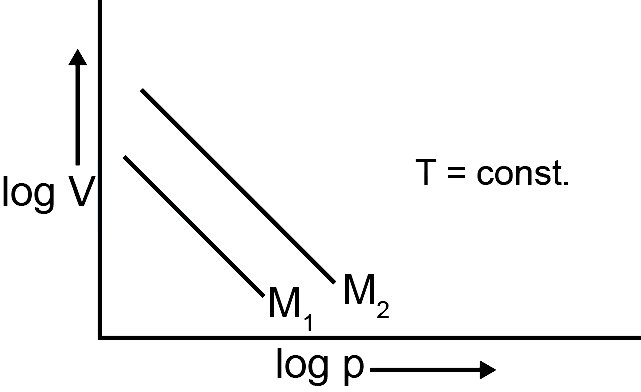
For same mass of two different ideal gases of molecular weights \(M_{1}\) and \(M_{2}\), Plots of log \(V\) vs log \(p\) at a given constant temperature are shown. Identify the correct option.WBJEE 2017 Hard - A cricket ball thrown across a field is at heights \(h_{1}\) and \(h_{2}\) from the point of projection at times \(t_{1}\) and \(t_{2}\) respectively after the throw. The ball is caught by a fielder at the same height as that of projection. The time of flight of the ball in this journey isWBJEE 2014 Hard
- If \(x=\sin \theta\) and \(y=\sin k \theta\), then \(\left(1-x^2\right) y_2-x y_1-\alpha y=0\), for \(\alpha=\)WBJEE 2023 Medium