


WBJEE · Maths · Determinants
Let \(f(\theta)=\left|\begin{array}{ccc}1 & \cos \theta & -1 \\ -\sin \theta & 1 & -\cos \theta \\ -1 & \sin \theta & 1\end{array}\right|\). Suppose \(A\) and \(B\) are respectively maximum and minimum values of \(f(\theta)\). Then \((A, B)\) is equal to
- A \((2,1)\)
- B \((2,0)\)
- C \((\sqrt{2}, 1)\)
- D \(\left(2, \frac{1}{\sqrt{2}}\right)\)
Answer & Solution
Correct Answer
(B) \((2,0)\)
Step-by-step Solution
Detailed explanation
\(\begin{aligned} & f(\theta)=\left|\begin{array}{ccc}1 & \cos \theta & -1 \\ -\sin \theta & 1 & -\cos \theta \\ -1 & \sin \theta & 1\end{array}\right| \text { (after expansion) } \\ & f(\theta)=1+\sin 2 \theta \\ & A=2, B=0 \quad(A, B)=(2,0)\end{aligned}\)
See the Complete Solution
Get step-by-step explanations for this and 2.5 Lakh+ more JEE, NEET & CET questions.
- Unlock all solutions
- Practice the full chapter
- Track accuracy across PYQs
4.8 rated on Google Play · 14,000+ reviews
More questions from Maths
- If \(x^{2}+y^{2}=a^{2}\), then \(\int_{0}^{a} \sqrt{1+\left(\frac{d y}{d x}\right)^{2}} d x=\)WBJEE 2020 Medium
- The value of \(\int_{-100}^{100} \frac{\left(x+x^3+x^5\right)}{\left(1+x^2+x^4+x^6\right)} d x\) isWBJEE 2025 Easy
- If \(\sin \theta=\frac{2 t}{1+t^2}\) and \(\theta\) lies in the second quadrant, then \(\cos \theta\) is equal toWBJEE 2011 Medium
- Let \(a=\min \left\{x^{2}+2 x+3: x \in R\right\}\) and \(b=\lim _{\theta \rightarrow 0} \frac{1-\cos \theta}{\theta^{2}} \cdot\) Then \(\sum_{r=0}^{n} a^{r} b^{n-r}\) isWBJEE 2019 Medium
- Let \(z_{1}\) and \(z_{2}\) be complex numbers such that \(z_{1} \neq z_{2}\) and \(\left|z_{1}\right|=\left|z_{2}\right| .\) If \(\operatorname{Re}\left(z_{1}\right)>0\) and
\(\operatorname{Im}\left(z_{2}\right) < 0,\) then \(\frac{z_{1}+z_{2}}{z_{1}-z_{2}}\) isWBJEE 2018 Medium - Two smallest squares are chosen one by one on a chess board. The probability that they have a side in common isWBJEE 2024 Easy
More PYQs from WBJEE
- If \(R\) be the set of all real numbers and \(f: R \rightarrow R\) is given by \(f(x)=3 x^{2}+1\). Then, the set \(f^{-1}([1,6])\) isWBJEE 2014 Medium
- A metal \(M\) (specific heat 0.16 ) forms a metal chloride with \(65 \%\) chlorine present in it. The formula of the metal chloride will beWBJEE 2018 Easy
- What will be current through the \(200 \Omega\)
resistor in the given circuit, a long time after the switch \(K\) is made on?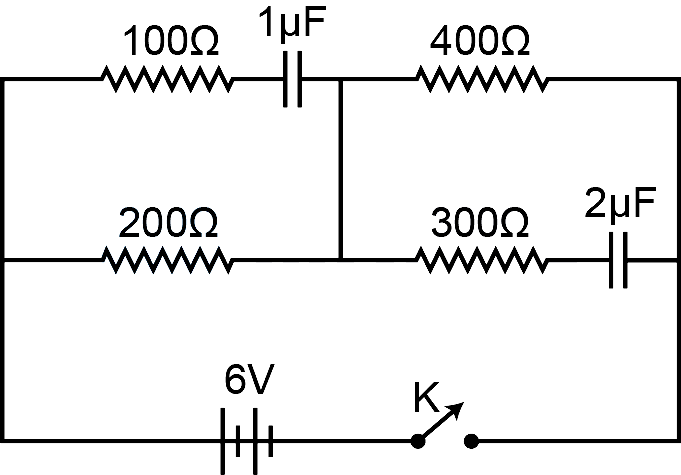 WBJEE 2018 Medium
 - In a certain test, there are n questions. In this test \(2^{n-i}\) students gave wrong answers to at least i questions, where i \(=1,2, \ldots \ldots \mathrm{n}\). If the total number of wrong answers given is 2047 , then \(\mathrm{n}\) is equal toWBJEE 2020 Hard
- What will be the approximate terminal velocity of a rain drop of diameter \(1.8 \times 10^{-3} \mathrm{m}\), when density of rain water \(\approx 10^{3} \mathrm{kgm}^{-3}\) and the coefficient of viscosity of air \(\approx 1.8 \times 10^{-5} \mathrm{N}-sm^{-2}\) ? (Neglect buoyancy of air)WBJEE 2018 Easy
- The value of
\(\lim _{n \rightarrow \infty} \sum_{r=1}^n \frac{r^3}{r^4+n^4} \text { is }\)WBJEE 2011 Hard