


WBJEE · Maths · Determinants
Let \(a, b, c\) be such that \(b(a+c) \times 0\)
If \(\left|\begin{array}{ccc}a & a+1 & a-1 \\ -b & b+1 & b-1 \\ c & c-1 & c+1\end{array}\right|\)
\(+\left|\begin{array}{ccc}a+1 & b+1 & c-1 \\ a-1 & b-1 & c+1 \\ (-1)^{n+2} a & (-1)^{n+1} b & (-1)^{n} c\end{array}\right|=0\)
then the value of \(n\) is
- A any integer
- B zero
- C any even integer
- D any odd integer
Answer & Solution
Correct Answer
(D) any odd integer
Step-by-step Solution
Detailed explanation
We have, \(\left|\begin{array}{ccc}a & a+1 & a-1 \\ -b & b+1 & b-1 \\ c & c-1 & c+1\end{array}\right|\) + \(\left|\begin{array}{ccc}a+1 & b+1 & c-1 \\ a-1 & b-1 & c+1 \\ (-1)^{n+2} a & (-1)^{n+1} b & (-1)^{n} c\end{array}\right|=0\)…
See the Complete Solution
Get step-by-step explanations for this and 2.5 Lakh+ more JEE, NEET & CET questions.
- Unlock all solutions
- Practice the full chapter
- Track accuracy across PYQs
4.8 rated on Google Play · 14,000+ reviews
More questions from Maths
- General solution of \(y \frac{d y}{d x}+b y^{2}=a \cos x\) \(0 \leq x < 1\) is (Here, \(c\) is an arbitrary constant)WBJEE 2016 Medium
- If \(\log _{0.3}(x-1) < \log _{0.09}(x-1),\) then \(x\) lies in
the intervalWBJEE 2016 Medium - The equation \(2 x^{2}+5 x y-12 y^{2}=0\) represents aWBJEE 2013 Medium
- A bulb is placed at the centre of a circular track of radius \(10 \mathrm{~m}\). A vertical wall is erected touching the track at a point P. A man is running along the track with a speed of \(10 \mathrm{~m} / \mathrm{sec}\). Starting from \(\mathrm{P}\) the speed with which his shadow is running along the wall when he is at an angular distance of \(60^{\circ}\) from \(P\) isWBJEE 2021 Medium
- A circle passing through (0,0),(2,6) (6,2) cut the \(x\) -axis at the point \(P \neq(0,0)\) Then, the lenght of \(O P,\) where \(O\) is the origin, isWBJEE 2013 Medium
- \(\triangle O A B\) is an equilateral triangle inscribed in the parabola \(y^2=4 a x, a\gt0\) with \(O\) as the vertex, then the length of the side of \(\triangle \mathrm{OAB}\) isWBJEE 2024 Medium
More PYQs from WBJEE
- Let \(f(x)=\max \{x+|x|, x-[x]\}\), where \([x]\) stands for the greatest integer not greater than \(x\). Then \(\int_{-3}^3 f(x) d x\) has the valueWBJEE 2025 Medium
- Calculate \(\mathrm{K}_{\mathrm{C}}\) for the reversible process given below if \(\mathrm{K}_{\mathrm{P}}=167\) and \(\mathrm{T}=800^{\circ} \mathrm{C}\)
\(\mathrm{CaCO}_3(\mathrm{~s}) \rightleftharpoons \mathrm{CaO}(\mathrm{s})+\mathrm{CO}_2(\mathrm{~g})\)WBJEE 2010 Easy - Two identical cells each of emf \(\mathrm{E}\) and internal resistance \(\mathrm{r}\) are connected in parallel with an external resistance \(\mathrm{R}\). To get maximum power developed across \(R\), the value of \(R\) isWBJEE 2009 Medium
- Assume that each diode as shown in the tịgure has a forvard bias resistance of \(50 \Omega\) and an infinite reverse bias resistance. The current through the resistance \(150 \Omega\) is
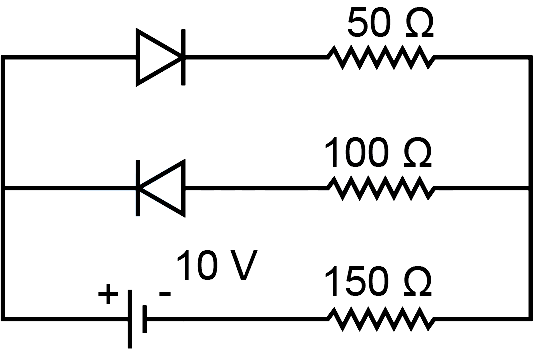 WBJEE 2015 Easy
 - Identify \([\mathrm{A}]\) and \([\mathrm{B}]\) in the following
\[
{ }_{89}^{227} \mathrm{Ac} \stackrel{-\beta}{\longrightarrow}[\mathrm{A}] \stackrel{-\alpha}{\longrightarrow}[\mathrm{B}] \stackrel{-\alpha}{\longrightarrow} \mathrm{Rn}
\]WBJEE 2010 Medium - The line \(A B\) cuts off equal intercepts \(2 a\) from the axes. From any point \(P\) on the line \(A B\) perpendiculars \(P R\) and \(P S\) are drawn on the axes. Locus of mid-point of \(R S\) isWBJEE 2016 Hard