


WBJEE · Maths · Matrices
Let \(A=\left(\begin{array}{ccc}0 & 0 & -1 \\ 0 & -1 & 0 \\ -1 & 0 & 0\end{array}\right)\), then
- A A is a null matrix
- B A is skew symmetric matrix
- C \(\mathrm{A}^{-1}\) does not exist
- D \(A^2=1\)
Answer & Solution
Correct Answer
(D) \(A^2=1\)
Step-by-step Solution
Detailed explanation
\(A^2=1\)
See the Complete Solution
Get step-by-step explanations for this and 2.5 Lakh+ more JEE, NEET & CET questions.
- Unlock all solutions
- Practice the full chapter
- Track accuracy across PYQs
4.8 rated on Google Play · 14,000+ reviews
More questions from Maths
- \(\int \frac{\mathrm{dx}}{\sin x+\sqrt{3} \cos x}\) equals
where \(\mathrm{c}\) is an arbitrary constantWBJEE 2009 Medium - Let \(f\) be a function which is differentiable for all real \(x\). If \(f(2)=-4\) and \(f^{\prime}(x) \geq 6\) for all \(x \in[2,4]\)WBJEE 2025 Medium
- \(\lim _{n \rightarrow \infty} \frac{3}{n}\left\{1+\sqrt{\frac{n}{n+3}}+\sqrt{\frac{n}{n+6}}+\sqrt{\frac{n}{n+9}}\right.$$+\ldots+\sqrt{\frac{1}{n+3}(n-1)}\)WBJEE 2019 Hard
- The differential of \(f(x)=\log _{e}\left(1+e^{10 x}\right)-\tan ^{-1}\left(e^{5 x}\right)\) at \(x=0\) and for \(d x=0.2\) isWBJEE 2021 Medium
- \(\lim _{x \rightarrow \infty} \frac{1}{n^{k+1}}\left[2^k+4^k+6^k+\ldots .+(2 n)^k\right]=\)WBJEE 2024 Medium
- The equation of the chord of the circle \(x^2+y^2-4 x=0\) whose mid point is \((1,0)\) isWBJEE 2009 Easy
More PYQs from WBJEE
- The conformations of \(n\) -butane, commonly known as eclipsed, gauche and anti-conformations can be interconverted byWBJEE 2019 Hard
- The reagents to carry out the following conversion are
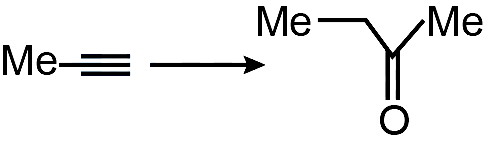 WBJEE 2014 Easy
 - Which of the following does not represent the mathematical expression for the Heisenberg uncertainty principle?WBJEE 2012 Easy
- Domain of \(y=\sqrt{\log _{10} \frac{3 x-x^2}{2}}\) isWBJEE 2022 Easy
- A particle of mass \(m\) is attached to three identical massless springs of spring constant ' \(k\) ' as shown in the figure. The time period of vertical oscillation of the particle is
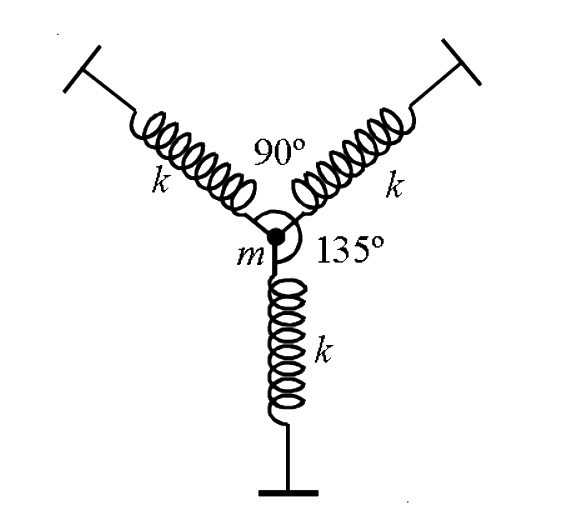 WBJEE 2010 Medium
 - If \(\log _{0.3}(x-1) < \log _{0.09}(x-1),\) then \(x\) lies in
the intervalWBJEE 2016 Medium