


WBJEE · Maths · Quadratic Equation
If \(\alpha, \beta\) are the roots of the quadratic equation \(x^{2}+a x+b=0,(b \neq 0),\) then the quadratic equation whose roots are \(\alpha-\frac{1}{\beta}, \beta-\frac{1}{\alpha},\) is
- A \(a x^{2}+a(b-1) x+(a-1)^{2}=0\)
- B \(b x^{2}+a(b-1) x+(b-1)^{2}=0\)
- C \(x^{2}+a x+b v=0\)
- D \(a b x^{2}+b x+a=0\)
Answer & Solution
Correct Answer
(B) \(b x^{2}+a(b-1) x+(b-1)^{2}=0\)
Step-by-step Solution
Detailed explanation
Given equation is, \(x^{2}+a x+b=0,(b \neq 0)\) its roots are \(\alpha\) and \(\beta\). Then, sum of roots \(=\alpha+\beta=-a\) Product of roots \(=\alpha \cdot \beta=b\) Now,…
See the Complete Solution
Get step-by-step explanations for this and 2.5 Lakh+ more JEE, NEET & CET questions.
- Unlock all solutions
- Practice the full chapter
- Track accuracy across PYQs
4.8 rated on Google Play · 14,000+ reviews
More questions from Maths
- The degree and order of the differential equation \(y=x\left(\frac{d y}{d x}\right)^2+\frac{d y}{d x}\) are respectivelyWBJEE 2011 Easy
- The displacement \(\mathrm{x}\) of a particle at time \(\mathrm{t}\) is given by \(\mathrm{x}=\mathrm{At}^2+\mathrm{Bt}+\mathrm{C}\) where \(\mathrm{A}, \mathrm{B}, \mathrm{C}\) are constants and \(\mathrm{v}\) is velocity of a particle, then the value of \(4 \mathrm{Ax}-\mathrm{v}^2\) isWBJEE 2010 Easy
- Let \(\rho_{1}\) and \(\rho_{2}\) be two equivalence relations defined on a non-void set \(S\). ThenWBJEE 2020 Easy
- The even function of the following isWBJEE 2011 Easy
- If the sum of ' \(n\) ' terms of an A.P. is \(3 n^2+5 n\) and its \(m\)th term is 164 , then the value of \(m\) isWBJEE 2025 Medium
- If one of the diameter of the circle, given by the equation \(x^{2}+y^{2}+4 x+6 y-12=0,\) is a chord of a circle \(S,\) whose centre is \((2,-3\) ), the radius of \(S\) isWBJEE 2018 Medium
More PYQs from WBJEE
- For a spontaneous process, the correct statement(s) is (are)WBJEE 2014 Easy
- Compound \(X\) is tested and the results are shown in the table.
\(\begin{array}{l|l}\hline \text{ Test } & \text{ Result } \\\hline \text{ Aqueous sodium } & \text{ Gas given off which turns }\\\text{ hydroxide is added, }& \text{ damp red litmus paper }\\\text{ then heated gently. }& \text{ blue. }\\\text{ Dilute hydrochioric }& \text{ Effervescence, gas given }\\\text{ acid is added. }& \text{ off which turns lime water }\\& \text{ milky and acidified }\\& \mathrm{K}_{2} \mathrm{Cr}_{2} \mathrm{O}_{7} \text{ paper green. }\\\hline\end{array}\)
Which ions are present in compound \(X ?\)WBJEE 2016 Medium - The differential equation of \(\mathrm{y}=\mathrm{ae}^{\mathrm{bx}}\) (a & \(\mathrm{b}\) are parameters) isWBJEE 2011 Easy
- Four capacitors of equal capacitance have an equivalent capacitance \(\mathrm{C}_1\) when connected in series and an equivalent capacitance \(\mathrm{C}_2\) when connected in parallel. The ratio \(\frac{\mathrm{C}_1}{\mathrm{C}_2}\) is:WBJEE 2009 Easy
- The set of points of discontinuity of the function \(f(x)=x-[x], x \in \mathbb{R}\) isWBJEE 2025 Easy
- Two straignt conducting plates form an angle \(\theta\) where their ends are joined. A conducting bar in contact with the plates and forming an isosceles triangle with them starts at the vertex at time \(t=0\) and moves with constant velocity \(\vec{v}\) to the right as shown in figure. A magnetic field \(\vec{B}\) points out of the page. The magnitude of emf induced at \(t=1\) second will be
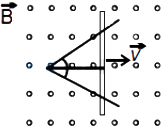 WBJEE 2024 Easy