


WBJEE · Maths · Application of Derivatives
Given \(f(x)=e^{\sin x}+e^{\cos x}\). The global maximum value of \(f(x)\)
- A does not exist
- B exists at a point in \(\left(0, \frac{\pi}{2}\right)\) and its value is \(2 e^{\frac{1}{\sqrt{2}}}\)
- C exists at infinitely many points
- D exists at \(x=0\) only
Answer & Solution
Correct Answer
(C) exists at infinitely many points
Step-by-step Solution
Detailed explanation
Hint : \(f(x)=e^{\sin x}+e^{\cos x}\) \(f^{\prime}(x)=0\) \(\begin{aligned} & \Rightarrow e^{\sin x} \cdot \cos x+e^{\cos x}(-\sin x)=0 \\ & \Rightarrow e^{\sin x-\cos x}=\tan x \end{aligned}\) \(\mathrm{x}=\pi / 4\) or in general \(\mathrm{x}=\mathrm{n} \pi+\frac{\pi}{4}\) Now,…
See the Complete Solution
Get step-by-step explanations for this and 2.5 Lakh+ more JEE, NEET & CET questions.
- Unlock all solutions
- Practice the full chapter
- Track accuracy across PYQs
4.8 rated on Google Play · 14,000+ reviews
More questions from Maths
- The sequence \(\log \mathrm{a}, \log \frac{\mathrm{a}^2}{\mathrm{~b}}, \log \frac{\mathrm{a}^3}{\mathrm{~b}^2}, \ldots \ldots \ldots\). isWBJEE 2011 Medium
- Two dice are tossed once. The probability of getting an even number at the first die or a total of 8 isWBJEE 2010 Easy
- The number of solution(s) of the equation \(\sqrt{x+1}-\sqrt{x-1}=\sqrt{4 x-1}\) is/areWBJEE 2014 Easy
- Let \(f: R \rightarrow R\) be given by \(f(x)=\left|x^{2}-1\right|, x \in R\). thenWBJEE 2021 Easy
- If \(P\) be a point on the parabola \(y^{2}=4 a x\) with focus \(F\). Let \(Q\) denote the foot of the perpendicular from \(P\) onto the directrix. Then, \(\frac{\tan \angle P Q F}{\tan \angle P F Q}\) isWBJEE 2013 Medium
- Let \(A\) be the point \((0,4)\) in the xy-plane and let \(B\) be the point \((2 t, 0)\). Let \(L\) be the midpoint of \(A B\) and let the perpendicular bisector of \(A B\) meet the \(y\)-axis \(M\). Let \(N\) be the midpoint of LM. Then locus of \(N\) isWBJEE 2023 Medium
More PYQs from WBJEE
- In open interval \(\left(0, \frac{\pi}{2}\right)\),WBJEE 2020 Medium
- \(\mathrm{A}\) student appears for tests 1 , 11 and \(\mathrm{III}\). The student is successful if he passes in tests I,II or I, III. The probabilities of the student passing in tests I. II and III are respectively,
p,q and \(1 / 2 .\) If the probability of the student to be successful is \(1 / 2 .\) ThenWBJEE 2018 Easy - "Two particles \(A\) and \(B\) are moving as shown. in the figure.
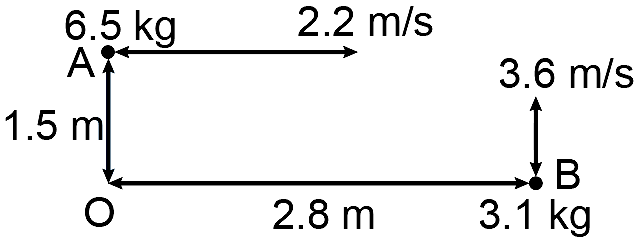
Their total angular momentum about the point \(O\) isWBJEE 2015 Medium - \(12 \mathrm{mC}\) and \(6 \mathrm{mC}\) charges are given to the two conducting plates having same cross-sectional area and placed face to face close to each other as shown in the figure. The resulting charge distribution in \(\mathrm{mC}\) on surface \(A, B, C\) and \(D\) are respectively,
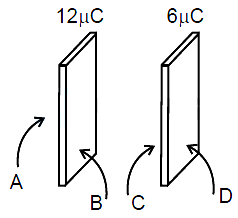 WBJEE 2023 Easy
 - There are 100 students in a class. In an examination, 50 of them failed in Mathematics, 45 failed in Physics, 40 failed in Biology and 32 failed in exactly two of the three subjects. Only one student passed in all the subjects. Then, the number of students failing in all the three subjectsWBJEE 2012 Medium
- Let \(n \geq 2\) be an integer. \(A=\left[\begin{array}{ccc}\cos (2 \pi / n) & \sin (2 \pi / n) & 0 \\ -\sin (2 \pi / n) & \cos (2 \pi / n) & 0 \\ 0 & 0 & 1\end{array}\right]\) and \(I\) is the identity matrix of order 3 . Then,WBJEE 2014 Hard