


WBJEE · Maths · Matrices
For a matrix \(A=\left(\begin{array}{ccc}1 & 0 & 0 \\ 2 & 1 & 0 \\ 3 & 2 & 1\end{array}\right)\) if \(U_{1},U_{2}\) and \(U_{3}\) are \(3 \times 1\) column matrices satisfying \(A U_{1}=\left(\begin{array}{l}1 \\ 0 \\ 0\end{array}\right), A U_{2}=\left(\begin{array}{l}2 \\ 3 \\ 0\end{array}\right), A U_{3}=\left(\begin{array}{l}2 \\ 3 \\ 1\end{array}\right)\) and \(U\) is \(3 \times 3\) matrix whose columns are \(U_{1}, U_{2}\) and \(U_{3}\). Then, sum of he elements of \(U^{-1}\) is
- A 6
- B 0
- C 1
- D \(2 / 3\)
Answer & Solution
Correct Answer
(B) 0
Step-by-step Solution
Detailed explanation
Let \(U_{i}=\left(\begin{array}{l}a_{i} \\ b_{1} \\ c_{i}\end{array}\right),\) where \(i=1,2,3\) \(\therefore \quad A U_{1}=\left(\begin{array}{lll}1 & 0 & 0 \\ 2 & 1 & 0 \\ 3 & 2 & 1\end{array}\right)\left(\begin{array}{l}a_{1} \\ b_{1} \\ c_{1}\end{array}\right)\)…
See the Complete Solution
Get step-by-step explanations for this and 2.5 Lakh+ more JEE, NEET & CET questions.
- Unlock all solutions
- Practice the full chapter
- Track accuracy across PYQs
4.8 rated on Google Play · 14,000+ reviews
More questions from Maths
- Let \(a, b, c, p, q\) and \(r\) be positive real numbers such that \(a, b\) and \(c\) are in GP and \(a^{p}=b^{q}=c^{r}\). Then,WBJEE 2012 Medium
- The number of ways in which the letters of the word ARRANGE can be permuted such that the R's occur together, isWBJEE 2016 Medium
- The total number of tangents through the point \((3,5)\) that can be drawn to the ellipses \(3 x^2+5 y^2=32\) and \(25 x^2+9 y^2=450\) isWBJEE 2009 Easy
- The approximate value of \(\sqrt[5]{33}\) correct to 4 decimal places isWBJEE 2011 Medium
- If \(\log _{0.3}(x-1) < \log _{0.09}(x-1),\) then \(x\) lies in
the intervalWBJEE 2016 Medium - Let \(\vec{\alpha}, \vec{\beta}, \vec{\gamma}\) be the three unit vectors such that \(\vec{\alpha} \cdot \vec{\beta}=\vec{\alpha} \cdot \vec{\gamma}=0\) and the angle between \(\vec{\beta}\) and \(\vec{\gamma}\)
is \(30^{\circ} .\) Then \(\vec{\alpha}\) isWBJEE 2018 Easy
More PYQs from WBJEE
- The area of the region lying above \(X\) -axis, and included between the circle \(x^{2}+y^{2}=2 a x\) and the parabola \(y^{2}=a x, a>0\) isWBJEE 2018 Medium
- If \(0 \lt \theta \lt \frac{\pi}{2}\) and \(\tan 3 \theta \neq 0\), then \(\tan \theta+\tan 2 \theta+\tan 3 \theta=0\) if \(\tan \theta \cdot \tan 2 \theta=\mathrm{k}\) where \(\mathrm{k}=\)WBJEE 2024 Medium
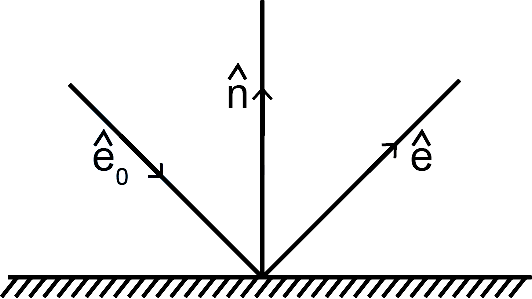
- A ray of light is reflected by a plane mirror. \(\hat{e}_{0}, \hat{e}\) and \(\hat{n}\) be the unit vectors along the incident ray, reflected ray and the normal to the reflecting surface respectively. Which of the following gives an expression for ê?
 WBJEE 2019 Medium
 - Correct pair of compounds which gives blue colouration/precipitate and white precipitate, respectively, when their Lassaigne's test is separately done isWBJEE 2013 Medium
- Two bodies of masses \(m_{1}\) and \(m_{2}\) are separated by a distance \(R\). The distance of the centre of mass of the bodies from the mass \(m_{1}\) isWBJEE 2016 Medium
- If \(\theta \in\left(\frac{\pi}{2}, \frac{3 \pi}{2}\right)\) then the value of \(\sqrt{4 \cos ^{4} \theta+\sin ^{2} 2 \theta}+4 \cot \theta \cos ^{2}\left(\frac{\pi}{4}-\frac{\theta}{2}\right)\) isWBJEE 2015 Hard